Türkçe
 Español
 Français
 日本語
 हिन्दी
 العربية
 中文
Poet of Faith and the Quran: Mehmed Akif Ersoy
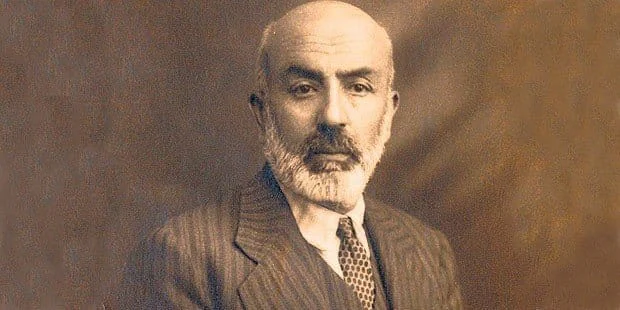
Mehmed Akif Ersoy, the poet of the Quran who wrote the Independence March, is being commemorated on the 76th anniversary of his death.
Mehmed Akif, who stood constantly with the nation both during the National Struggle and afterward, was forced to go to Egypt in 1925 because of differences of opinion with those who founded the new regime after the founding of the republic. While in Egypt he fell ill from the sorrow of being separated from his homeland and returned to Türkiye in 1936. Six months after returning, he died on 27 December 1936.
ONLY THE NATION WAS AT HIS FUNERAL
Mehmet Akif, who stirred the feelings of the people with the articles he wrote and the sermons he gave in mosques during the War of Independence, made important contributions to the national struggle and also served as a deputy in the First Assembly. With the Independence March he wrote, Mehmet Akif Ersoy put into verse the epic written by our nation and again presented it to its true owner, the nation.
Mehmet Akif Ersoy, who went to Egypt in 1925 because of differences of opinion with the newly founded regime after the War of Independence, remained in Egypt until 1936. While in Egypt he also taught literature courses at the university; he fell ill, partly from the grief of being separated from his country, and returned to Türkiye on 17 June 1936. As his illness progressed, Mehmet Akif Ersoy began treatment. During his time in Istanbul, Mehmet Akif, frequently visited by his old friends and those who loved him, died on 27 December 1936 in the apartment where he was staying in the Mısır Apartment building in Beyoğlu. The newspapers reported the news of Akif's death the next day.
The death of Mehmet Akif Ersoy caused great sorrow in the country. Thousands of young people who loved him, along with his friends, attended the funeral ceremony held at Beyazıd Mosque. No official, and no one from any public institution, took part in the funeral ceremony. Prof. Dr. Sulhi Dönmezer, who attended Mehmet Akif's funeral ceremony as a law student, describes that day in his article titled “Akif's Funeral Ceremony” in the newspaper Tercüman on 5 January 1987:
‘…Within the authoritarian order of the single ruling party in our country in those times, since no one wanted to come into conflict with the administration, not much news was published in the press about Mehmet Akif's return to the homeland and the course of his illness…. When we arrived at the square, although the prayer time was near, we did not come across a coffin, and we were all waiting together. Suddenly we saw a hearse arrive at the front of the restaurant; two men lowered a coffin on which not even a cover had been placed. Thinking that the funeral of a poor, destitute person had been brought, some friends attempted to help. But when it was understood that the coffin belonged to Mehmet Akif, hundreds of young people suddenly began to cry. …The young people at once took the flag of Emin Efendi Restaurant and spread it over the coffin. Then some of the deceased's friends began to arrive, but neither the governor, nor the mayor, nor any of the single party's leaders was anywhere to be seen.”
This injustice done to this venerable person, one of the symbolic names of the country's struggle for independence, who had won an important place in the nation's heart with the Independence March he wrote, showed how far the single-party regime had drifted from the nation.
MEHMET AKİF ERSOY
Mehmed Âkif, poet, man of thought and struggle, was born in 1873 in a modest house in the Sarıgüzel quarter of Fatih. He was the son of Mehmed Tahir Efendi, one of the professors of the Fatih Madrasa.
His father came to Istanbul from the village of Suşisa, a silk town in Albania, and received a license (icazet) from Yozgatlı Hacı Mehmed Efendi. His mother belonged to a family from Bukhara. Mehmed Âkif was born to this mother and father in the Sarıgüzel quarter of Istanbul's Fatih district. His father gave him the name “Ragif” (H. 1290), a word that gives the year of his birth by abjad reckoning. Because this name was not common or well known, it was pronounced “Âkif,” and he became known by this name.
At the age of four he began at the Emir Buharı Neighborhood School; after his primary (iptidai) education he completed the Fatih Central Rüşdiye and the preparatory (idadi, high school) section of the Mekteb-i Mülkiye. Having moved on to the higher (âlî) section of the Mülkiye, in the same year his father died and their house in Sarıgüzel burned down (1887-88). For this reason he transferred to the newly opened boarding Halkalı Mülkiye Veterinary School. His interest in poetry began at this school.
ÂKİF'S OFFICIAL LIFE
Graduating from the Veterinary School at the top of his class (1893), Mehmed Âkif was appointed Assistant Inspector-General for Veterinary Affairs and Animal Improvement.
By his own account, for three or four years he traveled in Rumelia, Anatolia and Arabia for the treatment of contagious animal diseases. He served as veterinary inspector in Edirne and as provincial veterinarian in Adana.
Meanwhile he married İsmet Hanım (1898). He taught at the Halkalı Agricultural School (1906) and the Farming Machinist School (1907). He was appointed to a professorship of Ottoman Literature at the Darülfünun (11 November 1908). His last civil service post in the Ministry of Agriculture was Assistant Director of Veterinary Affairs. After the Balkan War he resigned from his post in the Ministry of Agriculture, angered by an injustice done to someone in the same department (11 May 1913).
At the end of 1913, after the Unionists disapproved of the publications of Sebilürreşad and criticized Mehmed Âkif, the director of this magazine, for teaching at the university, he resigned from the Darülfünun. Only his post at the Halkalı School continued. Toward the end of the Balkan War he was elected a member of the Publications Branch of the Committee for National Defense (Müdafaa-yı Millîye Heyeti). Before the First World War he went to Egypt and the Hijaz (1914). During the war, at the invitation of the German government, he was sent to Berlin through the Special Organization (Teşkilât-ı Mahsusa, the Ottoman secret organization) to see the condition of Muslim prisoners in Germany (1914). In the same year he began giving Turkish and literature courses in the middle section of the Darü'l-Hilafeti'l-Aliye Madrasa. He was again sent by the Teşkilât-ı Mahsusa to İbnürreşid, Emir of Najd. İbnürreşid, unlike Sharif Hussein, who was proclaimed King of the Arabs by the British, was loyal to the Ottoman State. In July 1918, while in Lebanon as a guest of Sharif Haydar Pasha, Emir of Mecca, Mehmed Âkif was appointed chief secretary of the Dârü'l-Hikmeti'l-İslâmiye Society and began the post on returning from the trip.
POETRY AND STRUGGLE
After the occupation of İzmir (14 May 1919), he went to Balıkesir to strengthen the resistance emerging here and there in Western Anatolia. He worked to guide the people through sermons. He published his impressions of Balıkesir in Sebilürreşad. After the occupation of Istanbul, he set out to join the National Struggle that had begun in Anatolia. He left Istanbul in mid-April and probably reached Ankara on 23 or 24 April. Because of these activities, his post at the Darü'l-Hikmeti'l-İslâmiye was terminated (3 May 1920). He joined the Grand National Assembly as deputy for Burdur (5 June 1920). He was sent to Konya to suppress the revolt there. Later he went to Kastamonu. There he preached at the Nasrullah Mosque (the famous address of 19 November 1920). He met Eşref Edip, owner of Sebilürreşad, who had come there. He published Sebilürreşad in Kastamonu for a while (November 1920). Returning to Ankara, he settled in the Tâceddin Dergah. The poem he wrote at this time was adopted as the Independence March (12 March 1921). He was elected to the Te'lîfât-ı İslâmiye Heyeti founded by the Ministry of Sharia (1922). After the National Struggle concluded he returned to Istanbul (May 1923).
DISILLUSIONMENT AND AFTERWARD
Mehmed Âkif, who worked for the salvation of Türkiye as a soldier of the cause of Islam, was in conflict with the attitudes of the upper-level administrators, which were far from the original aims of the National Struggle and entirely in the opposite direction.
For this reason, in October 1923 he went to Egypt with Abbas Halim Pasha. After spending the winter there he returned in the spring. For a few years he spent winters in Egypt and summers in Türkiye. In these years the first revolutionary measures were launched; the Republic's administrators had embarked on activities aimed at cutting the ties of the country and society with Islam. After the winter of 1926 Mehmed Âkif did not return to his homeland. He settled in Helwan near Cairo and taught Turkish Literature (or Turkish language) at the Egyptian University (Camiatü'l Mısriye Darülfünunu) (1929-36). In 1935 he fell ill with his liver and in July went to Lebanon for a change of air (the village of Sûku'l-garb near Aley). At that time the malaria he had previously caught also reappeared. After stopping for a while at Antioch as well, Mehmed Âkif returned to Egypt before his health had improved. His longing for home was weighing on him heavily. He feared dying in Egypt without returning to his homeland. At the start of summer 1936 (17 June) he came to Istanbul. He was admitted to the Nişantaşı Health Home. Cirrhosis (teşemmu-ı kebed), seen in those who stay long in Egypt, had become impossible to treat because he could not leave there in time. After the health home, Mehmed Âkif was for a while a guest of Halim Bey, son of Said Halim Pasha, at the Baltacı Farm in Alemdağı, and he died in the Mısır Apartment in Beyoğlu (14 Shawwal 1355 - 27 December 1936). He was buried in the Edirnekapı Cemetery next to Babanzâde Ahmed Naîm Efendi. The government and the guided press showed no interest in his funeral. Even the attention shown to Samipaşazâde Sezai, who had died shortly before and whose place in our literature cannot be compared with that of Mehmed Âkif, was withheld from Mehmed Âkif. No official funeral ceremony was held. But the nation and its youth, in a great congregation, bade farewell to the national poet, this mujahid who, as a believer and a mystic of the nation, had made the Independence March a monument.
At the end of 2005 the newspapers reported that a lecture hall of the university in Cairo where Mehmed Âkif taught had been named Mehmed Âkif Ersoy (see Yeni Asya, 27.12.2005)
A POET BY NECESSITY IS BORN
The poor Muslim environment of Istanbul, where he was born and raised, is among the main elements that played a role in shaping Mehmed Âkif's later literary personality. With his mother's side rooted in a family from Bukhara, Âkif in this respect carries the influences of Eastern Islam; through his father, who came from Albania, those of Western Islam; and through the milieu in which he was born and raised, those of central Ottoman Islam. The Fatih district was, especially in Mehmed Âkif's childhood and youth, the center of learning of Muslim Istanbul. High-level educational institutions, with the mosque at the center, were influential in forming the character of this district. Mehmed Âkif, a person who thought of others and of society more than himself, of good morals and honor, an exemplary Muslim, is a child of these interactions.
In addition, his formal and private education brought him into contact with Eastern and Western cultures along with Islam lived as a way of life. Mehmed Âkif's private education begins with the religious knowledge he received from his father, Arabic and creed (aqaid). Of his father he says, “both my father and my teacher.” In his poem Fâtih Camii he describes how his father took him by the hand at a young age to the Fatih Mosque (Safahat, I).
I was about eight years old; my father said, “come tonight
Children, let us go to the mosque early
If you go, come, but behave yourselves in prayer
If you mean mischief, here is the house, sit down!”
So he would say, and take my brother and me…
Later he tried to memorize the Quran (hifz) with Arap Hoca, the head imam of the Fatih Mosque. He studied Persian with Selânikli Esad Dede and Arabic with Halis Efendi. Besides these Eastern languages he learned French from Veterinarian İbrahim Efendi.
Mehmed Âkif's first poetic efforts began in the years he studied at the Veterinary School. His first published poems are two ghazals in the magazine Hazine-i Fünûn (1893-1894) and Kur'an'a Hitap (Address to the Quran) in the Mektep Mecmuası (vol. II, March 1311/1895). In these years when Mehmed Âkif's poetic sense was developing, the literary outlook of the Edebiyat-ı Cedide writers was spreading. But Âkif's inclination was toward tradition. For this reason one of the first magazines he wrote for was the Resimli Gazete (1896), in which the traditionalist writers appeared. In the Terci-i bend among his youthful poems the influence of Ziya Paşa is felt. The one who really fed his traditionalist side was Muallim Naci, his teacher at the Mülkiye. Muallim Naci, one of the most important names of traditionalism at that time, appeared as the spokesman of the traditionalists in the debate between Western-style innovators and traditionalists. Despite his traditionalist tendencies, Mehmed Âkif later described the ghazals he wrote in his early youth as “futile,” and his traditionalism did not prevent him from being an innovator in subject and style. In this context, one of those who influenced him was Abdülhak Hâmid (Tarhan). This influence is not felt in his poems after 1908. In fact, Mehmed Âkif gave up the literary activities he had begun at a young age and entered a waiting period lasting ten years (1898-1908). This period should be regarded as one in which he prepared himself with the experiences he gained from the realities of life.
Among those who influenced Mehmed Âkif's understanding of poetry are also the Persian poets of Shiraz, Hafez and Saadi. Among the translations he published in Servet-i Fünûn from 1898 are poems of Hafez. Saadi influences Mehmed Âkif through his versification of stories full of wisdom.
Among his poems published in the Resimli Gazete in 1898 is ‘Sadi.’ He also has translations from this Persian poet. Quotations from Saadi are also found in some of his poems. In his answer to a survey published in Servet-i Fünûn he stated that the writer he was most under the influence of was Saadi (1919). Those from the West whose influence he expressed were Lamartine and Alexandre Dumas fils.
The turning point in Mehmed Âkif's literary and intellectual life is the year 1908. In that year he was appointed to the professorship of General Literature at the Darülfünun. Thus his occupation with literature became easier. He began writing in Sırât-ı müstakim, published by Ebülûlâ (Mardin) and Eşref Edib (Fergan) (after volume VIII it took the name Sebilü'r-reşâd on 8 March 1912). In this journal 29 of his poems were published in 1908, 5 in 1909 and 7 in 1910. Among these poems are those that won him wide fame, such as Küfe and Seyfi Baba. Mehmed Âkif found his true literary personality with the poems he published in this journal after 1908, and drew attention especially with his verse stories.
Mehmed Âkif, who had been curious about stories and tales since childhood, is known to have read among the first works the classic love story Leylâ and Mecnûn (Fuzûlî). In the new beginning of his literary life, the fashion of verse stories among the Edebiyat-ı Cedide writers was widespread. In this period Mehmed Âkif treated subjects drawn from various sections of social life in a lively and engaging way. He took the subjects of his stories from social events, from his own life and from Islamic history, and also turned some of his journeys into verse stories.
AWARENESS OF THE AGE AND ISLAM
The decline of the Muslim communities, which had fallen behind the technology developing in the West, first economically and then politically and socially, became the principal problem of intellectuals. While some intellectuals adopted the path of entirely imitating present Western civilization and culture, the Islamists advocated transferring the West's science and technology but remaining loyal to the sources of Islam in spiritual and cultural values. They stressed the role of moving away from Islam and misunderstanding Islam among the causes of Muslims' decline. According to Jamal al-Din al-Afghani, Muslims had lost Islam. They had put superstitions in place of religion and called it Islam. Muhammad Abduh states that for Muslims to escape this situation there is no remedy other than returning to the true source of religion, the Quran and the sunna; on the political plane too the Islamists are of the view that all Muslims should form a political union. Mehmed Âkif treated these basic principles constantly in his poems and writings.
HIS WORKS
Mehmed Âkif published his poems in 7 books; the name of the first, Safahat, was later given as the name of the collected poems. The 7 books that make up Safahat:
- Safahat (1911). Except for four of the poems published in Sırât-ı müstakîm between 1908 and 1910, they are included in this book. The poems in the book can be classified as social stories (Küfe, Meyhane, Mahalle kahvesi), historical stories (Kocakarı ile Ömer, Dirvas) and those arising from his own life (Hasta, Bebek-yahut hakkı karar, Seyfi Baba). Âkif's first book also drew the attention of the Servet-i Fünûn writers. There were debates between Celâl Sahir and Hamdullah Suphi.
- Süleymaniye kürsüsünde (1912). A single poem in the form of a sermon, its hero Abdürreşid İbrahim, one of the Eastern Turks.
- Hakkın sesleri (1913). Besides the explanation of 8 verses and 1 hadith, it contains the very sorrowful poem titled Mevlîd gecesi.
- Fâtih kürsüsünde (1914). A single poem in the form of a sermon. In this book too various problems of the Islamic world are dealt with.
- Hâtıralar (1917). Besides impressions of his journeys to Egypt and the Hijaz at the beginning of 1913 and to Berlin and Najd in 1914, commentaries on verses and hadiths are included.
- Âsım (1924). An entire verse story in dialogue.
Characters: Hocazâde (Mehmed Âkif), Köse imam (Ali Şevki Hoca, one of the students of Mehmed Âkif's father), Âsım (Ali Şevki Hoca's son). Emin (Âkif's son). In Âsım, Mehmed Âkif symbolizes the new generation he longed for, which he hoped had already grown up or would yet grow up. In describing the martyrs of Çanakkale he reaches the peak of lyricism.
- Gölgeler (Egypt, 1933). In this book of Âkif, who had earlier written religious-didactic poems, religious-lyric poems hold an important place.
Mehmed Âkif's poems were published after his death by Ömer Rıza Doğrul in a single book under the name Safahat (1943). Some poems not included in his earlier books were also added to this book (the most important of which is the Independence March, which the poet had not included in his books on the ground that it belonged to the nation). This book, continuously printed since 1943, was prepared for publication by M. E. Düzdağ from the 8th edition, some poems were added from the 10th edition (1975), and some parts that had been removed or altered as being contrary to the reforms were restored. Safahat has received an interest granted to no other book in Turkish publishing. After the fiftieth year of Mehmed Âkif's death (1986), numerous editions were published because the copyright had expired.
Translations: Müslüman kadını (from Ferid Vecdi, 1909), Hanoto'nun İslâmiyet'e hücumuna karşı Şeyh Muhammed Abduh'un müdafaası (1915), İçkinin hayât-ı beşerde açtığı rahneler (from Abdülaziz Çaviş, 1923), Anglikan kilisesine cevap (from A. Çaviş, 1924, partly published under the names Hazreti Ali diyor ki -1959 and Hazret-i Ali'nin bir devlet adamına emirnamesi -1963), İslâmlaşmak (from S. Halim Paşa, 1919), İslâm'da Teşkilât-ı siyasîye (from S. Halim Paşa, serialized in Sebilürreşâd, 1922), Quran translation (The First Grand National Assembly entrusted the task of translating the Holy Quran to Mehmed Âkif and its commentary to Elmalılı M. Hamdi. But Mehmed Âkif later gave up the work on the ground that he “would not be able to succeed.” According to another opinion, he did not want to hand over the text, thinking his translation might be put in place of the Quran in worship by the Republican government. He left it with Yozgatlı İhsan Efendi, one of the scholars of Al-Azhar, on condition that it be burned if he died).
Other works: Kastamonu Nasrullah kürsüsünde (his address at the Nasrullah Mosque during the National Struggle, printed at the Diyarbekir press by Nihat Paşa, commander of Elcezire, 1921). Kur'an'dan âyet ve hadisler (selections from talks and articles published in Sebilürreşâd by Ö. Rıza Doğrul, 1944). Various articles of Mehmed Âkif were collected and published on the fiftieth anniversary of his death (1987, edited by Abdülkerim-Nuran Abdülkadiroğlu). Mehmed Âkif had also planned to write Hacceti'l-vedâ, to describe our Prophet's last pilgrimage, İkinci Asım, which would be a continuation of Âsım, and a play about Saladin.
Source: http://www.dunyabulteni.net/?aType=haber&;ArticleID=240483