Türkçe
 Español
 Français
 日本語
 हिन्दी
 العربية
 中文
Ebu'l-Hasen en-Nedvi – A Rabbani Scholar and Wise Caller to God
When Ebu'l-Hasen en-Nedvi is mentioned, India comes to mind, and when India is mentioned, Ebu'l-Hasen en-Nedvi comes to mind. The first member of his family, whose lineage goes back to Hasan (may God be pleased with him), the grandson of the Messenger of God (peace be upon him), to come to India was Kutbuddin Muhammed el-Medeni (581-677 AH). In the seventh century of the Hijra, fleeing the Tatar invasion, he migrated from Baghdad to India with a large caravan. From that day to this, this family has performed many scholarly and administrative services in India and has raised scholars and fighters in God's cause. To this day this blessed family still renders great services in India.
Ebu'l-Hasen en-Nedvi, who came from such a blessed lineage, is the third child of Abdulhay el-Haseni Hocaefendi and Lady Hayrunnisa. He was born on 6 Muharram 1333 AH (1914 CE), in a settlement of five or ten houses belonging to the same family on the bank of the Sai River, about 2 km northeast of the town of Rae Bareli, 80 kilometers from Lucknow, the capital of the Indian state of Uttar Pradesh.
Coming from a family of knowledge and virtue, Nedvi met books at a very young age, and love of books and passion for knowledge settled in his heart. When he was only five or six years old he began to imitate his father, a well-known scholar, preaching and giving guidance as he did. With childlike curiosity he tried to apply the exemplary life he saw in his father. He lost his father at about the age of nine, and with this loss, for the first time, he came to know the close attention of his elder brother, whom until then he had always seen busy with his lessons. He grew up under his brother's upbringing.
After his father's death his family's income decreased and they suffered hardship for a time. In this period he thought that, because of poverty, he would no longer be able to study. But his mother's prayers would be accepted, and he would become a sun shedding light on the community. God Almighty made Prince Nur Hasan the means of this, who said to the master, "Do not grieve that your father is dead, and do not worry that you will no longer be able to study; I take on your education expenses." In this period he stayed as a guest in Prince Nur Hasan's magnificent and splendid palace. He continued his studies. At the age of twelve or thirteen he had learned Arabic to such an advanced level that he could speak Arabic with great scholars in their gatherings. Besides this, he also advanced in Urdu and Persian. He also learned English well enough to read and write. When he reached the age of twenty, he had studied the sciences taught in the madrasas of his time.
At the age of twenty he was appointed as a teacher to Nedvetü'l-Ulema, an ambitious educational institution in India. He gave tafsir lessons to people of his own age and even to his elders. He tried a different method in teaching Arabic. He succeeded in teaching Arabic through Arabic, and in a short time brought his students to the level of speaking and understanding Arabic. He thought the available textbooks were insufficient and himself wrote the necessary books according to the curriculum. In his view every country should produce its own textbooks. Success in education through translation is not possible. For this purpose he wrote books containing Arabic reading passages and produced works on Arabic literature. In later years he also wrote dozens of books of the nature of textbooks for the madrasas.
He traveled to many cities and engaged in scholarly and cultural activities. He met the famous Islamic poet Muhammad Iqbal and was captivated by his poems. On the horizon of his thought, in his own words, lightning flashed. Until he knew Iqbal, he had thought the faculty of poetry was related to culture and reading. As for Iqbal, he says that the meanings he conveyed into the language of poetry are not things that can be obtained by thinking or reading or through culture.
He was of the opinion that scholarly activity alone would not be enough. For this purpose he entered a search. He traveled to neighboring provinces, met the leading figures of his time and opened his thoughts. His aim was to benefit from different experiences and, without repeating the mistakes of those before, to cover long distances in a short time. For this purpose he met Muhammad Ilyas Kandhlawi, the leader of the Tablighi community. He was greatly impressed and wished to apply the same movement in his own world.
His horizon had broadened and he had begun to take interest in the Muslim world outside India as well. In this period he wrote his work "What the World Lost with the Decline of the Muslims," which stirred storms in the world of knowledge and thought and gathered great interest and admiration. Since he was not yet acquainted with the Arab world, he translated the work into Urdu and had it first printed in India. In 1947 he made his first pilgrimage. Here he met the leading scholars of the Hijaz. But on his second pilgrimage in 1950 he met thoroughly with Hijaz scholars, gave conferences and made speeches on the radio. Meanwhile he obtained the opportunity to have his work printed in Arabic. The work was printed by one of Egypt's respected publishing houses and in a short time became a handbook. Now the author would be known by this work. Those who introduced him would present him as "so-and-so, the author of this work." The work lays bare the base and insidious games of the English and became a means of awakening the Muslims. For this reason the British government of the time banned this book from entering England for a long time.
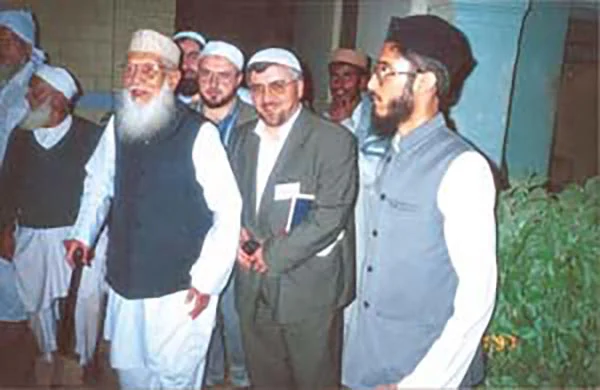
When he visited Egypt in 1951 he was a well-known person in Egypt. He exchanged ideas with leading thinkers and scholars of the era such as Sayyid Qutb, Muhammad al-Ghazali and Hasanayn Makhluf. He met Muslim students who came from various parts of the world and opened his thoughts to them. Meanwhile he also gave talks to students who had gone from Türkiye. He says that he quickly established familiarity with them and that their blood mingled. Among these students was our esteemed teacher Muhammed Emin Saraç, who still continues teaching in the traditional manner at our Fatih Mosque. Afterwards, whenever he came to Türkiye, he would look for and ask after the Hocaefendi, and the seed sown in those days would bring the Hocaefendi to the master's mind whenever Türkiye was mentioned. As a fruit of this friendship, the Hocaefendi, who was invited to India on every occasion, found the chance in late 1997 to go to an international meeting held in India, and with a group including the author of these lines was granted a visit of about one week to the city of Lucknow in India, the center where Nedvetü'l-Ulema is located. There the opportunity arose to see and know the master closely. One came to know a scholar perfect in every respect, a man of thought, a great person who lived what he knew and said what he lived. In this century one saw a person hard to find the like of, who melted those who approached him like the sun with his asceticism and humility, and who was a guide in every direction like a star with his knowledge and wisdom. In every state of his he showed that he did not belong to this century. He belonged to the age of his forefather Hasan (may God be pleased with him), and in this state he was always a stranger in this world.
On this journey we were received in India as the children of the Caliphate center, and were astonished at the interest we saw. We understood that the master's admiration for the Ottomans was felt with the same warmth in the heart of every Indian Muslim brother. These eyes and the other eyes taking part in the visit were enchanted by the marvelous scene they saw. Unfortunately, the Ottoman descendants perhaps do not remember at all the Indian Muslims who always lived and breathed the Ottomans. Muslims of every nation were leaving works there, but they wanted to see a mosque in the example of Ottoman architecture. Because they were accustomed to seeing the works of the Turks who had ruled there for hundreds of years.
To return again to the master's life journey, with his visit to Egypt he had now gained an international identity. After this he traveled to many Islamic countries. Between the east and west of the Islamic world there was almost no place he had not traveled or seen. He traveled to the West and America and gave conferences there. He strove to awaken the Islamic youth. He was an educator. His only thought was to save Islamic youth from the materialistic and immoral world of the West. For this, wherever he went he met with administrators and exchanged ideas with men of knowledge and thought. There is much to be said for the master, but only virtuous people can know and recognize those who possess virtue. How true and apt are these words Ali Tantawi used for the master: "I knew Ebu'l-Hasen closely in Mecca, in Medina and in Damascus, and I had known of him from India before. In every case I saw him as one who stands upright on the path of truth, works for God, a true ascetic and a man of humility. He did not live the asceticism of the heedless who live behind the curtain of life, who do not know what the world is, who are unaware of what is in the world, but the asceticism of a scholar who knows the world and its people. Having seen the East and the West, having traveled in the capitals and cities of the world, having sat with great and small, having spent the early years of his youth in the palace of Prince Nur Hasan, having lived the finest of luxury and comfort, he was a true ascetic who had withdrawn from all of this. His asceticism was not an asceticism born of deprivation. He was not living the asceticism of a hungry man with no morsel to eat who presents himself as an ascetic. On the contrary, he lived an asceticism by remaining without appetite for the many kinds of dishes before him. When he took part in international conferences, he avoided staying in the grand hotels where the guests stayed and preferred to be a guest at the homes of his students. How many students he had!
If one who builds a fortress or commands an army is counted among the great, it should be known that Ebu'l-Hasen built, in the hearts of his students, fortresses firmer and stronger than fortresses built of stone; he formed a small community of righteous scholars and sincere callers to God."1.
Ebu'l-Hasen en-Nedvi spent his whole life on education and teaching. In his philosophy a generation could be educated and raised every ten years. And this was without doubt the most lasting service. When he ended, at the age of eighty-five, the life of education and teaching that he had begun at about fifteen, a full seven generations had passed through his training. Thousands of students received grace from him in person. Millions of individuals of the Islamic community read his books and benefited. His ideas spread to every corner of the world. For Muslims, India came to be mentioned with his name. Without doubt he walked to his Lord; there is no state to weep over; not to mention that gray fell on his beard and hair, he attained his wish as a white and pure Muslim, with his hair and beard. In paradise, God willing, degrees as many as the hairs of his beard and head, every strand of which turned white for Islam, await him. If there is to be weeping, it should be for the entire Islamic world in general and for India in particular. Let those who seek wisdom, knowledge and true politics weep; a great plane tree in which these concepts were manifested in their true sense has left this transient world.
One of the hardest pieces of writing is without doubt the obituary a person writes for someone he loves. While he himself is in need of condolence, writing a condolence piece is not an easy thing at all. And if the person who is the subject of the piece is a great person who is the plane tree of wisdom, the ocean of knowledge and the sea of gnosis of the community in this century, this writing becomes that much harder. Because to describe him in words, to set him down in lines, is almost impossible. He is a name who is an heir of the Messenger of God (peace be upon him) in all senses. He is the name of authority of the Indian land. He is a leader raised with the ideas of Muslims of the whole world. A learned man, a man of thought, a personality who led Islamic movements. A noble person who, when one looked at him, brought God to mind. At the end of a life of more than eighty years, full of knowledge and gnosis, wisdom gushing from every side, he walked to his Lord, whose good pleasure was his only aim. Hundreds of thousands performed his funeral prayer, and funeral prayers in absentia were performed throughout the Islamic world. In the Sacred Mosque alone, on the Night of Power, more than two and a half million people performed the funeral prayer in absentia. May God's mercy and blessing be upon him, may God grant him intercession. There is no doubt: اَلَّذ۪ينَ اِذَٓا اَصَابَتْهُمْ مُص۪يبَةٌۙ قَالُٓوا اِنَّا لِلّٰهِ وَاِنَّٓا اِلَيْهِ رَاجِعُونَۜwho say, when struck by a disaster, “Surely to Allah we belong and to Him we will ˹all˺ return.” (Al-Baqarah 2:156, Diyanet)2.
YOU DIE AS YOU LIVE
Master Hasan en-Nedvi was extremely devoted to the sunna. Since reading Surah al-Kahf on Friday is a sunna, from the age of 10 he would not perform the Friday prayer without reading Surah al-Kahf. From the age of 12 he would spend the last 10 days of the month of Ramadan continuously in i'tikaf. It was the year 1999 and the 23rd day of Ramadan. For the Friday prayer he took the full ablution, put on his spotless clothes and went to his place in the mosque where he was staying in i'tikaf. As was his custom, he asked his student to bring his Quran in order to read Surah al-Kahf. Until his student brought the Quran, he began to recite Surah Ya-Sin from memory. While he was reciting Surah Ya-Sin, the destined death came and took his pure soul to the Most Merciful. What a beautiful death this is, one that gathers many beauties together!
My supplication to God, Possessor of might and majesty, in whose disposal is the system and order of this vast universe: may He grant us too a life lived for Islam and a death that ends in faith. O my God whose glory is exalted! You are able to do this and You are powerful over all things. Allahumma amin.
(Ebu-l Hasan en-Nedvi, Pub. Daru-l Kalem, pp. 23-200)
Footnotes: 1. Fi Mesireti'l-Hayat, Ebu'l-Hasen en-Nedvi, Beirut, 1410-1990, Foreword, vol. 1, p. 16 ff.2. Prepared by drawing on the master's work Fi Mesireti'l-Hayat. This work of the master is a masterpiece that every man of thought and action must read, in which the important life experiences of a life lived fully for eighty-five years are conveyed. His view of communities, his view of community leaders, and his understanding of life and jihad are seen in this work in the best way. We hope that this work will be brought into Turkish as soon as possible.
Source: Ahmet Hamdi Yıldırım – Altınoluk