Türkçe
 Español
 Français
 日本語
 हिन्दी
 العربية
 中文
Who Is Salih Baba?
Love is like an unknowable, unsolvable secret. At times it strikes tongues dumb, at times it cries out like a nightingale. Sometimes it falls silent and listens to the voice of the heart, and sometimes it makes itself heard to the whole world.
Love keeps no schedule, day or night; no one can say where or when it will enter a heart. It gives no warning, it does not announce "I am coming," it names no date. We shall tell the story of love through a dervish upon whose heart Divine love fell: Salih Baba of Erzincan (born 1820, died 1908).
There were two friends, and both were named Salih. One was Salih the locksmith (Salih Baba); the other performed music and poetry at gatherings and, because he was blind in one eye, was nicknamed "the Blind": Blind Salih. This man would sometimes drink in taverns, and on his way home he would slip back secretly so as not to be seen by his sheikh, Pir-i Muhammed Sami Erzincani (k.s), one of the masters of the Naqshbandi tariqa. One day, coming out of a tavern, remorseful and crushed, he reached the door of the lodge. Ashamed to enter, he recited these couplets:
"From the tower, from the tower, I heard your voice from the tower,
It was your brow and your eye that made me your slave."
Hearing this, Hazrat Pir-i Muhammed Sami (k.s) said, "Come, Salih, every fault of yours is a skill," and after those words he never drank again.
Salih Baba, however, was on a wrong path, one with a great deal of disregard for the Sharia. Because he loved his friend Salih Baba, Blind Salih was not content to see him on that path. He made him an offer:
"One day you come to the talk of our sheikh. Another day I will come to yours, and let us see from which of the two we receive more spiritual grace (feyz) and inner delight."
Salih Baba did not turn the offer down but accepted it. He went to the lodge of Hazrat Pir-i Muhammed Sami El Erzincani (k.s), a treasury of Divine love and affection, to listen to the talk that flowed from his blessed tongue, a talk that cleansed hearts of all that is other than God and turned them toward God. Salih Baba was now in the hearth of love, though he did not know that he was about to burn in the fire of love.
Hazrat Pir-i Sami (k.s), the Sultan of Hearts, began his talk, the Talk of the Soul (Suhbat-i Jan), and Salih Baba was entranced. As the master spoke, he took from every word the share that was his; until the talk ended he questioned himself, and at the end he understood that he was the one on the wrong path. The talk ended. Salih Baba said to his friend:
"I was on the wrong path. Seeing the truth here, I understood. I have now left my old gathering and I will never go back. I am grateful to you for being the means by which I saw the truth."
Salih Baba went on attending the Talk of the Soul without fail. He had found his way now; he had turned his inner face toward the qibla of love. How could he part from these talks in which he had found life? It was impossible. Salih Baba would sit quietly, shy and unlearned, hiding himself in a back corner, hesitant to speak with anyone, keeping to himself; he came and went like a shadow.
Once again Salih Baba came to the talk. Before it began, couplets, ghazals and odes were being recited from the wise books and poems of great figures such as Yunus Emre, Niyazi Misri and Kuddusi Baba. Then a murid came before Pir-i Sami (k.s) and said:
"My master, on this path we have no poets like those masters. If only we had, so that we could read their words, so full of beautiful wisdom." At these words Hazrat Pir-i Sami (k.s) said:
"My child, why should we not? We will pray for it. Even our Salih here can recite these wise poems," and he signaled to Salih Baba to rise.
The Divine love burning in Salih Baba's heart was about to carry him to the station of love, and the miracle (karamat) of a friend of God was about to unfold in Salih Baba. The time was the time of union, the time for Salih Baba to be annihilated (fana) in love in his murshid (that is, to truly come into being).
Salih Baba rose to his feet and, beyond his own will, began to recite poems.
In the city of Truth I saw a Beauty,
I could not see the one who sees Him, what can I do?
Burned to ashes in the longing of love,
No one knows, I could not ask, what can I do?
For a time I waited at Layla's mountain,
For a time I waited at the rose's bough,
For a time I waited at the Beloved's pavilion,
I could not reach union with the Beloved, what can I do?
The nightingale's lot is sighing and lament,
What sort of rose is it that withers so soon?
A heart becomes a servant, at times a sovereign,
I could not reach this secret, what can I do?
A rose that has an owner, I do not call Beloved,
For eyes without blood-tears I do not call it sighing and lament,
Without seeing His face I do not say "I have a Beloved,"
I could not find this Beloved, what can I do?
Many call "Beloved" with a heart set on buildings,
Many call "Beloved" with a heart set on adultery,
Many have a heart set on buying and selling,
Who this Beloved is I could not know, what can I do?
I heard that my Beloved's dwelling is Qaf,
What the tongues speak is empty talk,
If you ask its origin, its "nun" is "qaf,"
I could not lay my face at His feet, what can I do?
Help, Pir-i Sami, look upon my state,
They have done this Salih great wrong,
Lift the veil of union, show me my rose,
I wept much, I could not laugh, what can I do?
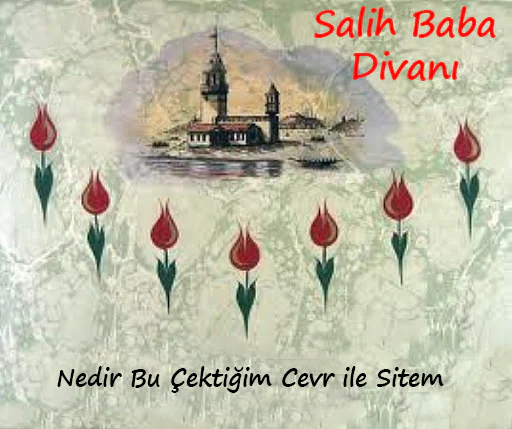
From Salih Baba's tongue, through the favor (himmat) and prayer of his murshid, these beautiful lines poured out like pearls. Everyone was amazed and filled with admiration before this miracle. Salih Baba recited without pause and without tiring, and continued until his murshid said, "Enough, Salih!" Yet Salih Baba was an unlettered man who could neither read nor write. He had now truly become a righteous man (salih), like his name. Let only the love of God enter the heart, and then in that body not only the tongue and lips but every limb speaks, in the language of the state (lisan-i hal). The poems that came forth as a result of this miracle were compiled into a book called the Divan of Salih Baba, also known as Rabita-i Naqshi Hayali. On this blessed path, even today, they are recited, as a means of spiritual grace and affection for the murids and brethren, in the talk gatherings of Abdurrahim Reyhan (k.s) Efendi Hazrat of Erzincan (1930–1998), whose dwelling is now Paradise, a representative of the path of Pir-i Sami (k.s) Hazrat.
Source: http://www.yeniasya-international.de/2012/09/salih-baba