Türkçe
 Español
 Français
 日本語
 हिन्दी
 العربية
 中文
Hazrat Mawlana Khalid al-Baghdadi (k.s)
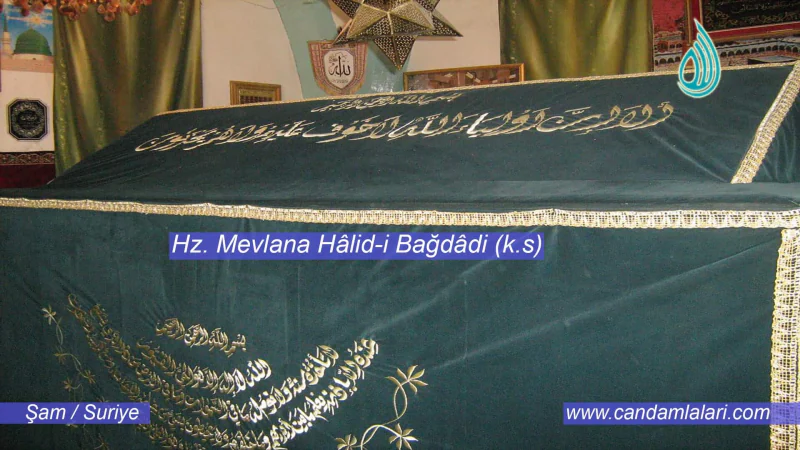
He was born in Shahrazur, near Mosul in Iraq, then part of the Ottoman Empire (AH 1192-1242, CE 1769-1829). His full name is Mawlana Khalid Ziyaeddin, son of Husayn. His lineage reaches Hazrat Uthman Dhu al-Nurayn (may God be pleased with him). On his mother's side his lineage reaches Pir Khidr, one of the great saints of his time. He began madrasa education at what could be called a very young age. First he studied the Shafi'i catechism in the madrasas of Karadağ. Then he moved to Sulaymaniyah and, having won the admiration of the great scholars there, went on to Baghdad.
He studied the outward sciences; the famous scholars of the time who met him there could not hide their admiration for his intelligence and the knowledge he had gained in a short time. In various scholarly assemblies he made all the scholars of the time acknowledge his superiority. Al-Baghdadi was also versed in exegesis, hadith, jurisprudence, Sufism, creed, morphology, syntax, rhetoric, expression, semantics, preaching, literature, prosody, principles, logic, philosophy, astronomy, geometry, arithmetic, eloquence, theology, and the lofty and useful sciences such as the astrolabe. Though Mawlana Khalid knew all these sciences, he still could not fill a great emptiness in his heart, and he went on searching.
The ledunni knowledge, so often spoken of in the science of Sufism, was now the last branch of knowledge he wanted to possess. In the days of this search he set out on the pilgrimage. First he would fulfill the obligation of pilgrimage, and then he would begin a search for a perfect murshid who would teach him this ledunni knowledge. First he went to Syria, took lessons from a Qadiri sheikh there and was given authorization immediately. He continued his journey. On the road to Mecca he experienced a spiritual state in which he was told that the murshid he sought was at the Kaaba. He fulfilled the obligation of pilgrimage. Then every day he searched around the Kaaba for the person who had been indicated to him by a sign.
One day, as he was wandering about in that search, someone sitting with his back against the Kaaba was watching him. He approached a little, but his sitting with his back turned to the Kaaba seemed strange to him. Suddenly he gave up and turned back. Just as he was about to leave that place, a voice called him by name, "Mawlana Khalid." He turned back again; it was the person whose way of sitting he had disliked a moment before, calling him by name. In greater astonishment he approached, and the man said, "What is there in our sitting that you dislike? We have leaned our back against the house of Khalil, and we gaze at the house of Jalil." These words were spoken in so stirring a voice and cadence that he staggered and all but collapsed at the man's feet, pressing his face to them and saying, "It is you I have been seeking." "No, what you seek is in India, there, there," said the unknown man. (According to some Sufis that blessed person was Hazrat Abdullah Dehlevi (k.s), and according to other Sufis it was Hazrat Mazhar-ı Can-ı Canan (k.s). Indeed we too hold this view.) And he went away from there; now at least he knew where he would go. On returning from the pilgrimage he stayed two months in Sulaymaniyah, then, despite all the insistence of those who loved him that he not go, he set out. His journey lasted a full year. He reached Jahanabad.
On the road he had seen Hazrat Abdullah Dehlevi (k.s) in his dream almost every night, and now he had reached the great sheikh. On entering the city he gave away to the poor all the belongings he carried, made his way to Dehlevi's lodge and introduced himself. Before even telling him to sit, the sheikh took him to the place where the ablution rooms were and commanded him: "Your task is to carry the water for this place from the river opposite," he said. And this was his last conversation with him for a long time. He was given a pole with a rope with a hook at each end, and two large water vessels to be hung on the hooks at the two ends. And at that moment began his service, which would last six months. He would begin right after the morning prayer and carry water from the river five hundred meters away, and from time to time he would meet his sheikh on the way. But no conversation took place between them other than greetings. This continued for six months; on the road along which he carried water there was the house of an old Zoroastrian woman, and she saw that the water pole had made wounds on Mawlana Khalid's shoulders and that the wounds bled from time to time. From grief she could not sleep until morning. Then she sewed shoulder pads of wool, like those used by water carriers, and went out to his path to give them to him. Mawlana Khalid objected. But the woman said, "Take this for the sake of the one you serve." Mawlana Khalid, having no choice, accepted and placed the pad on his shoulder. But what was this? His sheikh was waiting at the door. He scolded Mawlana Khalid sharply: "So you are that fond of your comfort! You have sewn yourself a shoulder pad. Or have you tired of our service?" he said. His eyes streaming like two fountains, Mawlana Khalid threw himself at his master's feet: "My master, my sultan, it is known to you that I did not put this pad on my shoulder myself; an old woman in that house over there took pity on our state and gave it, and I did not accept. But when she said 'For the sake of the one you serve,' I had no choice and accepted. Now tears flowed from Dehlevi's eyes. "Rise, my son, shall we not be even as merciful as a Zoroastrian woman? Leave the buckets and join the suhba!" Now the door of suhba and tawajjuh had opened. He slipped in through that door. In the suhbas that lasted six months such a door of spiritual opening was granted him that fana and baqa came about first in his sheikh, then in the Messenger of God, then in God, and all the openings known to the people of the path were realized, and the return too was completed. He was given authorization in six great tariqas, and now the time of parting had come. Hazrat Dehlevi put him on a horse. And he walked beside him on foot for four leagues. Meanwhile he conveyed to him his last commands.
"Whatever God gave us, we have given to you. We gave little, you received much. We said little, you understood much. Go now, establish your lodge and spread the Naqshbandi path to the seven climes. Uproot there the innovations that have clung to this path. Revive our tariqa upon the Sharia and the Sunna, so that God may revive you and us. Whatever you are, let your khalifas be so too. Let them regard as lawful what you regard as lawful, and as unlawful what you regard as unlawful, let them say what you say and not add to it, let them live and make others live what they have seen. There are three things to which this tariqa is very sensitive. May the curse of all our great ones be upon whoever does them and whoever turns a blind eye to their being done. Backbiting, innovation, fame. To the murid who takes these three prohibitions of the tariqa lightly, even if he flies like a two-winged bird, pay no regard and give no assignment. We cannot reject ecstasy, wonders or unveiling. But none of these is a condition of sainthood. The condition is steadfastness, steadfastness, steadfastness. When this exists, everything is complete. When it does not, everything is lacking." These were the last words. And they parted.
On his return, everywhere he stopped he invited people to guidance. He gave lessons in tariqa to those who asked, in the tariqa they wanted. But his own and his close ones' tariqa practices and suhbas were according to the Naqshbandi rule. He entered into debates with many Rafidis he met on the road, and refuting all their theses, humiliated their leaders before their followers. Ambushes were laid, but no one could prevail against him. He could now be overcome neither by knowledge nor by brute force. Thousands of people met Hazrat Mawlana Khalid al-Baghdadi (k.s) on his return. He stayed a short time in Sulaymaniyah. From there he went to Baghdad, settled in the Abdulqadir zawiya, and continued his duty of guidance there.
When Mawlana Khalid settled in this zawiya, the governor Said Pasha visited him, beheld there, as a spiritual state, the greatness of the spiritual being of Hazrat Mawlana Khalid al-Baghdadi (k.s), and remained in a swoon, beside himself, for hours. When he came to himself he asked for a prayer from Hazrat Baghdadi, and Baghdadi said: "On the Day of Resurrection everyone will be asked about himself. But you will be asked both about yourself and about all the people under your administration. For this reason fear God and guard against the things that will bring His punishment." Thereupon the governor Said Pasha wept with loud cries. When Said Pasha had left his presence, Hazrat Baghdadi declared that the Pasha's faith was sound.
As those who loved and followed him grew in number in Baghdad, he became the target of the opposition and slander of some scholars and tariqa leaders who had not yet reached perfection. But he did not even feel the need to answer them. A book containing accusations going as far as declaring Hazrat Mawlana Khalid al-Baghdadi (k.s) an unbeliever was written by Sheikh Ma'ruf of Barzinj, a Qadiri sheikh. Seyyid Ma'ruf and the community with him invited Sheikh Yahya al-Marwazi from Mosul to Baghdad to help them. Al-Marwazi, after meeting with Hazrat Mawlana Khalid, understood that none of what was written and said about him was true and asked to be accepted as a student. Thereupon Sheikh Ma'ruf sent the treatise he had written to Said Pasha, the governor of Baghdad, and asked that Hazrat Mawlana Khalid be expelled from Baghdad. Said Pasha threw the letter on the ground and trampled it, saying, "Subhanallah! If Mawlana Khalid is not a Muslim, who is a Muslim?" Said Pasha asked the scholars to write a refutation on the matter. The Mufti of Baghdad, Ubaydullah Haydari, wrote a treatise containing proofs transmitted from the Holy Quran and the Sunna and also the views of prominent scholars and Sufis. And this treatise was approved by the great scholars of the time and published. After this Mawlana Khalid went again to Sulaymaniyah and began his activities of guidance. He continued the duty of guidance here for a time. From here he made short preaching visits to many regions. Later he returned to Baghdad, and after a short time he took his khalifas and murids with him, went to Damascus and settled there.
Hazrat Mawlana Khalid al-Baghdadi (k.s) had three wives. Two of them died very shortly after Baghdadi's death, and the third wife, Hatice Hanim, lived for many years. From these marriages he had four sons named Shihabuddin, Bahauddin, Abdurrahman and Necmuddin, and three of them died before him. When Mawlana Khalid came to Damascus, his son Shihabuddin and his wives remained in Baghdad. Hazrat Mawlana Khalid later wrote letters and summoned them to him, and they set out at once to reach Damascus. When they came to Urfa they were guests at the house of Muhammed Hafiz of Urfa, one of Hazrat Mawlana Khalid's khalifas, and Shihabuddin died there. At the moment of his death, as Hazrat Mawlana Khalid al-Baghdadi (k.s) was in suhba at his lodge in Damascus, two tears flowed from his eyes and he said exactly this: "Shihabuddin has just died in Urfa. May God give patience to us and to his mother." His khalifas immediately recorded the date of that day. Later it was learned that this event had occurred in Urfa on the same date and at the same hour.
His other son Muhammed Bahaeddin was a student of his khalifa Muhammed Nasih. Though only five years old, he was a very intelligent and clever child who spoke Arabic and Persian very well. He died of plague on the eve of Friday, 28 Shawwal 1242. When Hazrat Mawlana Khalid al-Baghdadi (k.s) received news of his death, he said: "O my Lord, grant me patience, ease and joy in the face of this calamity. God willing, he will be a great provision for me in Your exalted presence. My son Bahaeddin is our magnet. He draws us to himself, we shall all go to him, he is our deputy." Hazrat Mawlana Khalid himself led the funeral prayer of Muhammed Bahaeddin, and he was buried at a place called "Tel" on Mount Qasiyun. A short time after Muhammed Bahaeddin's death, on the second Monday of the month of Dhu al-Qa'da, his other son Abdurrahman also died of plague and was buried beside his brother.
A short time later, in a suhba he gave, he announced that his death was near, saying "We did not come to Damascus for any purpose other than to die," and on the last day of Ramadan of that year he himself was seized by plague like his sons. During the burial of his son Bahaeddin, he showed the place of his grave to his khalifa Sheikh Abdulqadir al-Dimlani, saying "Begin digging my grave today." Although Hazrat Mawlana Khalid grieved during his sons' illness and let those around him feel his grief, after their deaths he did not grieve at all, but rather rejoiced. His khalifas and murids, astonished at this, asked the reason, and Hazrat Mawlana Khalid al-Baghdadi said: "For a person to feel pity and grief for his children on their sickbed and deathbed is a requirement of nature. But the mature person rejoices in what his Beloved wants. He is content with the works of the Almighty, with His decree, with destiny and fate. For the Messenger of God, our Master (peace be upon him), grieved at the death of Hazrat Ibrahim and said, 'The eye weeps, the heart is sad. O Ibrahim, I am sorrowful at your parting!'" Hazrat Mawlana Khalid (k.s) said: "If I were not afraid of people saying 'Mawlana Khalid is displaying wonders,' I would take leave of all my friends and companions. I think we shall depart this coming eve of Friday." His khalifa Sheikh Ismail, who was beside him at that moment, was so affected by these words that out of grief he fainted and fell at his sheikh's feet. The mother of the said khalifa brought food and offered it to the blessed one. But the blessed one said: "I cannot eat this or any other food. Have you ever seen a man who wishes for death and also eats food?" For a long time he ate nothing. "I do not wish to meet my Lord sated with the foods of the world," he said.
Like a father playing with his child, he kept stamping his feet for joy on the floor of the house. Such a state had never been seen in him before. He endowed all his books by a deed. Gathering all his khalifas and murids, he spoke to them these last words: "O my friends, my murids, I have appointed Sheikh Ismail al-Anarani (k.s) as khalifa. After him I have chosen Muhammed Nasih, after him Abdulfattah, after him Ismail al-Ghazi Efendi as executors in my place. I have set aside a thousand kurush for the remission (iskat) of my prayer debt. I have willed that what is necessary be done to have a water cistern built beside my grave. I have also willed that the remaining money be given to the poor at our door. As written on the back of the Qamus, I have chosen Ismail Efendi and my other khalifas as caretakers and executors in my place. All of you, submit to Ismail Efendi with full obedience and do not go outside his commands. This I bequeath to you. Holding fast to the Sunna of Hazrat Muhammad (peace be upon him), be upon the right path in the tariqa we are in. Show patience and endurance in the difficulties you will meet. No calamity greater than our passing will reach you. Do not burden my spirit by recounting my character, my form and my traits and by wailing and crying aloud. Write letters far and wide and instruct that no one grieve or weep at my passing. Whoever loves me and holds love for me, let him offer a sacrifice for me. Let him send to my spirit the Quran, Fatihas and precious prayers. As some people whose hearts are filled and intoxicated with love of the world say, 'I do not need charity; I need only Fatiha and the noble Ikhlas,' do not say so yourselves. Do material good for me as well and give charity. Do deeds that will bring you closer to us. Our life has reached fifty. Remit and make up thirty-five years of obligatory prayers. In our life we never abandoned the forenoon prayer, the awwabin prayer and the tahajjud prayer besides the five daily obligatory prayers. O Ismail, you know the worth of my khalifas and companions. Beware of what would cause them distress. I think that before long a lodge for the poor will be built near my mansion." After this address he went into the house; at that moment he was in sound health. But he never came out of the house again.
Ismail Efendi, with twenty others, went in to visit him. He was lying on his right side in a state of muraqaba. Sheikh Ismail asked how he was. He opened his eyes and looked at them in thanks and kindness, and indicated by a sign that he did not wish to be disturbed. He did not honor the Khatm-i Khwajagan performed in the morning with his presence. That day he spoke with no one. Despite the great suffering and distress he endured, no word that would reveal his suffering came from his mouth. He only made ablution for his prayers, performed his prayers, and lay again on his right arm. Thus he remained in a state of muraqaba until the call to the evening prayer was recited. When Molla Ömer began to recite the call for the evening prayer and said "Allahu Akbar," he recited the verses يَٓا اَيَّتُهَا النَّفْسُ الْمُطْمَئِنَّةُۗ اِرْجِع۪ٓي اِلٰى رَبِّكِ رَاضِيَةً مَرْضِيَّةًۚ فَادْخُل۪ي ف۪ي عِبَاد۪يۙ وَادْخُل۪ي جَنَّت۪ي˹Allah will say to the righteous,˺ “O tranquil soul! Return to your Lord, well pleased ˹with Him˺ and well pleasing ˹to Him˺. So join My servants, and enter My Paradise.” (Al-Fajr 89:27-30, Diyanet) and, when he had finished, his spirit rose to its station in the high holy realm.
His khalifas: It is said that he raised 365 khalifas. However, only 100 of their names have survived to the present day. Here we will give those of the khalifas he sent to Anatolia whose names are known.
THE CALIPHS OF ANATOLIA
1. Seyyid Taha al-Hakkari
2. Ismail Shirvani
3. Ahmet b. Süleyman al-Ervani
4. Muhammed b. Abdullah Enh
5. Abdulfattah al-Akri
6. Osman Siracüddin
7. Muhammed Hafiz al-Ruhani
8. Ahmet Eğribozî
9. Ali Septî
10. Feyzullah Erzurumî
11. Hasan Kutsi Efendi
12. Hüseyin Vaiz Efendi
13. Ahmet Siyahî
14. Abdullah Mekkî Erzincanî
15. Abdullah Şemdinî
16. Khalid-i Cezerî
17. Seyyid Abdullah al-Hakkari
We apologize to the spirits of his other khalifas whose names we could not include here because we could not find them in the records. Mawlana Khalid (k.s), who raised these khalifas, determined their conditions for serving as khalifa and communicated, orally and in writing, the method of preaching and guidance they would apply, down to what they should look for in the persons they would teach in the lodges they would establish; these are the foundations of Khalidism. We will try to set out, article by article, with all its rules, the Khalidism that Mawlana Khalid al-Baghdadi (k.s) and these great khalifas lived and wanted to be lived.
THE FOUNDATIONS OF KHALIDISM
To walk and advance on this exalted path, those devoted to it must accept the basic principles written below and follow them absolutely. It is absolutely impossible for anyone who takes lessons from a Khalidi murshid to benefit from this tariqa and from his murshid unless he follows these principles to the letter. The benefit meant here is in the sense of sayr wa suluk (journey on the path of God). Otherwise there is a benefit that loving and respecting the murshids and members of this path gives to every person, and of course that is not what we mean. Mawlana Khalid al-Baghdadi (k.s) required the khalifas, deputies and murids of the Khalidi branch of the Naqshbandi tariqa to follow the rules that form the foundation of Khalidism, and said of those who do not follow them, "he is not of us." These rules are:
1. There is no tariqa without the Sharia.
2. We have no work, deed or act that does not conform to the Sharia and the Sunna; there cannot be. If a khalifa or murid says he is Naqshbandi and on our path although he himself does not conform to the Sharia and the Sunna, and you believe them, may God set them and you right. For you and they are none other than the misguided.
3. There is no difference between backbiting and adultery. Indeed the case of the backbiter is harder. For the adulterer in every case knows that what he does is a sin and repents. But the backbiter is mostly unaware that he commits a sin. For this reason he does not repent either.
4. Take what the Sharia has made lawful and spend it in the way of good.
5. When your believing brother is in need, do not make unnecessary expenditure.
6. Do not despise anyone. Do not think your nafs is superior to another, and instill in your nafs that it has no good deed.
7. Do not abandon worship by relying on God's bounty, like those whose minds Satan plays with.
8. Continue worship with dhikr of the heart.
9. Do not enter the service of any emir who holds authority.
10. Do not walk about, eat, drink or sleep without ablution.
11. Do not abandon the Sunnas. Abandon the concessions in proportion to your strength.
12. Do not leave your prayers to be made up. Perform at once the ones that have been left.
13. Do not oppose those in charge over you. If you see in them a state contrary to the Sharia and the tariqa, warn them privately, outside their place of duty; if the same states continue, inform your murshid.
14. Do not hold a suhba that does not conform to the Sharia and the Sunna, and do not stay close to one who does.
15. The most beautiful way of showing your devotion to your murshid is to obey your murshid's command.
16. One who postpones the command of his beloved has not loved him.
17. Do not meet with the denier of your sheikh. Stand against whoever speaks ill of him with whatever your strength allows. Do not even give greeting to one who denies him.
18. Do not neglect service to your lodge with property and body, on one condition: what you do by cutting off your family's maintenance will be of no benefit to you.
19. Earn lawfully, eat and drink without waste.
20. One who abandons his khatm, his lesson, his wirds and his supererogatory prayers for 15 days without excuse has ceased to be a murid; to return he must inform his murshid of the situation, and if his murshid accepts, he must renew his lesson.
21. The sin of adultery causes the murid's expulsion. His repentance is accepted in the Sharia; but in the tariqa the conditions are examined; it is either accepted or not. Even if accepted, the sayr wa suluk begins anew. This state causes all of the murid's deeds to be erased. May God protect us.
22. One who engages in politics can be a murid. On one condition: with this identity he cannot enter the lodges and cannot engage in politics in our lodges for any reason whatsoever.
23. Whoever tries to make changes in our tariqa to win the approval of people or emirs has had his tie with our tariqa cut.
24. The person who makes the tariqa a tool for his own political and commercial ambitions is as if he has declared war on the great ones of this tariqa.
25. The first thing a person newly entering the tariqa should do is to learn Quran, jurisprudence and catechism sufficiently to perform all his acts of worship fully.
26. On Fridays, do not set out on journeys during which you may fail to reach your destination before the Friday prayer. Strive to go to the Friday prayer in a state of ghusl (full ablution).
27. Come to tawajjuh in a state of ghusl and without having eaten any food. Wash your mouth and teeth and wear clean clothes.
28. No exception has been granted in your dealings with the sisters of the tariqa. The measures of the Sharia apply exactly.
29. Sisters and brothers cannot read the khatm together. Even if they take part in the same khatm in separate sections, the women cannot recite; they can only listen.
30. A woman cannot be a khalifa or deputy. But in case of necessity they may give the instruction.
31. Male murids may give the lesson and instruction to women who are their mahram.
32. The sin of one who introduces an innovation into the tariqa is greater than the sin of a murderer who has killed ten people.
33. Loud dhikr is absolutely forbidden to the travelers of this path.
34. Do not condemn vocal ecstasy. But do not give it much regard either.
35. Do not give regard to ecstasy, unveiling and wonders that occur in people who do not conform to the Sharia and the Sunnas.
36. Wonders are real. But they are not a condition of sainthood.
37. Prophets are charged with showing their miracles, and saints with concealing their wonders.
38. One is not counted as having entered the tariqa unless ghusl has been taken and the prayer of repentance performed.
39. Divide the night into three; spend the first part in suhba, the second in sleep, the third in worship.
40. Do nothing without rabita.
41. The awwabin and tahajjud prayers are for you like the obligatory prayers.
42. Keep attending the mosques and the congregation.
43. Do not throw your brother's fault in his face.
44. Hide your mistake from the brethren, do not hide it from your murshid.
45. Acting by dreams does not exist in our tariqa. If you think there is a sign in a dream, tell your dream to your murshid.
46. Suhba is one of the most important elements of our tariqa. There is no murshid without suhba. A murid without suhba is hard to raise.
47. Do your lesson after the morning prayer. This is the most excellent time.
48. Do not neglect salawat and salams.
49. If what arises in the heart does not conform to the Sharia, give it no regard.
50. Continue the suhba that gives you love and steadfastness.
51. Do not give regard to a place where your murshid's suhba does not take place.
52. After the morning prayer, until the sun has risen and nearly an hour has passed, revive that period with the dhikr that has been taught.
53. Guard the time between the afternoon and evening prayers.
The instructions that Hazrat Mawlana Khalid al-Baghdadi gave to the khalifas he sent to Istanbul were given to them in writing, and Khalid al-Baghdadi also took from them written and sealed documents that they would follow these instructions absolutely.
1. The khalifas who go to Istanbul for guidance will not frequent the statesmen, viziers and judges, will not sit and rise with them, and will not form familiarity and intimacy with them.
2. They will not ask statesmen for a salary, monthly allowance or donation in their own name or in the name of a lodge or zawiya. They will keep away from such things. They will not reach out to the public treasury either. They will rely on God's bounty and generosity.
3. They will not marry another woman besides their wife. Even if they marry, they will not marry a woman of Istanbul. For with such a marriage they would sink into pleasure and ease and show neglect in the work of guidance.
4. Whether murid or visitor, they will not meddle in anyone's affairs concerning the public or come between them. Like some who claim to be sheikhs, they will take no donation from those who come to them under the name of repentance and return money.
5. They will not allow women to come and go to their lodge. They will be more careful with young women and with women who do not observe the commands and prohibitions of Islam as they should. Even if these come for the tariqa, they will still behave carefully. For observing the manners of the Sharia and holding fast to the conditions of the exalted tariqa is necessary to avoid falling into Satan's tricks and traps.
6. The khalifa who accepts to serve in Istanbul will not cut his connection with him even in small matters, will not abandon caution, and will avoid individual conduct.
7. They will be content in worldly affairs and avoid imitating the showy life of the great statesmen, and will not put out of mind the command of our Messenger of God (peace be upon him): "Work for your world as much as you will live in it, work for your hereafter as much as you will remain in it. Work for God as much as you need Him, and work for hell as much as your strength to endure the burning of the fire."
Hazrat Mawlana Khalid sent Sheikh Abdulwahhab Susi to Istanbul as his deputy. Many wonders were seen from him; not knowing these to be from his murshid but taking them to be from himself, he was seized by arrogance. He met a great deal with the palace and statesmen, and bound the palace and many of the people to himself. While his murshid was alive he had people make rabita to himself. Hearing this news, Hazrat Mawlana Khalid (k.s) sent two khalifas to Istanbul and, learning the situation, informed those who loved him in Istanbul that Sheikh Susi had departed from the way of the great ones, that he was rejected from studentship, and that he must not be met. Since in that time his murshid's murshid was also alive, Sheikh Susi went to India and asked Hazrat Abdullah Dehlevi (k.s) to have Hazrat Mawlana Khalid (k.s) pardon him. Hazrat Abdullah Dehlevi (k.s) told him that he accepts whomever Hazrat Mawlana Khalid accepts and rejects whomever he rejects.
THE SUFI VIEWS OF MAWLANA KHALID-I BAGHDADI
Hazrat Khalid al-Baghdadi, who set out his Sufi views in his work called Risale-i Khalidiyya and in his Letters, explained the tariqa as "Being saved from bad habits and characters and putting good ones in their place. Cleansing and polishing the heart (this is only through dhikr) and surrendering it to its Owner, to God." And he draws attention to the necessity that the tariqa be founded absolutely on the foundations of the Sharia and that nothing related to the Sharia be changed. He declares that if manners and method are not observed, entering the tariqa cannot be virtuous and its outcome cannot be good. According to him:
1. No change should be made in the tariqa with an eye to people's approval.
2. The tariqa should not be used to form intimacy with rulers and as a tool of political exploitation.
3. Those who do not act with taqwa within the measures of the tariqa incur the wrath of God.
4. The claim of people to be possessors of lofty states cannot be an excuse for their not observing the principles of the tariqa.
5. No one can abandon the commands of the Sharia and the manners and rules of the tariqa on grounds of sincerity or belief.
6. The tariqa consists of living the commands and prohibitions of the religion at the level of strict observance (azima). Moreover the tariqa brings the pleasure of God and the love and character of our Prophet, and is a means of ascent.
7. The tariqa takes great care to be among the majority of common Muslims, dressing outwardly like them and eating and drinking like them, but in the world of the heart not resembling them at all, with only God in the heart and nothing else contrary entering there. The tariqa is never to give regard to states such as arrogance and pride!
8. In the tariqa the sheikh is a means between the murid and his Lord. To turn away from the means is to turn away from God. As long as his murshid is alive, he does not leave his control. Whomever he indicated to him before leaving this world, he should enter his command and show him the same respect he showed his murshid. If no such indication was given and he himself has not yet reached perfection, then he should seek and find a murshid for himself.
9. Those who put aside the commands of the Sharia, the requirements of the Sunna and the principles of the tariqa and bring to the fore their own states and dreams, acting by them even if they do not conform to the Sharia and the Sunna, are unfortunate persons whose reason God has taken away. When one meets them one should flee from them as one flees from a lion.
10. For sheikhhood on our path to pass from father to son, that sheikh must have many khalifas, and only one of them may be his son; still the conditions of authorization, proof and witness are for them exactly as for the other khalifas. Nothing apart from these is given regard.
11. Look whether those who claim to be Naqshbandi khalifas hold an authorization or a certificate. In a certificate each proof must have at least two witnesses among prayerful murids. If these do not exist, do not follow him on account of his unveilings, his wonders and his power to attract. Do not introduce innovation into this great tariqa. Seven generations of those who do so have incurred the curse of the great ones of this tariqa.