Türkçe
 Español
 Français
 日本語
 हिन्दी
 العربية
 中文
Hazrat Seyyid Abdullah Dehlevi (k.s)
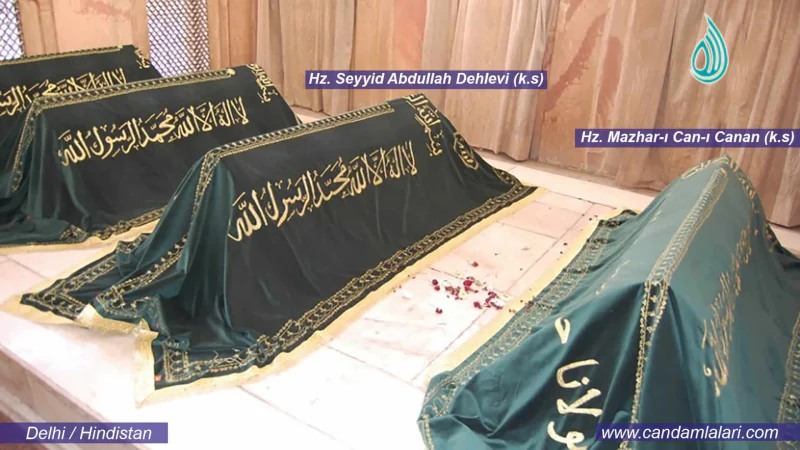
Hazrat Seyyid Abdullah Dehlevi (k.s) was born in 1745 in the city of Punjab in India. He passed away in Delhi in 1824. His grave is at his dergah near the Shah Jahan Mosque, right beside his murshid, Hazrat Mazhar-ı Can-ı Canan (k.s). His father, Abdullatif Efendi, was a learned, righteous and ascetic man. One day in a dream Hazrat Ali said to him: "God (Exalted is He) will grant you a son, and he will be a great person. You shall give him our name."
Our Master, the Messenger of God (peace be upon him), in a dream also commanded his uncle, who was one of the friends of God, that the child to be born be given the name Abdullah. When the child was born, his father named him Ali and his uncle Abdullah. When Hazrat Abdullah-ı Dehlevi reached the age of six, out of love and respect for Hazrat Ali, he did not want to be called Ali and called himself "Gulam Ali," meaning servant of Ali, and became known by this name.
He had an exceedingly superior intelligence, a gift from God. He memorized the Holy Quran in a short time. He learned the religious sciences and the natural sciences of his time.
He went into the presence of Hazrat Mazhar-ı Can-ı Canan (k.s) and asked to be accepted as a student. The master replied: "Go wherever you please. Our path is like licking a saltless stone." He answered, "I am content with everything, my master." The master said, "May it be blessed," and he was accepted as a student. Hazrat Abdullah-ı Dehlevi (k.s) was honored with his suhba for 15 years. When he attained high degrees in sainthood, he received absolute ijaza and became his khalifa.
Hazrat Abdullah-ı Dehlevi said:
A student means a sincere seeker. He burns with the love of God (Exalted is He) and with the desire to attain His love. He is bewildered by a love he does not know and cannot understand. Sleep flees him and his tears do not cease. Ashamed of the sins he has committed, he cannot raise his head. In everything he does he fears and trembles before God, and strives to do the things that will bring him to the love of God. He is patient in everything. In every disagreement and hardship he sees the fault in himself. With every breath he thinks of his Lord. He does not live in heedlessness. He quarrels with no one. He fears hurting a heart. He knows hearts to be the house of God (Exalted is He). He speaks well of the noble Companions, and when their names are mentioned he says "may God be pleased with them." He says that all of them were good. Our Prophet (peace be upon him) commanded us not to speak of the things that took place among the noble Companions. The righteous Muslim does not speak of them, write of them or read of them. In this way he protects himself from any disrespect toward those great ones. Loving those great ones is a sign of loving the Messenger of God. By his own knowledge and his own opinion he does not rank the noble friends of God as lower and higher than one another. That one of them is higher and superior can be understood only through the noble verse, the noble hadith and the consensus of the noble Companions. Those who speak otherwise in the intoxication of love are excused. Among his students, Hazrat Mawlana Khalid al-Baghdadi was one of his khalifas, and the Golden Silsila continues with Hazrat Mawlana Khalid al-Baghdadi.