Türkçe
 Español
 Français
 日本語
 हिन्दी
 العربية
 中文
Hazrat Abdülhalik Gücdevani (k.s)
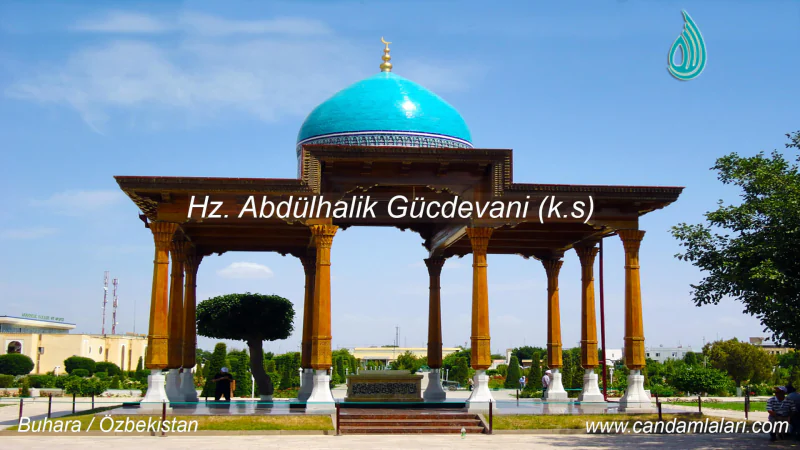
He was tall, with a rather large head, a white complexion and a beautiful face. His eyebrows were thick, and his chest and shoulders were broad. His mother and father had migrated from Malatya to Bukhara. He is one of the great ones of the Khwajagan. His father, Hazrat Abdulcemil, was a pious man of gnosis who had met and conversed with Khidr, peace be upon him. Khidr, peace be upon him, said to him:
-God will give you a righteous son. Name him Abdülhalik, he said.
While Abdülhalik was still in his mother's womb, his father Abdulcemil emigrated with his relatives from Malatya in Türkiye, first to Transoxiana and then to Bukhara, and they settled there. When Abdülhalik was five years old, he was learning the Holy Quran from Hâce Sadreddîn, one of the great scholars of Bukhara. One day, as he was reading the verse اُدْعُوا رَبَّكُمْ تَضَرُّعًا وَخُفْيَةًۜ اِنَّهُ لَا يُحِبُّ الْمُعْتَد۪ينَۚCall upon your Lord humbly and secretly. Surely He does not like the transgressors. (Al-Araf 7:55, Diyanet) (Surah al-A'raf, 55), Abdülhalik said:
What is the true nature of secrecy, and how is the hidden dhikr performed? If a person performs dhikr and prayer aloud, there is the fear of ostentation (riya). When ostentation enters, the dhikr and prayer are not performed as they should be. And if he performs dhikr and prayer in the heart, that is, secretly, then, according to the noble hadith, since Satan circulates in the blood, he mixes into the dhikr and the prayer, he said. His teacher, marveling at this question and this understanding, said:
-My son, this is divinely inspired knowledge (ilm-i ladunni). If God Almighty wills, He will lead you to one of the friends of God. He will teach you the hidden and the audible dhikr. Thus your problem will be solved, he said.
At this sign, Hazrat Abdülhalik Gücdevani began to wait for that great person who would solve his problem. One day Khidr, peace be upon him, came to him. He taught him the ways of remembering (dhikr) God Almighty secretly and openly, accepted him as a spiritual child, and described it to him: "In your heart you will perform dhikr of the pure phrase La ilaha illallah, Muhammadun Rasulullah in such and such a way!" Following this description, Hazrat Abdülhalik began to say this blessed phrase of tawhid silently in his heart. He took it as his lesson. This state became the cause of his rising in the spiritual stations. Around this time Hazrat Yûsuf-i Hemedânî came to Bukhara. Abdülhalik Gücdevani entered his service and stayed in this service for a time. He himself tells of this as follows:
I was twelve years old. Khidr, peace be upon him, advised me to seek knowledge from Hazrat Yûsuf-i Hemedânî. Hearing at that time that he had come to Bukhara, I went to him at once, and I benefited from him greatly. Thus Yûsuf-i Hemedânî became Hazrat Abdülhalik Gücdevani's teacher in suhba, and Khidr, peace be upon him, his teacher in the practice of dhikr. Hazrat Abdülhalik Gücdevani kept his state hidden from people. He did not follow the desires of his nafs, and subjected himself to very heavy trials by doing the things he did not want to do, but he let no one notice anything. Above all, no one was aware of the spiritual knowledge he attained with Khidr, peace be upon him. Under the education and training of both Khidr, peace be upon him, and the great scholars of Islam, Abdülhalik Gücdevani became the peerless figure of his time. People began to come from the four corners of the world in caravans to benefit from him.
Hazrat Abdülhalik Gücdevani would perform his five daily prayers at the Holy Kaaba and return to Bukhara again. One day of Ashura, he was explaining the states of sainthood to his students in a lesson. A young man in Muslim dress came in and sat among the students. After listening to his talk for a while, he asked leave to speak:
My Master! The Messenger of God, peace and blessings be upon him, says: "Beware of the discernment of the believer, for he looks with the light of God." What is the secret of this noble hadith? he asked.
Hazrat Abdülhalik Gücdevani cast an awe-inspiring gaze upon the young man and said: "In that case, cut the zunnar at your waist, the round cord, as thick as a finger, which Christians tie around their waists in worship and at the end of which a cross hangs, and come to faith." These words of the master came as a shock to those present. The young man protested in alarm: "God forbid! I swear I have nothing like that on me." Then Hazrat Abdülhalik signaled to one of his students to take off the young man's cloak. When the student took the cloak off him, a zunnar tied in knots was seen at his waist. Faced with this, the young man was deeply ashamed. He did not know what to do. A love for Islam arose in his heart. He began to feel affection and love for Hazrat Abdülhalik Gücdevani. Thus he understood very well what it means that the saints look with the light of God Almighty. He recited the word of testimony (kalima al-shahada) and had the honor of becoming a Muslim. He became one of his sincere students. The great murshid then turned to those around him and said:
"O friends! Come, let us too keep the covenant and cut our zunnar. Let us believe. Just as this young man cut the material zunnar, let us cut the zunnar that belongs to the heart. That is pride and arrogance. This young man became one of those who ask forgiveness; let us too attain forgiveness." His students, in an instant, drank the sherbet of healing that Hazrat Hâce offered to the wounds of their hearts, and renewed their repentance. Thus their hearts no longer had any attachment to anything other than God Almighty.
Hazrat Abdülhalik Gücdevani laid down 11 principles as proof, maxim and method for the exalted tariqa. Those who enter sayr wa suluk are obliged to apply them in order to benefit from this path and receive spiritual flow (feyz).
Hüş-derdem: To be awake in every breath taken and given.
Nazar-berkadem: To walk looking at the tips of one's feet, to avoid idle glances and to guard oneself.
Sefer-der vatan: To journey, at every step, toward one's origin, toward the Truth.
Halvet-der-encümen: To be alone with the Truth among the people.
Yad-kerd: To unite the dhikr of tawhid of the heart and the tongue with the breath, for God's sake alone.
Baz-geşt: To know that the only thing sought and intended is the good pleasure of God.
Nigah-daşt: To guard the heart from passing thoughts.
Yad-daşt: To be with God in every breath.
Vukuf-i zemani: To know the time one is in and to make good use of it.
Vukuf-i adedi: To observe the count in dhikr.
Vukuf-i kalbi: To keep the heart occupied with the dhikr of God, with thought of Him and with His command.
Hazrat Abdülhalik Gücdevani was a master of the Sharia, the tariqa, gnosis (marifet) and reality (hakikat). His words are proof and authority. He trained great personages. In the chain he received the trust from Hazrat Yûsuf-i Hemedânî.