Türkçe
 Español
 Français
 日本語
 हिन्दी
 العربية
 中文
Hazrat Arif Rivegeri (k.s.)
He was of medium height, with a moon-like face, large eyes, and thin eyebrows curved like a crescent. His complexion was rose-colored. A pleasant fragrance spread from his body. He was one of the great ones among the Turkish saints, a man of knowledge, forbearance (gentleness of character), piety, spiritual discipline and worship. He had served Hazrat Hace Abdülhalik Gucdüvani for years. He was among his most virtuous brethren and his great khalifas. He applied to the letter the principles the Hazrat laid down for sayr wa suluk, and received grace (feyz). He was very meticulous in following the sunna of our Prophet. For this reason he reached a high degree. After the passing of Hazrat Abdülhalik Gucdüvani, great sincerity and zeal were seen in him in continuing the same duty. It is probably for this reason that he is called "Pîşuva-yı Arifan" (Leader of the Gnostics) in the silsila. So much so that Hazrat Muhammed Bahaeddin Nakşibendî, who was to come four generations after him, spread grace across the world and became renowned through the principles of sayr wa suluk that they laid down.
He became a means for many to reach guidance and high degrees in the stations of sainthood. He was unique in his time. He treated everyone very kindly and gently and never broke anyone's heart. He never did what his nafs desired, and worked hard to do what it did not want, in order to raise his spirit. He avoided the unlawful strictly, and even gave up an excess of the permissible for fear of falling into the unlawful. He spent his nights always in worship and his days teaching students, and, because it is a sunna, he took a short midday nap (qaylula) before noon. He knew the exalted sunna of our Prophet very well and, so that it would not be forgotten, dwelt on it in his counsels and explained it. He showed great effort for the blessed sunnas to be lived. In every suhba of his he would say: "May Almighty God honor all of us with the felicity of following the Messenger of God, our Master, the lord of this world and the next and the highest and best of all people in every respect! For Almighty God greatly loves following him and conforming to him. The smallest particle of conforming to him is superior to all the pleasures of the world and all the blessings of the hereafter. True superiority is following his exalted sunna."
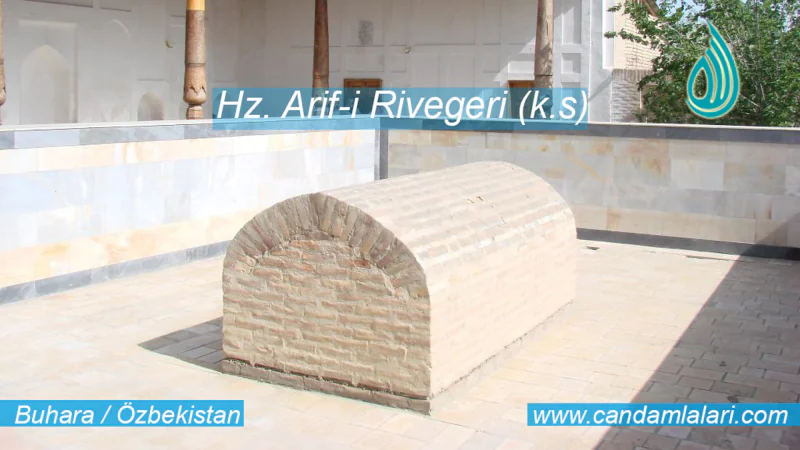
Hazrat Arif Rivegeri's transition from silent dhikr to loud dhikr (dhikr-i jahri) falls in the last years of his life. This teaching of open dhikr was among the requirements of the time. By teaching loud dhikr to his khalifa Hazrat Mahmud Fağnevi, he wished to rescue the people from the gloom of heedlessness and awaken them with the awe of dhikr. Thus the people who were heedless of dhikr, hearing the open dhikr, came to feel delight and eagerness, and through the collective dhikr, movement in the body, benefit and outpouring (receiving feyz) were achieved. Hazrat Arif Rivegeri lived a long life. He passed away in Riveger in 1315 (715 AH). His grave is there. Those who visit receive his grace and blessings.