Türkçe
 Español
 Français
 日本語
 हिन्दी
 العربية
 中文
Hazrat Yusuf-i Hemedani (k.s)
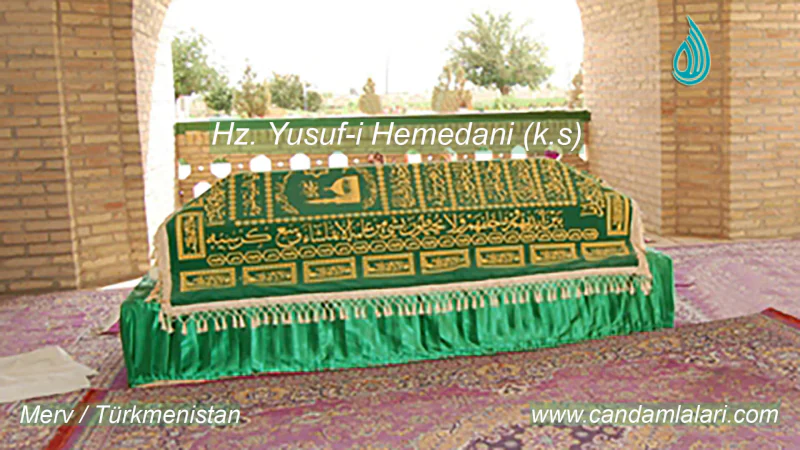
His name is Yusuf bin Yakub Hemedani, and his kunya is Abu Yakub. He is a descendant of Imam-i Azam (Abu Hanifa). He was born in Hamadan in 1048. In 1140, while travelling from Herat to Merv, he passed away on the road.
He learned the science of Sufism from Hazrat Ebu Ali Farmedi, and reached perfection, trained in his suhba.
Staying in various cities of Iraq, Khorasan and Transoxiana, he was occupied for more than sixty years with showing people the right path. Hundreds of students took lessons from him. He would tell his students about the stories and virtues of the four great caliphs and advise them to adopt their character. He trained great saints such as Abdullah-i Berkî, Hasan-ı Endâkî, Ahmed Yesevî and Abdülhâlık-ı Goncdüvânî. Yûsuf-i Hemedânî told all his friends to follow his student Abdülhâlık-ı Goncdüvânî. After him, this student showed people the right path.
According to what is related in the work called Fetâvâ-i Hadîsiyye by Hazrat Ibn Hajar al-Makki;
Ebû Saîd Abdullah, Ibn al-Sakka and Seyyid Abdülkâdir-i Geylânî came to Baghdad to acquire knowledge. Hazrat Abdülkâdir-i Geylânî was very young then. They had heard that Hazrat Hâce Yûsuf-i Hemedânî was preaching at the Nizamiyya Madrasa. They decided to visit him. Ibn al-Sakka said: "I will ask him a question that he will not be able to answer." Ebû Saîd Abdullah said: "I too will ask a question. Let us see whether he can answer." Abdülkâdir-i Geylânî, who despite his young age was a model of great propriety, said: "God forbid. How could I ask a question? I will only wait in his presence, and be honored and blessed by seeing him."
At last they reached the place where Hazrat Yûsuf-i Hemedânî was. He was not there at that moment. About an hour later he came. Turning to Ibn al-Sakka, he said: "Shame on you, O Ibn al-Sakka! So you will ask me a question I will not be able to answer, will you! The question you want to ask is this. Its answer is thus. I see that the smell of unbelief comes from you." Then, turning to Ebû Saîd Abdullah, he said: "You too will ask me a question and watch how I will answer it. The question you intend to ask is this, and its answer is thus. But because you too did not observe propriety, your life will pass in sorrow." Then he turned to Abdülkâdir-i Geylânî. He drew near him and said: "O Abdülkâdir! With the beauty of this propriety of yours, you have pleased God Almighty and His Messenger. It is as though I see you sitting in Baghdad on a pulpit, explaining very exalted knowledge, and saying: 'My foot is upon the necks of all the saints.' And it is as though I see all the saints of your time bowing their necks before your superiority over them," he said, and then vanished from sight. They could not see him again.
Many years passed. Abdülkâdir-i Geylânî came of age. He became the foremost, the crown of the saints of his time. He attained such high degrees and stations that people and eminent persons alike would all come to benefit from his blessed suhba. One day he was sitting on a high pulpit preaching. He said: "My foot is upon the necks of all the saints." All the saints of his time knew that he was far higher than themselves, and their necks would bow before his superiority. As these things came to light, the states that Hazrat Hâce Yûsuf-i Hemedânî had foretold as a miracle years before were understood.
As for Ibn al-Sakka, after that incident between him and Yûsuf-i Hemedânî, he occupied himself with the religious sciences. He spoke very well. His fame reached the sultan of the time. The sultan sent him to Byzantium as an envoy. The Christians showed great interest in him. Finally, deceived by their lies, he became a Christian. The person who relates this incident says: "One day I saw him. He was ill. He was about to die. I turned his face toward the qibla. He turned it the other way. I turned it toward the qibla again. He turned it the other way again, and so he died."
Ebû Saîd Abdullah also says: "I came to Damascus. I held some offices. My life passed with various hardships. What Hazrat Yûsuf-i Hemedânî said about all three of us came to pass exactly."
Cemâleddîn Muhammed bin Ebî Bekr al-Hadrami al-Shafi'i, the author of the book al-Mashrab al-Rawi, says: "This story, even if its wording differs, has become mutawatir in meaning because of the great number of those who relate it. Those who dare to deny the friends of God Almighty, God forbid (we seek refuge in God Almighty), should greatly fear falling into the state of Ibn al-Sakka. It is mentioned in Behcet-ül-Musannife, where the stories of Hazrat Abdülkâdir-i Geylânî are told, that despite his great knowledge and deeds, the reason Ibn al-Sakka fell in the end into such an endless calamity was that he showed disrespect toward the friends of God."