Türkçe
 Español
 Français
 日本語
 हिन्दी
 العربية
 中文
Hazrat Bayezid-i Bistami (k.s.)
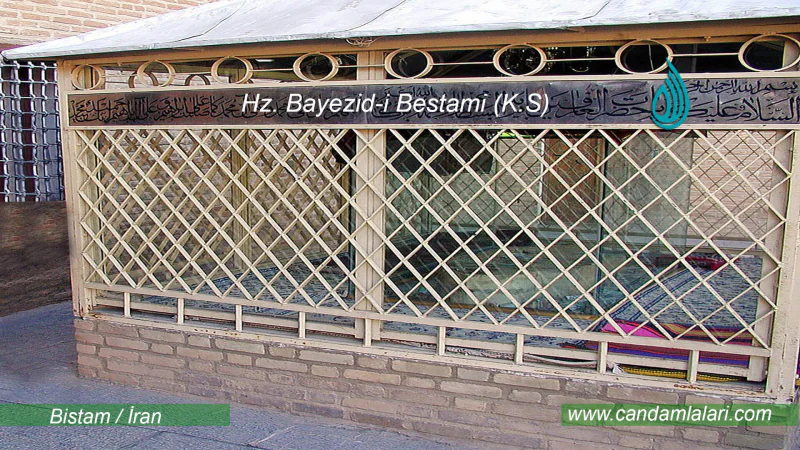
Bayezid is his kunya. His real name: Tayfur.
His father's name: İsa.
He was born in Bistam in 188 H.
He had two brothers, Ali and Adem, both adorned with asceticism and piety and both on the path of Sufism.
The Nafahat al-Uns reports that his teacher in the outward sciences was of Kurdish origin. His respect and reverence for his teacher was so great that, at his death, he left a will that his grave be made lower than his teacher's grave. He benefited from the company of Imam Ali Riza and, through his blessing, from the spirituality of Imam Jafar al-Sadiq. In the Sharh-i Mawaqif, page 617, it says: Abu Yazid did not exist in the time of Imam Jafar al-Sadiq. But he benefited from the Imam's spirit. He is famous for receiving spiritual flow (feyz) from him.
The young Bayezid, upon reading a verse, came home early. His mother asked:
– Why did you come back so early?
– I came upon a verse: God (Exalted is He) commands me to serve Him and to serve you. I ran to your service at once.
– Either plead for me and I will serve you, or else let me give myself to God (Exalted is He).
– I have left you to God (Exalted is He); give yourself to Him.
He used to say: "I labored thirty years in the work of striving (mujahada), and at the end of it I understood that the hardest thing for a servant is knowledge and doing what knowledge requires. " Like Mansur, words contrary to the Sharia have at times come out of my mouth, as is well known.. The state of unity (wahda).. a subtle secret..
He used to say: "If you hear that such words contrary to the Sharia have poured from my mouth, attack me with daggers and swords."
They asked him for the description of the possessor of gnosis (irfan). He gave this answer: "Just like the people of Hell... they have a life that knows neither dying nor being raised... they burn... they burn.. but what burns them is another fire.. It is the fire of love.. the fire of affection.."
The saying attributed to Mevlana but in fact Bayezid's: "Either appear as you are, or be as you appear."
One day one of the scholars of Bistam asked him:
– O Bayezid, from whom and from where did this knowledge come to you? He received this answer:
– From God (Exalted is He).. And God's (Exalted is He) bounty..
From His Essence.. The explanation is very easy… If you read this noble hadith of the Prophet (peace be upon him), you will understand!
"If a person acts upon what he knows, the Exalted Truth grants him what he does not know." The scholar who had come fell silent before the answer, grasped the matter, and went away.
He used to say: "One who asks something of God (Exalted is He) prays to Him by the names of His attributes. But one who seeks His Essence must turn to Him with the Essence-name, God (Exalted is He)."
Sheikh Feridun-i Attar says in his book Tadhkirat al-Awliya: a man named Yusuf Necurani came into Bayezid's presence, demanding a miracle (karamat) in order to test him. The Blessed Sheikh said: "We have entrusted our miracles and our wonders to him; go to him," and sent him to Sheikh Ebu Said Raî, one of his murids.
At this sign, when Yusuf Necurani went to Sheikh Ebu Said, he saw the Sheikh praying in the desert while wolves were shepherding and guarding his sheep. When Ebu Said finished the prayer, Yusuf Necurani asked him for fresh grapes.
Sheikh Raî broke the staff in his hand in two and planted one piece on his own side and the other on Yusuf Necurani's side; no sooner had he planted them than, by the wisdom and bounty of God, they became vines and gave fresh grapes. But the grapes on Sheikh Raî's side appeared white, and those on Yusuf-i Necurani's side appeared black.
When Yusuf-i Necurani asked why the colors of these grapes were different, Sheikh Raî answered: "I asked the Exalted Truth with certainty (yaqin), but you asked in order to test. Then it is perfectly natural for everything to take the color of its own state."
Then he gave Yusuf-i Necurani a rug and told him to guard it well. Yusuf took the rug and went on the pilgrimage; at Arafat the rug was lost. When he returned to Bistam after the pilgrimage, he found the rug in front of Sheikh Raî. Sincerely repenting in his heart for having demanded a miracle from so exalted a saint as Bayezid, he entered among his murids with repentance and asking forgiveness.
Imam Rabbani (k.s) says in the Maktubat:
– The meaning of Bayezid-i Bistami's saying "Subhani" is the declaration of the transcendence (tanzih) of God, the Truth (al-Haqq). It is not a declaration of his own transcendence.
– Bayezid-i Bistami said the saying "Subhani" while he was in the middle of the path. Afterwards he passed beyond this and
attained perfection.
One day he said to his companions: "Rise, let us go out to meet one of God's saintly servants," and they rose.. When they came out to the main road they met İbrahim bin Şeybe-i Hirevi. Ebu Yezid said to him:
"It came to my mind to meet you and to intercede for you with my Lord." İbrahim bin Şeybe replied: "Even if you interceded for all creatures, it would not be too much. For all of them are a lump of clay." Hazrat Bayezid was astonished at this answer.
Imam Shafi'i relates: Someone asked Abdurrahman bin Yahya about trust in God (tawakkul). He said: "It is that you put your hand into the mouth of a dragon, even up to your wrist, and remain with God (Exalted is He) and fear no one else." I went to ask Hazrat Bayezid also about trust in God. I knocked at the door. Suddenly he said: "Was Abdurrahman's word not enough for you?" I said, "Open the door." He said: "You did not come to visit me, and you received your answer from behind the door." And he did not open the door to me. I left, and came to visit him a year later. I stayed with him about a month. During that time he told me everything that passed through my heart.
"Love the saints, who are God's beloved servants, so that they may love you too. The Exalted Lord looks at their hearts. If He sees your name in the heart of one of them, He forgives you."
Bayezid-i Bistami (k.s.)
After his death they saw him in a dream and asked: "How are you?"
– They said to me: "O elder, what have you brought?" I said: "When a beggar comes to the door of the king, no one asks him, 'What have you brought?' They ask, 'What do you want?'" The call came: "He speaks the truth; leave him be."
In the year 231 H., or 232, or, according to the account of Ibn Khallikan, 261 or 262, on the fifteenth day of the blessed month of Shaban, he passed away, again in Bistam. His blessed tomb in Bistam is a place of visitation for everyone.
His blessed appearance (hilya): he was tall, fair-faced, white-bearded and deep-set of eye. His beard was sparse. He closely resembled Hazrat Abu Bakr.