

 Türkçe
 Español
 Français
 日本語
 हिन्दी
 العربية
 中文
Hazrat Abu Bakr as-Siddiq (may God be pleased with him)
"For the one who is patient there is no such thing as a calamity. Nothing is gained by weeping and wailing. Life before death is very simple and easy. Life after death is hard. Think of the departure of the Messenger of God (peace be upon him) from among us, of the loss of him; remember it, so that your calamities may grow small... And may God increase your reward."
"Beware of following your nafs! Only the one who overcomes his desire, greed and anger will attain success."
"Do not threaten with a punishment heavier than the offense; for if you carry it out, you fall into sin; if you do not, you turn out a liar."
"The person who obeys a ruler who commands good and forbids evil attains salvation and has paid the right that the ruler holds over him."
"The most obedient person to God is the one who is most hostile to his own sin."
"When a servant becomes arrogant because of something of the blessings of this world, God Almighty hates him until that blessing leaves the servant." Hazrat Abu Bakr (may God be pleased with him)
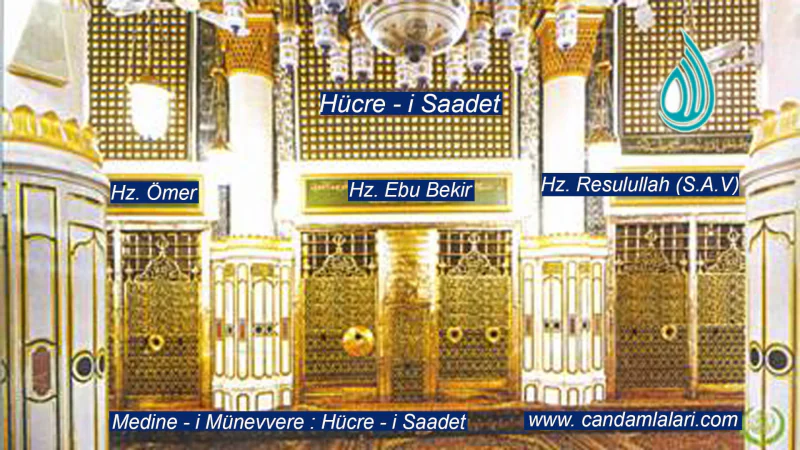
The Blessed Chamber
He is the first caliph of Hazrat Muhammad (peace be upon him). He was given glad tidings of Paradise while alive. After the prophets he is the most excellent of all people. He was born in Mecca in 573. His original name is Abdullah bin Ebu Kuhafe bin Amir bin Ka'b bin Sa'd bin Teym bin Murra. He passed away in 634 in Medina the Illuminated.
When our Master informed Hazrat Abu Bakr of his prophethood and asked him to become a Muslim, he accepted Islam without any hesitation. When he was honored with becoming a Muslim he was 38 years old.
When the polytheists heard of our Prophet's miracle of the Mi'raj, they did not accept it. They even mocked him. Then they asked Hazrat Abu Bakr. When Hazrat Abu Bakr heard our Prophet's name he said, "If he said it, I believe. He went and returned in an instant." That day our Master, the Messenger of God, gave Hazrat Abu Bakr the title "Siddiq."
Hazrat Abu Bakr was the closest friend of our Master, the Messenger of God. Their companionship continued in the Hijra from Mecca to Medina as well. He became his (peace be upon him) companion in the cave. Until they reached Medina he performed all of our Master's service. When the mosque in Medina was being built, they worked together. He did not fall short in any service or sacrifice.
Hazrat Abu Bakr took part in all the battles together with our Master. At Badr, Uhud and the Trench he showed great heroism against the polytheists. In the battle of Tabuk he fulfilled the duty of standard-bearer.
Hazrat Abu Bakr led the pilgrim caravan in 631, in the ninth year of the Hijra. During our Prophet's final illness he served as imam for three days and led seventeen prayers. In three of these our beloved Prophet prayed behind Hazrat Abu Bakr, following him.
Upon the passing of the Messenger of God, he was chosen caliph by the consensus of the noble Companions (may God be pleased with them all).
After the Messenger of God's passing, Hazrat Abu Bakr grew a little weaker with each passing day. One day his daughter, our mother Aisha al-Siddiqa, asked the reason for this weakening. In reply he said: "The separation from Muhammad (peace be upon him) has weakened me like this."
Hazrat Abu Bakr fell ill in 634, at the time the battle of Yarmuk was being fought. In the last days of his illness, one night he saw our Prophet in a dream. Our Prophet said to him: "O Abu Bakr! We have missed you greatly, the time of reunion has drawn near." And he said, "I have missed you too, O Messenger of God!" "Choose as caliph for this community Faruq, the just, the truthful, who has won the pleasure of everyone on earth and in heaven, the purest of his time!" he said. His caliphate lasted 2 years, 3 months and 10 days. At the age of 63, on Monday the seventh of the month of Jumada al-Akhira in the 13th year of the Hijra, 634, he fell ill. After lying ill for 15 days he passed away. Hazrat Umar led the funeral prayer. He was buried in the Blessed Chamber where our Prophet's grave is. May God be pleased with him.
In his time the foundations of state administration were made firm; just as no ruling of the Holy Quran was departed from, no opportunity was given to those who wished to leave the religion. In these wars against the apostates, many memorizers of the Quran (hafiz) were martyred at Yamama. At the proposal of Hazrat Umar, it was decided that the Holy Quran be collected into a book, and this task was given to Zayd bin Thabit.
Hazrat Abu Bakr also rendered an eminent service in the science of hadith. He was very closely acquainted with every state and every deed of the Messenger of God. The noble Companions would ask Abu Bakr how our Master, the Messenger of God, acted in many matters.
Some of the noble hadiths he related having heard them himself are the following:
"The siwak is a means of attaining the good pleasure of Almighty God."
"Pay attention to truthfulness and goodness, for these two lead to Paradise. Beware of lying and evil, for these lead to Hell."
"The prophets do not leave an inheritance. What they leave is charity."