Türkçe
 Español
 Français
 日本語
 हिन्दी
 العربية
 中文
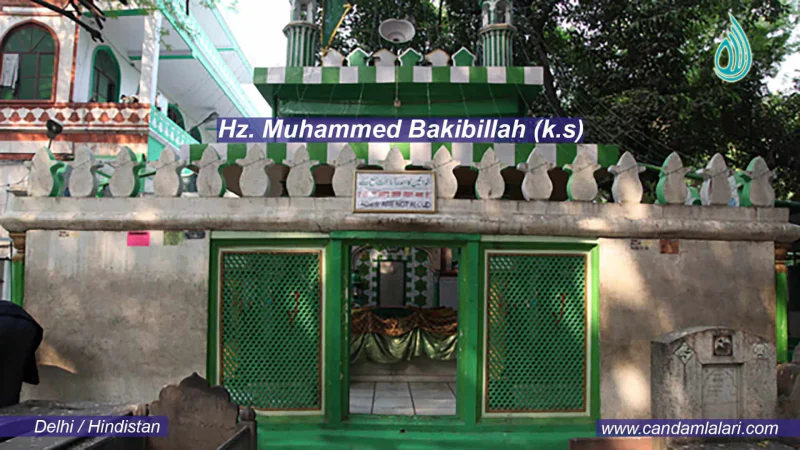
Hazrat Muhammed Bakibillah (k.s)
He was of medium height, with a ruddy complexion and a sparse beard that was white in places. He always preferred seclusion and spiritual discipline. He ate little, slept little, spoke little, and day and night occupied himself with the Holy Quran.
In his youth he migrated from the city of Kabul in Afghanistan to Samarkand. He had a love for knowledge and piety, and applied both the outward and the inward sciences. He was full of ecstasy (jadhba) and love of God. His character was very beautiful. He was a man of many spiritual states. He benefited greatly from the spiritual presences of Hace Muhammed Bahaeddin Nakşibend (k.s) and Hace Ubeydullah Ahrar (k.s), and his spiritual flow (feyz) increased thereby. For this reason he was also called Uwaysi. In the chain he received the trust from Hazrat Hacegi İmkenegi, and spiritually from Hazrat Şah-ı Nakşibend and Hazrat Ubeydullah Ahrar. He is remembered as "the locus of manifestation of the Truth."
He himself relates: At last, in a dream, I made a complete repentance in the presence of Hazrat Behâeddîn Buhârî Nakşibend. After this the desire to enter the path of Sufism became evident in me. I resorted to every means in order to enter this path. At last one of the blessed personages said to me: "The dhikr that comes from our Prophet leads to the goal." With all my effort I strove to receive dhikr and muraqaba from the person who said this. For two years I continued the dhikr, muraqaba and tasbihat of that person's chain. Although hidden signs at that time pointed to entering another path, I could not lift my feet from the ground. Thus, having overcome the nafs, I sowed in the garden of my heart, with the leave of God Almighty, the seed of the generosity of the great ones. God willing, in their generosity and favor they will nourish that seed with rivers that no eye has seen and no ear has heard. After this I went to Kashmir and continued in the suhba of Baba Vali, and attained his blessed gaze and tawajjuh. Praise and thanks be to the Exalted Truth, through those tawajjuhs the door of acceptance was set ajar. After his passing as well, I received spiritual flow from the spirits of the saints.
As Muhammed Bâkîbillah was going to one of the cities of Transoxiana, Mevlânâ Hâcegî İmkenegî (k.s) said to him, "O son, I have been watching for your coming!" and so he came into his presence and received much help and favor. After hearing of his lofty states, his murshid conversed with him alone in a room for three days and three nights. Through attending the suhba of Hâcegî İmkenegî (k.s) and through the help of the lofty spirituality of Hazrat Behâeddîn Nakşibend (k.s) and his khalifas, he entered this chain of great ones, became a khalifa of Hâcegî İmkenegî (k.s) and took his station.
After Hacegî İmkenegî had in a short time brought Muhammed Bâkîbillah up in Sufism and raised him to high degrees, he said to him: "Your work has been completed, by the help of God Almighty and by the training of the spirits of the great ones of this path. Go to India again. For I see that this exalted chain will shine through you. With your blessing and training, people will come there who will benefit greatly from you and do great things." Thus he was giving the glad tidings that Imam Rabbani (k.s), the renewer (mujaddid) of the second millennium, would be raised there.
When some of his students heard that Hâcegî İmkenegî had appointed Muhammed Bâkîbillah as khalifa, given him a full authorization (ijaza) and was sending him to India, they were stirred with jealous zeal, and unease arose among them. Since they had been there a long time themselves, it troubled them that a newly arrived young man should leave so soon with a full authorization. When Hâcegî İmkenegî heard of this, he said: "Let my friends know that they completed this young man's work and sent him here to us. He came to us to check whether his states were sound. Without doubt, one who comes thus goes thus."
Hazrat Muhammed Bâkîbillah (k.s), at his teacher's command, went to India and stayed a year in Lahore. The scholars and the learned there came to his suhba and benefited. Then he went to Delhi, stayed there until his death, and showed people the right path. Although he was in the station of guidance for only a short time, two or three years, he raised many scholars and saints. Foremost among those he raised was his successor, the renewer of the second Hijri millennium, the apple of the eye of the scholars of Islam, Imam Rabbani Ahmed Faruki Serhendi (k.s). When Imam Rabbani (k.s) had grown and reached maturity, Hazrat Muhammed Bâkîbillah (k.s) left the training of all his students to him. He had two sons named Hâce Ubeydullah and Hâce Muhammed Abdullah. He left their upbringing too to Imam Rabbani. In the Maktubat of Imam Rabbani there are letters written to them. His sons were among the distinguished persons trained in Sufism.
The mother of Hazrat Muhammed Bâkîbillah, although she had women servants who served her in her house, herself did the work of the dergah. She even set and baked the bread in the tandoor herself. She cooked and prepared the meals. She gave the fresh bread to those in the dergah, and ate dry bread herself. Most of the time she slept on a dry mat. One day Hazrat Muhammed Bâkîbillah (k.s), seeing his mother weak and without strength, said that someone else should do the cooking of the dergah. But his mother wept, saying she had been deprived of such a service: "I do not know what fault I committed that God Almighty has deprived me of this service. The best thing I did was to cook bread and food for that virtuous son of mine, Muhammed Bâkîbillah, and his students. They have taken that from me too." Out of the abundance of her humility, her brokenness and her courtesy, she did not tell this to her son Muhammed Bâkîbillah. When this distress of his mother was reported to Hazrat Muhammed Bâkîbillah, he gave this service, which was a blessing, back to his mother.
"Flee as from a lion from the scholars who make their knowledge a means for rank, position and boasting."
"The great ones of this path are extremely zealous and delicate. Their path is, without any deficiency, the path of the Messenger of God."
"For those who are content with God's decree, calamities are not misfortunes. They do not dislike calamities. For the one who gives the calamities is God Almighty Himself."
"We, the truthful and those who have reached the Truth, say with one voice: the Straight Path, that is, the unerring way, is the way of Ahl al-Sunna wal-Jama'a."
"To be a Muslim means to do, to live, to fulfil the divine commands."
"Never be among those who fearlessly eat whatever they find, lawful or forbidden! One must make great effort and take great care not to eat a morsel that is forbidden or doubtful."
Every night, from the evening prayer until the tahajjud prayer, he would complete a recitation of the Glorious Quran from beginning to end, then perform the tahajjud prayer, perform the morning prayer after true dawn, and recite Surah Yasin until sunrise. When the sun rose:
–O my Lord! How swiftly the nights pass, he would say.
In 1014 AH, at the age of about 41, he passed away in Delhi.