Türkçe
 Español
 Français
 日本語
 हिन्दी
 العربية
 中文
Hazrat Hace Ali Ramitani (k.s)
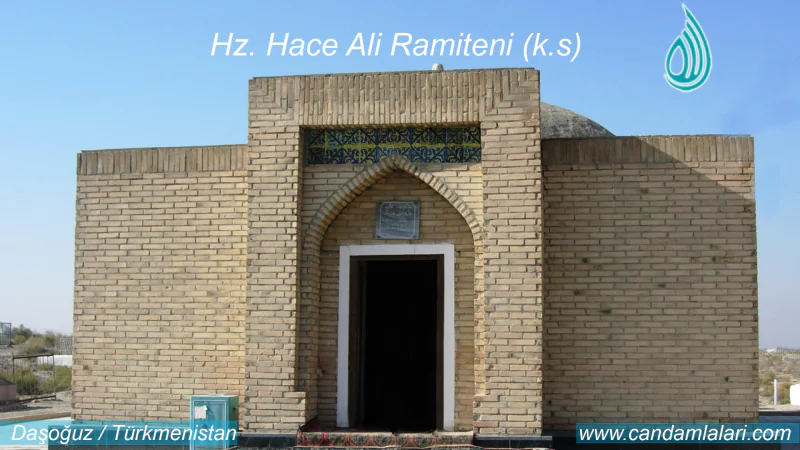
He was of medium height, and his face and other members were very beautiful. He had chosen poverty (fakr). He earned his living by weaving cloth. Outwardly he was with the people, inwardly with the Truth. His spiritual stations were high, and many miracles (karamat) of his were witnessed. He entered the service of Hazrat Hace Mahmut Fağnevi, and became the pillar of his brethren and the greatest of his khalifas. Hazrat Ali Ramitani is famous by the names Pîr-i Nessâc and Azîzan. After worship and lessons, in his free time he practiced weaving in order to earn a lawful morsel. For this reason he was called Pîr-i Nessâc, meaning the sheikh of weavers.
The reason Hazrat Ali Ramitani was called "Azîzân" is told as follows: Once there was nothing to eat in Ali Ramitani's house for two or three days. The household was greatly distressed from hunger. There was nothing in the house to offer a guest who had come. At that moment a young man, one of Hazrat Ali Ramitani's students, who sold food, brought as a gift a rooster stuffed with rice. He pleaded, saying: "I prepared this dish for you and your family. If you accept our gift, you will make us happy." At that delicate moment, he was extremely pleased with the food that had come and showed kindness to his student. He offered the dish to his guest and entertained him. After the guest had gone, he summoned that student and said: "This food you brought came to our aid at a time of distress. You too, ask of us whatever you desire! For the door of petition is open at this very moment." The young man said: "I have no wish other than to resemble you in knowledge and in the station of sainthood. I beg you, my Master, to bring me to that state!" Hazrat Ali Ramitani said: "You have desired a very hard thing, with a heavy burden. You cannot bear its load. If the burden that is upon us falls upon your shoulders, you will be crushed. If you wish, make another request." The young man said: "My only desire in the world is to be exactly like you. Nothing but resembling you will console me. Nevertheless, I am content with whatever you wish, my Master." Upon this Hazrat Ali Ramitani said, "Very well," and taking him by the hand they entered his private retreat together. Sitting face to face, he began to direct his tawajjuh at that person. After a while that young man, by the leave of God Almighty, attained the degrees of Ali Ramitani outwardly and inwardly. But, intoxicated with love, he lost himself. He lived forty more days in this way and passed away. Because he gave him his own stations in an instant and made him like himself, the revered master's name remained "Azîzân", meaning "two dear ones."
Bedrettin Hemedani, one of the famous sheikhs of the time, asked Hace Ali Ramitani:
Is the dhikr commanded of us in the noble verse whose meaning is يَٓا اَيُّهَا الَّذ۪ينَ اٰمَنُوا اذْكُرُوا اللّٰهَ ذِكْرًا كَث۪يرًاۙO believers! Always remember Allah often, (Al-Ahzab 33:41, Diyanet)the hidden dhikr? Hazrat Hace Ali:
"For the beginner (the one at the start) it is audible, for the advanced (the one at the end) it is hidden," he said.
And to the question "What is your proof for the audible dhikr?" he said:
–"Prompt those of you who are living their last breaths with the dhikr of tawhid" is the hadith; "This prompting will naturally be audible, and the dervish must regard every breath as his last breath." he said.
It was asked of him: "We have heard that you occupy yourself with the audible dhikr instead of the silent dhikr; how can this be?"
Answer: "We too have heard that you occupy yourselves with the silent dhikr. Since we have heard it, yours is evidently audible too. The point of the silent dhikr is that no one hears it. Once both are known, they are equal. Indeed, to occupy oneself with the silent dhikr is closer to ostentation (riya)."
Question: "Why do you prefer the audible dhikr?"
Answer: "Prompting a person with the audible dhikr at his last breath is the command of our Prophet (peace be upon him). And the dervish is at his last breath at every moment."
He said: "One who calls people to the Truth must be like a tamer of wild beasts. Just as that tamer knows the nature and disposition of the animal he deals with and acts accordingly, so must he…"
He said: "In the verse يَٓا اَيُّهَا الَّذ۪ينَ اٰمَنُوا تُوبُٓوا اِلَى اللّٰهِ تَوْبَةً نَصُوحًاۜ عَسٰى رَبُّكُمْ اَنْ يُكَفِّرَ عَنْكُمْ سَيِّـَٔاتِكُمْ وَيُدْخِلَكُمْ جَنَّاتٍ تَجْر۪ي مِنْ تَحْتِهَا الْاَنْهَارُۙ يَوْمَ لَا يُخْزِي اللّٰهُ النَّبِيَّ وَالَّذ۪ينَ اٰمَنُوا مَعَهُۚ نُورُهُمْ يَسْعٰى بَيْنَ اَيْد۪يهِمْ وَبِاَيْمَانِهِمْ يَقُولُونَ رَبَّنَٓا اَتْمِمْ لَنَا نُورَنَا وَاغْفِرْ لَنَاۚ اِنَّكَ عَلٰى كُلِّ شَيْءٍ قَد۪يرٌO believers! Turn to Allah in sincere repentance, so your Lord may absolve you of your sins and admit you into Gardens, under which rivers flow, on the Day Allah will not disgrace the Prophet or the believers with him. Their light will shine ahead of them and on their right. They will say, “Our Lord! Perfect our light for us, and forgive us. ˹For˺ You are truly Most Capable of everything.” (At-Tahrim 66:8, Diyanet) there is a sign (isharat) and a glad tiding (bisharat). The sign is: repent even if you turn away from repentance. The glad tiding is the acceptance of repentance. For if God Almighty were not going to accept repentance, He would not command it; His commanding shows His accepting. However, repentance must not be of the tongue, but in truth, with knowledge of one's fault."
He said: "Guard yourselves well in two states: when speaking and when eating."
He said: "The one who sits in the station of guidance and calling must be like a bird trainer. Just as he knows the nature of every bird and feeds each according to its temperament, the murshid too must be like this, and must train and raise the sincere seekers according to their capacities and dispositions."
He said: "Strive to do good deeds, but do not keep an account of them. Find your own faults and try to make them good."
He said: "The traveler on the path of Truth must increase his spiritual discipline (riyada) and striving (mujahada), so that he may attain states and stations. There is another way here, which is to enter the hearts of the saintly servants and try to win their love. For the hearts of these precious saints are the source of divine wisdoms. The seeker (salik) who wins their love obtains a great portion; the beautiful states in them begin to appear in him."
The ten conditions of being a beloved servant:
1. To be clean outwardly and inwardly.
2. The cleanliness of the tongue.
3. To try to keep away from people as far as possible.
4. To fast.
5. To remember God Almighty much and to say His name often.
6. To be free from khatir, that is, thoughts that come to the heart.
7. To be content with the decree of God Almighty and to submit to His will.
8. To choose the company of the righteous.
9. To be adorned with good and beautiful qualities.
10. To eat lawful and clean food.
He was a contemporary of Seyyid Ata. There had been meetings and correspondence between them. In his early days Seyyid Ata had doubts about the greatness of Hazrat Azizan. For this reason, an act that appeared discourteous toward him issued from the Seyyid. At that time a band of Turks from the Kipchak steppe plundered the region where Seyyid Ata lived and also took his son captive. Seyyid Ata understood where this grief came from and knew that it was the punishment for his discourtesy toward Hazrat Azizan. He repented of what he had done. He prepared a banquet and invited Hazrat Azizan in order to ask his forgiveness. He showed him great humility and brokenness. Hazrat Azizan understood what the Seyyid's purpose was, accepted his request and came. In this assembly there were many great ones, scholars and sheikhs. That day Hazrat Azizan was in a state of great expansion and ease (bast). When the table had been laid and the food was ready, Hazrat Azizan said:
"Until Seyyid Ata's son comes, Ali (which is his own name) will put no salt in his mouth from this table nor stretch his hand toward the food," and then fell silent for a moment. Those present began to watch for the outcome of this great word. A moment later the son of Seyyid Ata suddenly came in through the door. Seeing this, a cry, a lament, broke out in the assembly. Those present were astonished and stood stunned. They asked the youth who had come how he had escaped from the hands of the Turks. "Just now I was a captive in the hands of a group of Turks. My hands and feet were bound with ropes. Now I see myself with you. I know nothing more than this," he said. Those in the assembly understood with certainty that this was the spiritual intervention (tasarruf) of Hazrat Azizan, and all of them regarded becoming his students as the road to safety.
He had two sons. Both were scholars who practiced their knowledge and perfected gnostics, having gathered the outward and inward sciences within themselves. The elder was named Hace Muhammed and was known as Hace Horci (the Younger), because his father was called Hace-i Büzürk (the Great). In his father's lifetime he reached the age of 80. In 721 or 728 (1327 CE), at the age of one hundred and thirty, Hazrat Azizan passed away in the city of Khwarazm on Monday, the 28th of Dhu al-Qa'da. Hace Muhammed also passed away 19 days after his father. The younger was named Hace İbrahim and passed away in the year 793.
Hazrat Azizan had four great khalifas, all of them masters of state, word, virtue and perfection. After the death of Hazrat Hace, each of them was occupied with guiding the students who sought the Exalted Truth. The names of all four khalifas are Muhammed. The first is Hace Muhammed Külahdüz. He is buried in Khwarazm. The second is Hace Muhammed Hallac-ı Belhî. He is buried in the city of Balkh. The third is Hace Muhammed Baverdi, who is buried in Khwarazm. The fourth is Hace Muhammed Baba Semmasî, whose blessed tomb is in Semmas.