Türkçe
 Español
 Français
 日本語
 हिन्दी
 العربية
 中文
Hazrat Hace Alauddin Attar (k.s)
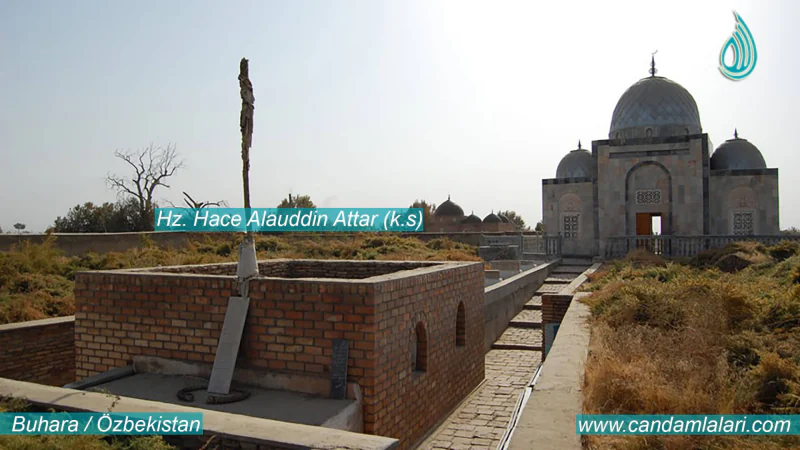
His name is Muhammed bin Muhammed Buhârî, and his epithet is Alâeddîn. His father, Muhammed-ül Buhara, had three sons. The youngest son was Alâeddin. After his father's death, Hoca Alâeddin accepted nothing of the inheritance and set about studying in one of the madrasas of Bukhara.
Hazrat Hoca Bahaeddin Naqshband is said to have had a little daughter. One day he said to his wife:
—When the girl reaches puberty, let me know!
When Hazrat Hoca Bahaeddin received the news that his daughter had reached puberty, he went from «Kasr-ı Arifan» straight to Bukhara and set foot in the madrasa where Hoca Alâeddin was. They found Alâeddin in his cell in the madrasa. In the cell there was an old mat, two mud-bricks in place of a pillow, and a broken jug. When Hoca Alâeddin saw Hazrat Shah-i Naqshband he fell at his feet, rubbed his face on his feet, and took an attitude of extremely respectful supplication.
The first words of Hazrat Hoca were these:
— I have a daughter who has just reached puberty. I am charged with marrying her to you.
— This favor of yours is the greatest of happinesses for me. But I own nothing of the means of this world or of livelihood. You see my condition.
Hazrat Shah-i Naqshband said:
—You and she have a provision with God, in whose coming you have no part and of whose manner of coming you have no knowledge. The marriage takes place, and some time later Hasan Attâr is born.
When Hazrat Hoca Bahaeddin Naqshband accepted Hoca Alâeddin as a son and took him out of the madrasa, in order to break whatever pride of learning and airs of mastery might come to mind in him, he filled a wooden tray with apples and said:
— Put this tray on your head and, barefoot, go about the markets and neighborhoods of Bukhara selling the apples in it, crying out loudly!
Hazrat Alâeddin Attâr received this command with all his heart and soul, and carried it out with peace of heart, without seeking the slightest excuse. But his brothers Şehabeddin and Hoca Mübarek were hurt by this state, felt a kind of wounded pride, and showed distress. When Hazrat Shah-i Naqshband learned of the situation, he gave Alâeddin this command:
— Go, put the fruit tray in front of your brothers' shop and sell there in a loud voice!
Alâeddin Attâr continued to carry out the command he had received until the path of inward training was opened to him by Hazrat Hoca.
The Great Murshid, in his assemblies, would seat Hazrat Alâeddin Attâr right beside him and would often turn toward him.
To those who asked the reason for this he said:
— I seat him beside me so that the wolf will not snatch him! For the nafs is always lying in ambush, watching for its chance. My turning to his state from time to time is to make him a recipient of manifestation. Whenever I bring him to mind, I remember God Almighty and His House (Beytullah). One who is in the house of the Generous One receives His generosity and attains it. This is the benefit of serving the friends of God and of entering the heart by way of service.
He himself relates:
—In the days when I had newly attached myself to Hazrat Hoca Bahaeddin, someone asked me: «What is the heart like, in your view?» I said to him: «The quality of the heart is not known to me.» The one who asked gave his own description of the heart: «In my view the heart is like a moon three days old.» I presented this description to Hazrat Bahaeddin. He said: «That dervish has described his own state.» While he said this, Shah-i Naqshband was sitting at the edge of a garden. He touched his blessed feet to my foot. Such a thing happened to me that I seemed to see all beings, the whole universe, within myself. When I came back to myself from that state, he said: «This is the heart that is the center of the relation (nisbet), not what the dervish imagines.» And he added: «How can you describe the state of the heart, when its greatness does not fit into molds of expression?» A hadith qudsi reports: «I did not fit in the earth or the heavens; I fit in the heart of my believing servant.»
This subtlety shows that whoever understands the heart has understood the goal.
Hazrat Hoca Bahaeddin Naqshband entrusted the training of many of his murids to Hoca Alâeddin and said:
—Alâeddin has lightened our burden considerably.
In Bukhara, a delegation of scholars opens a debate on whether God can be seen or not. One part insists that He can be seen, another that He cannot. Because they all had great trust in Hazrat Hoca Alâeddin, they knock at his door and say:
—Be an arbiter between us, they say. Can God be seen, or not?
Hoca Alâeddin Attâr says to those who belong to the Mu'tazila school and deny «ru'yat, the vision»:
— For three days, on condition of being perfectly clean and not speaking a word, sit in our assembly; after that let us give judgment!
They carry out the commands of Hazrat Hoca exactly, and sit with their full ablutions and prayer ablutions in order and their mouths sewn shut, as it were. On the third day such a state descends upon them that they fall to the ground and begin to writhe, and when they come to themselves they fall at the feet of Hazrat Hoca and say:
—«Ru'yat, the vision» is true, they say; we have believed!
According to what is recorded in the handwriting of Hazrat Hoca Muhammed Pârisâ, Hazrat Hoca Alâeddin Attâr said in his final illness:
—By the grace of God and by the gaze and respect of Hazrat Hoca Bahaeddin Naqshband, if he could have willed it, all humanity would have reached the Truth.
According to the account of Hoca Ubeydullah Taşkendî, while the state of being absent from oneself occurred often in Hazrat Hoca Muhammed Pârisâ, in Hazrat Alâeddin Attâr the state of consciousness and self-possession prevailed. The exalted people of haqiqa have also preferred the state of consciousness and being oneself over the state of spiritual intoxication and losing oneself.
After the passing of Hazrat Hoca Bahaeddin, all those close to him, even Hazrat Muhammed Pârisâ, pledged allegiance to Hoca Alâeddin Attâr. Hazrat Shah-i Naqshband had appointed Muhammed Pârisâ as his khalifa on the road to the Hijaz, and when asked about the same matter on his deathbed he replied:
—I had said it on the road to the Hijaz!
Given this, how allegiance came to be pledged to Alâeddin Attâr can be explained as follows:
Some dervishes possess the quality they call «Sahib-i zuhur», a sudden manifestation. Hazrat Hoca Alâeddin is among them.
Indeed, when Hazrat Mawlana Celâleddin Rumî, at the time of his passing, was asked who would take his place:
— Hüsameddin Çelebi, he said. And he answered the repetition of this question twice more in the same way:
— Hüsameddin Çelebi. After receiving this answer three times, those close to him asked Mawlana:
— And what do you say about Sultan Veled? Hazrat Mawlana answered, smiling.
— He is a champion; he has no need of a testament!
Thus an appointment does not negate another's worthiness.
He said:
—Although attachment to the murshid and rabita is in truth other-than-God and in the end unnecessary, at the beginning it is a cause of arrival (wusul). The seeker of this path is obliged, at the beginning, to negate all attachments other than his murshid and to hold only his murshid in his heart.
Commentary:
— For seekers (salik), preserving attachment to the murshid at the beginning is the most important obligation. For the murshid is the mirror of the divine truth, and turning toward him results in reaching the station of fana and attaining ecstasy (jadhba). Without ecstasy this path cannot be crossed. For this reason the seeker must keep attachment to the murshid in his heart, so that he may reach ecstasy. If the seeker, at the beginning of entering the path, were to think, "The murshid too is other-than-God and must be negated," he would be stranded on the road and could not advance a single step. It is necessary to accept everything in its place and to negate in its place. For example, negation is necessary for those who have reached the end of the path. For one who has come to the end has arrived at the Truth. And everything has become for him, like his murshid, a mirror of absolute beauty. Thus, from the point of view of being a locus of manifestation of the reality of existence, the sea and the drop, the sun and the atom are one. In this station, to continue seeing the Truth in the mirror of the murshid would be a deficiency.
He said:
—The high personalities of this path have said that divine success (tawfiq) comes through effort, and that only the one who works is granted success. What the seeker asks of spiritual flow from his murshid is obtained in proportion to his working on the way of the murshid's command. Meanings obtained without effort have no permanence. The effect of the murshid's turning toward the murid lasts only a few days if it is not worked on and deepened by the murid. What can the murshid give to a seeker who has no attachment? For this reason Mawlana Dâvud commanded us to work, and success became our companion. In the suhba of Hazrat Hoca Naqshband too, all our time passed in work. I know very few murids who did not spend their whole day in work until evening.
He said:
—At times it happens that during the turning and the work a state appears, and the murid sees this condition. But he does not know what he sees; he looks at himself and does not see himself, and is astonished. That state goes away, and its return becomes something the nafs desires. The seeker must, in this situation, look only at his own fault and not fall into sorrow and worry because that state has been hidden. Let him always sacrifice his own will to the will of the Beloved and not work for the sake of his nafs. After that state appears again, let him strive to preserve it with serious work. Everything consists of a few days of work, and after that such a skill arises in the work that the seeker, by his own will, reaches the stations of fana and the fana of fana.
He said:
—When the world of angels remains closed in the eye of the seeker, the world of fana is realized; and when his own essence is veiled, the fana of fana appears. Someone tested us, asking whether by the aspiration (himmet) of the murshid a seeker can forget his own existence. When he saw that meaning realized, awe seized him and he pleaded to be delivered from this state. One must refrain from testing this group.
He said:
—The seeker must cleanse his inside of whatever would hinder the murshid's tawajjuh. Only after that does he become worthy and deserving of divine spiritual flow. In the divine flow there is no deficiency or fault; deficiency and fault are in the seeker.
He said:
—The seeker must always contemplate his own need and helplessness in the presence of the murshid. The seeker must know that reaching the goal comes only by obtaining the murshid's good pleasure. The seeker must know that every side is closed except the path of good pleasure. As long as the seeker does not preserve the tawajjuh of his murshid, he is obliged to be conscious that his own personal effect and worth are nothing.
He said:
— The seeker will always see the fault of his own deeds, know his deficiency, and regard his own helplessness as a cause of kindness and generosity. Hazrat Hoca Bahaeddin always enjoined this quality upon the seeker and used to say: «They always employ me in this quality.»
He said:
— What the seeker needs is to be without will in every matter, small and great, of this world and the hereafter, and to follow the will of his murshid. What the murshid needs is always to employ the states of the seeker and to command him, in due time, every beneficial work. So that the murid may act and undertake the work by the will of the murshid.
He said:
"I guarantee that whoever enters this path by imitation will one day reach the Truth. My teacher Bahaeddin-i Buhari commanded me to imitate him. I imitated him, and in what I am still imitating I see the effect and result of it."
He said:
"The purpose of visiting a scholar or a saint is to turn toward God Almighty; visiting the noble spirits of those great ones with a complete turning is a means of earning the good pleasure of the Exalted Truth. Indeed, humility toward people in appearance is in truth humility toward the Truth. For showing humility to people for the sake of God Almighty is accepted."
He said:
"Seeing the saintly servants of God Almighty every day, or every other day, is a Sunna that must not be abandoned. But with courtesy and respect."
He said:
If a person keeps silent, his state must not be empty of these three things.
1. Preventing evil feelings from entering the heart
2. Ensuring the silent dhikr of God Almighty
3. Watching over the states of the heart.
At a moment when his illness had grown heavy:
—I am the champion of form and meaning in service! he said, and seeing the spiritual presence of Hazrat Bahaeddin Naqshband, who was present, he conversed with him at length. Saying that he had no preference or will in the matter of going or staying, he said to his murids:
— We have become two parties over our going or staying. Settle on one word, so that we may act accordingly! Ten days before his illness he longed to go to the hereafter and said:
— I will not turn back from this intention now!
His illness began chiefly with pains in the head and back. On Thursday, the 2nd of Rajab of the Hijri year 802, he took to his bed, and after the night prayer on Wednesday night, the 20th, he migrated to the world of eternity (baqa). His blessed grave is in the village of Neçıganiyan. Again, according to what Hazrat Hoca Mehmed Pârisâ wrote, one of his dervishes saw Hazrat Alâeddin Attâr in a dream about 40 days after his passing and was honored with this address:
He said:
The favor God has done us is far higher than the opinion and estimation of those who love us. And he added: I have left among you whatever you need. And taking a needle from the ground and placing it under his feet, he said: Sainthood is the right of the one who can stand upright on this upright needle and not bend or lie down to any side.