Türkçe
 Español
 Français
 日本語
 हिन्दी
 العربية
 中文
Hazrat Seyyid Emir Külal (k.s)
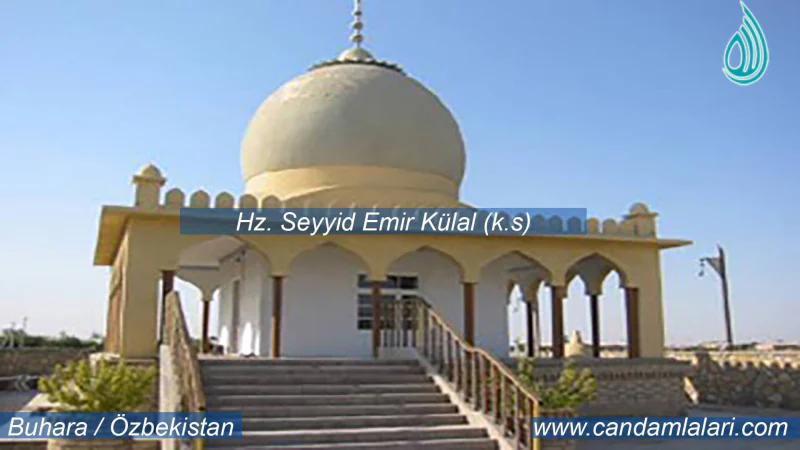
The foremost khalifa of Hazrat Hoca Mehmed Baba Semmâsî and, as we noted a moment ago, the one who carried on as a head of one of the branches of the Golden Silsila. The place where he was born and buried is the village of SUHARI. His craft was pottery. The name Külâl comes from there, meaning potter.
His mother relates:
—When I was carrying Emîr, whenever I ate doubtful food I would suffer stomach pains. When this showed itself several times, I understood that everything was happening because of the luminosity of the child I carried in my womb, and that he was an exceptional creature. After that I observed caution in every morsel I took into my mouth and awaited my child with hope.
As a young man, Seyyid Emîr Külâl was fond of wrestling. Many people would gather to watch him wrestle and follow the contest with curiosity. One day one of the spectators, considering himself on the side of the sharia, fell into this thought:
—How can a Sayyid descended from the Prophet wrestle and get caught up in a frivolous pastime that may be considered an innovation (bid'a)?
At that moment sleep overcame the one who held this thought. In his dream the man saw that the Day of Judgment was breaking out and that he himself was thrashing about in a mire. Then he looked, and Emîr Külâl was before him. He stretched out his sinewy arms and in one pull drew him out of the mire. The man woke up and saw that during the wrestling Seyyid Emir Külâl was looking at him.
Seyyid Emîr Külâl addressed him from afar:
—This is why we wrestle: to pull people like you out of the mire!
Another day, this time Hoca Mehmed Baba Semmâsî was at the wrestling ground. He had drawn aside and was watching the wrestlers. A few of the murids with him found this strange and wondered with amazement how the Hoca could pay attention to this worthless sight. The Hoca discovered these feelings passing through their hearts and gave this answer:
—On this field of combat there is a man through whose gaze and suhba many men will reach perfection. My gaze is upon him. I intend to catch him. And from afar he gazed deeply at Seyyid Emir Külâl. Emîr saw this gaze, and his eyes too froze on Hoca Semmâsî. After this gaze that pierced Emîr to the core, the Hoca withdrew with his murids. But Seyyid Emîr Külâl had given his heart to Mehmed Baba Semmâsî. He now had no thought, no will, no desire. He left wrestling, followed after the Hoca, and breathlessly knocking on his door, clung to his hem. Instruction in the tariqa and nisba in the seclusion room (khalwa). After that no one saw Seyyid Emîr Külâl in the bazaar, the market or the wrestling ground.
Seyyid Emîr Külâl remained 20 years in the training of Hoca Mehmed Baba, and throughout this time he did not fall short in serving his murshid with heart and soul. Two days a week he would run to his murshid's suhba, crossing on foot the five-league distance between Suhârî and Semmâs.
Hazrat Seyyid Emîr worked on the «Khwajagan» path in such a way that no one could perceive anything of his state, and behind a veil of complete secrecy he rose to the last steps of the ladder of perfection. The nisba of Hoca Bahaeddin Nakşibend, the great head of the branch who would give his name to the path, is to Hazrat Seyyid Emîr Külâl. The spiritual heirs of Seyyid Emîr Külâl, with Shah-i Nakşibend, the greatest of the great, at their head, are his four sons and four khalifas.
It is reported that Hazrat Emir Külâl (k.s) also entrusted the education of his four sons to the four khalifas he had trained. These were Burhaneddin, Hamza, Emirşah and Ömer. Of these, Shah-i Nakşibend, one of his khalifas, took on the education of Burhaneddin, Arif Dikkeranî that of Hamza, Mevlana Yadigar that of Emirşah, and Cemaleddin Dehistanî that of Ömer.
When Emir Külâl entrusted his son Burhaneddin to his khalifa Shah-i Nakşibend, he said: "When a master has trained his apprentice and brought him to perfection, he wishes to see his own work in his apprentice. In this way, if there are mistakes and shortcomings, he wants to correct them. For this reason I too entrust my son Burhaneddin to you. He has not received any education. Raise him as you wish, and let me gain peace of mind by seeing your work."
In accordance with the order received from his sheikh, Shah-i Nakşibend, who busied himself with his education, became the means of his advancing through the degrees in a short time. He trained Burhaneddin, who by his spiritual nature loved seclusion and solitude. He had him enter among the people and won his sheikh's appreciation. Seeing his son's spiritual progress, Emir Külâl would show favor both to his son and to his khalifa who had trained him, Hazrat Shah-i Nakşibend, saying "Burhaneddin is our proof (burhan)."
The tariqa, which developed through the sons and khalifas of Emir Külâl, continued with Shah-i Nakşibend.