Türkçe
 Español
 Français
 日本語
 हिन्दी
 العربية
 中文
Hazrat Seyyid Sibgatullah Arvasi (k.s)
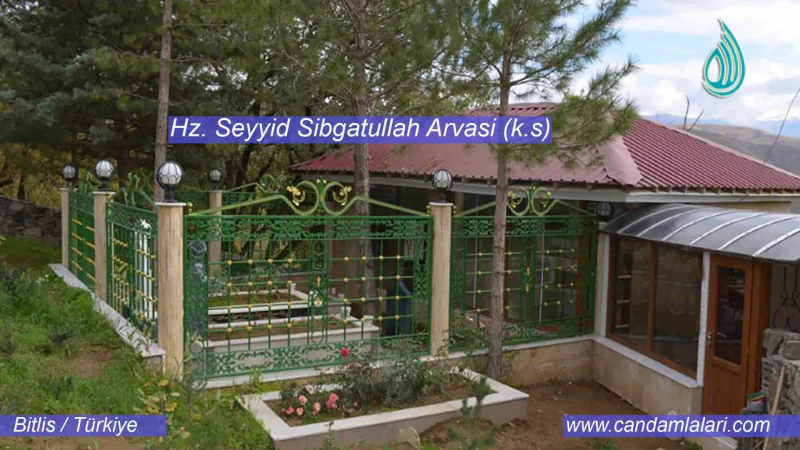
His family came originally from Baghdad. His father was Seyyid Lutfullah, whose own father was Seyyid Abdurrahman the Qutb. Hazrat Seyyid Sibgatullah Arvasi (k.s) attained the station of ghawthiyya (the rank of Ghawth) on this path. When they came here, they settled and lived in the Hizan district of Bitlis. His epithet was Ghawth-i Hizani.
The Ghawth occupied himself with the Islamic sciences until the year 1245 AH. In that year he met Sheikh Muhyiddin, who lived in Van, and took the tariqa from him. When his sheikh passed away, the Ghawth went to Sheikh Khalid of Cizre and served him. When he too passed away, he went to Sheikh Khalid's khalifa, Sheikh Salih-i Sipiki, and was authorized by him as a khalifa. Besides these, he also benefited from Sheikh Musa of Bitlis and Sheikh Abdulkadir. Meanwhile, according to the account of the Ghawth's son Sheikh Bahauddin and his khalifa Seydai Tagi, the Ghawth also met Khidr (peace be upon him) and benefited from him as well.
Thus a whole ten years passed in the company of great personages. Then Seyyid Taha sent word to the Ghawth: "Return home." This was the final return and the original goal. When Seyyid Taha passed away in 1268, he continued for a time in the service of Seyyid Taha's son, Seyyid Salih. After his passing as well, the Ghawth sat in the luminous circle that had been left to him on this path and served.
The son of Seydai Tagi, Hazrat (Muhammed Diyauddin), relates on the authority of the Ghawth's scribe: "In the villages where the forefathers of Ghawth-i Hizani lived there was no musical instrument of any kind, and no one who had an instrument on him could pass through those places. Most of them did not ride horses, did not shave their beards, and, in short, it was their custom not to wear fine clothes and not to smoke. They did not even allow smoking in their gatherings. The places where they sat were either the mosque, the madrasa or the tekke."
The Ghawth had eight sons:
Sheikh Celalüddin
Sheikh Bahauddin
Sultan Veled
Seyyid Bahri
Seyyid Burhaneddin
(These three passed away in childhood)
Sheikh Hamza
Seyyid Nur Muhammed
Sheikh Hasan.
The Ghawth was strongly devoted to the Sharia. So much so that making any concession in it was out of the question for him.
One day Seydai Tagi asked: "My Master, what is the aim of the tariqa?" The answer: "The aim of the tariqa is uprightness in the Sharia."
Seydai Tagi: "In that case, there is no one more devoted to the Sharia than so-and-so." The Ghawth said angrily: "He washes his face four times when he performs ablution."
One day his son Sheikh Bahauddin asked: "What shall we do if you are not with us?"
The Ghawth said: "Turn to the Sharia, and do what accords with the Sharia."
They asked: "Who is called a Sufi?"
The answer: "A Sufi is one who is like the peacock. Just as the peacock, when it sees the blackness of its feet, does not see the beauty of its body, so should the Sufi be in this frame of mind and this state. To do the opposite and look at one's own good state breeds pride and arrogance."
They asked: "How does a murid leave the tariqa?"
The answer: "A murid leaves the tariqa in two ways: one is persistence in major sins; the other is saying, 'I have left the tariqa.'"
He said: "Out of reverence for our Prophet (peace be upon him), the physical transformation (mesh-i sari) has been lifted from the Ummah of Muhammad (peace be upon him). The whole Ummah of the call (this expression covers all the jinn and humans who come into the world from the prophethood of our Prophet (peace be upon him) until the Day of Judgment) is included in this blessing."
As for the spiritual transformation (mesh-i ma'nevi): it continues. In the spiritual transformation, whichever evil trait is dominant in a person, he is turned, in his heart, into the animal known for that trait.
He said: "Without rabita there is no fana in the sheikh; without fana in the sheikh there is no fana in the Messenger. Without fana in the Messenger there is no fana in God; and without fana in God there is no arrival."
He said: "The murid should imitate his sheikh well; however, when one of the sheikh's states contradicts the Sharia, the murid follows the Sharia. He does not imitate the murshid, yet he does not deny the sheikh either." Then, speaking of the harm of a murid's imitating the murshid in all his states, he quoted these words of the Masters: "Whoever imitates one who has attained steadfastness (tamkin) becomes a heretic."
He said: "The folding of space (tayy-i makan) takes place between the evening prayer and the night prayer."
Above we spoke of the Ghawth's devotion to the Sharia; here is another event concerning him. It was reported that one of the sheikh-pretenders of the time prevented a rightful person from obtaining his right, and showed as evidence a law (or custom) made by people. The Ghawth, in great anger, said: "Look, look at the contradiction between these two things! He claims to be a sheikh, and yet he opposes the law of God (Exalted is He) and follows the rules set by people."
The Ghawth's miracles (karamat) are beyond counting. We shall mention only one event in which loyalty reached its ultimate point: "A woman's son, who had for a time been in the Ghawth's service, fell ill. When the illness grew very severe, the mother came to the Ghawth and asked for a prayer that her child might be healed by the leave of God (Exalted is He). The Ghawth said: 'There will be no healing.' When the woman pleaded again, the Ghawth said: 'It is of no use; the angel of death has come. He does not leave without taking a soul.' This word, too, had no effect on the woman, and she kept pleading. In the end she took the Ghawth to her son's side. And the Ghawth decided to give up his own soul in the child's place. Those present suddenly saw the color drain from the Ghawth's face. Just at that moment a murid of the Ghawth, a man of spiritual state, was coming back with firewood. Seeing the situation he understood; at once he put down the load from his back, sacrificed his soul for the soul of the Ghawth, and died there." After that, both the Ghawth and the child recovered.
At last, as the Quranic expression has it, كُلُّ نَفْسٍ ذَٓائِقَةُ الْمَوْتِۜ وَاِنَّمَا تُوَفَّوْنَ اُجُورَكُمْ يَوْمَ الْقِيٰمَةِۜ فَمَنْ زُحْزِحَ عَنِ النَّارِ وَاُدْخِلَ الْجَنَّةَ فَقَدْ فَازَۜ وَمَا الْحَيٰوةُ الدُّنْيَٓا اِلَّا مَتَاعُ الْغُرُورِEvery soul will taste death. And you will only receive your full reward on the Day of Judgment. Whoever is spared from the Fire and is admitted into Paradise will ˹indeed˺ triumph, whereas the life of this world is no more than the delusion of enjoyment. (Al-i-Imran 3:185, Diyanet) and وَلِكُلِّ اُمَّةٍ اَجَلٌۚ فَاِذَا جَٓاءَ اَجَلُهُمْ لَا يَسْتَأْخِرُونَ سَاعَةً وَلَا يَسْتَقْدِمُونَFor each community there is an appointed term. When their time arrives, they can neither delay it for a moment, nor could they advance it. (Al-Araf 7:34, Diyanet) came, and in the year 1287 AH he departed as a traveler to eternity. The cornerstone of this path after the Ghawth was the Great Qutb, Hazrat Abdurrahman Tagi (k.s).