Türkçe
 Español
 Français
 日本語
 हिन्दी
 العربية
 中文
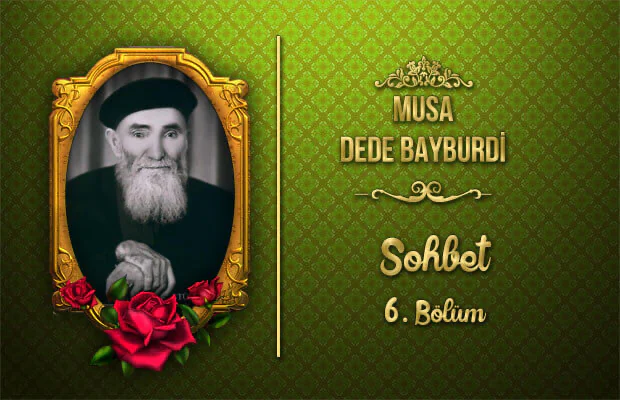
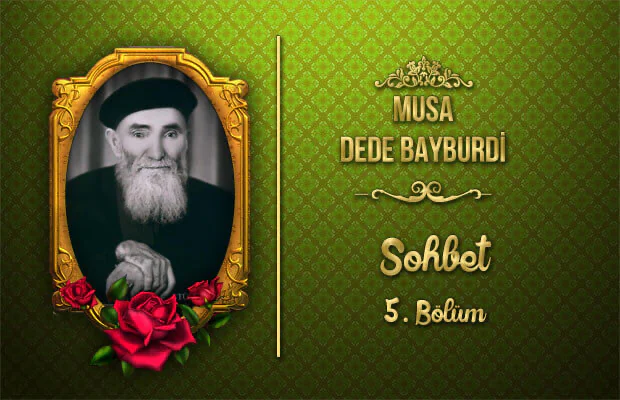
Dede Pasha Talk: Part 2
Although the date in his civil register is 1300, he was born in Bayburt in 1294 or 1295 (1878 or 1879 CE). He was born of the blessed marriage of Hacı Hüseyin Efendi, of a line known in Bayburt and in the village of Aşağı Lori (today Yazıbaşı) as the İzni Ağalar, hospitable, a friend to the poor and the weak, a "noble house" as the established phrase has it, and Gülhanım, who belonged to a family called the Seyyids (*).
After finishing primary and middle school, at the age of 18-19 he attached himself to Hazrat Beşir Efendi, and for the whole of his life, leaving every pleasure and every occupation, he turned his face and heart from every aim other than service to his sheikh and his tariqa; summer and winter, night and day, he traveled with his sheikh spreading the message. Though he owned wide lands and properties, he did not incline toward worldly goods and pomp, and sacrificed his existing wealth, his perfect health, his voice, known to be very beautiful, and his other bodily abilities exclusively to the command and service of his rabita..
Melting all his being and powers, material, physical and in deed, in worship, inner peace and supreme effort, and hiding them under a cloak of unmatched humility and unattainable self-effacement, he devoted his life to the service of the lodge for nearly 80 years, a golden age, and became a model of unique services and sacrifices peculiar to himself.
If others saw and heard of the service he rendered, it was told; if not, since his rank required it, he told hardly anyone, and most of his efforts remained unknown.. It is not possible to tell them by giving examples and explanations.
The essence of the matter can be approached only by this comparison: a sincerity that would illumine the universe, a love that would warm all the worlds, and a submission that would drown all creatures in tenderness and love! He reached such a field of nothingness that he attained the perfection of a self-effacement equal to the acceptable gift that our Prophet presented to God on the Ascension (Mi'raj). This is the last word, and the end of the word.
The end of self-effacement is the end of sainthood.
Though knowledge, saintly wonders (karamat), spiritual glance, grace and aspiration, and a superior and perfect connection were complete in his person, hinting and pointing out that these were instruments, he said:
– The aim is God.
In his state, deed and action he had become the very perfume of the Sunnah and the Shariah; his loyalty made him resemble Hazrat Siddiq in character as well as in form, and every state and behavior of his made him a match for our master, Siddiq al-Akbar.
If this grandfather and grandson, whose aims were the victory of Islam and the happiness and safety of Muslims, stood side by side, it would be hard to tell them apart. If one of the Companions rose and looked from behind, and suddenly saw his tall, slightly stooping body of perhaps 30-35 kilos, he would without doubt not be able to keep from calling out:
-O Abu Bakr.. The first and last two links who regard no deed as worthy except stepping in the footprints of their Prophet..
(*) In a suhba in Bor, to a young engineer who praised his sheikh, a Seyyid, he said that both his father and mother were of the Seyyids by separate lineages, hinting at the acceptability of attaining the rank of Seyyid spiritually. Hazrat Abdurrahim Reyhan also noted that he was a Husayni on both his father's and mother's side.
A few quatrains he recited very often are as follows:
"Today I became intimate with a beloved
I implored greatly to see your state
Paradise is ready for those who see your face
I burned in your fire, ever anew
With every kind of fire you flourish
Night and day you roast your very heart
From the hands of the ignorant you do not drink wine
From the hand of the Beloved, ever anew
Such a beloved you are that everything suits you
The nightingales who see you never cease their warbling
You are a very great murshid, everyone clings to you
To your lofty hem, ever anew"