Türkçe
 Español
 Français
 日本語
 हिन्दी
 العربية
 中文
37. Hazrat Musa Dede Bayburdi (Dede Pasha) (k.s)
He came from the village of Yazıbaşı in Bayburt, from a family known as the İznı Ağalar dynasty.
On both his father's and his mother's side he descended from the Sayyids, of Hanafi and Turkish lineage.
As was the custom of those times, he was entered in the population register five or six years late, and having lost his father at an early age, he grew up under the care of his maternal uncle.
After completing his education in the outward sciences, at the age of nineteen or twenty he attached himself to Hazrat Beşir al-Erzincani, to whom Hazrat Sami al-Erzincani, the khalifa of Hazrat Abdurrahman Tagi, had given authorization with the words, "Two lions do not fit on one seat (post); either I leave this place or you go somewhere else," and who is mentioned among the titles as (Kasım ül erzak Mürşidi sakaleyn). For more than seventy-five years he served the lodge with his body, his deeds and his wealth.
Each year, within three months, he would bring his very wide and fertile land under harvest, leave his family as much as they needed to live on, carry the rest in a saddlebag to the lodge in Erzincan and leave it at the lodge's disposal, and he continued to serve until the next harvest season; he remained faithful to this habit until his Sheikh's passing. Later he gave up his property altogether. During the Russian occupation he migrated to Zile with a single quilt, and there a servant (a helper from the jinn) of those devoted to Hazrat Beşir Efendi took care of his affairs, and every day he found a gold coin under his pillow.... (It was an unforgettable joy for us to hear him speak, in extraordinary rapture and with the utmost reverence, of these favors of his sheikh, the Qutb of the Qutbs of his time, and of his other incomparable karamat.)
Although his blessed life, always passed in ordeals veiled from the outward eye and too heavy for anyone to bear, was in every breath a series of supreme patience, dignity and karamat, we will not speak of them here; we leave them to their time and to those who are worthy of them.
We will content ourselves with noting only, in broad outline, some of his talks, his determinations and his counsels.
He is the pride of the murshids, the great Ghawth, Hazrat Sani
He found baqa within baqa, none like him has come again
Following Hazrat Beşir Efendi, whose glory is briefly expressed by this couplet in the Small Noble Chain and who was given the title SANI (the second of the Erzincanis; this is the way of remembering, in the Chain, a person's sainthood, glory and rank), he was less a khalifa to the brethren than a servant to them, and this manner, being his own station and state, returned with him to the abode of eternity.
So much so that in his talks he would say:
"You are our elders, and we are counted as your slaves. A slave gains honor through serving his master. Command, I am ready for your command."
"The saying (Hadim ün nas) (hadith) is our guide. Let me see," he would say.
"Sufism is knowing God, finding God... One must seek God in the way God is found."
"How is an extraordinarily valuable and incomparable treasure bought?... A fortune must be procured, one easily convertible into cash in the form of gold, jewels and antiques, such that this fortune could stand in the place of God... But the thing to be bought is the Necessary Being who created and owns every matter and meaning... To buy Him with wealth or matter is impossible. The price of God is God. What can be His price is the (beautiful dhikr) that can be accepted by Him. If this dhikr finally becomes sovereign and luminous, then this dhikr becomes the price of God. With God you buy God."
The dhikr that is the price of God is obtained only through dhikr performed with authorization. In one narration, dhikr (without authorization) is the mere clatter of the tongue (the rattling of the tongue).
"The perfect murshid is the ladder of the murid's ascension... The murshid cleanses and purifies, with the light of his sainthood, the dhikr the murid performs with devotion. After bringing it to a state fit to be handed over to its Owner, he presents it to our Prophet: 'O Messenger of God, this is the effort of such-and-such a member of your Ummah that I present; be so kind as to accept it.' His acceptance is arrival. The murid reaches his station, and thus a fortune is accumulated that will buy God."
"The murid is a trust placed with the murshid. Let us think what a trust means. They are the officials who have been appointed to deliver this trust to its Owner, who know all the knowledge of it, and who are authorized and able to do what it requires."
"The Sharia encompasses the outward and the inward. Any work without the Sharia is void. There is no murshid without the Sharia. A murshid without the Sharia is a heretic."
Hazrat Yunus says:
The Sharia and the tariqa are the road for the one who would arrive
The fruit of haqiqa lies deep within them
Then he would summarize what is needed for a murid who surrenders, like a corpse in the hands of the washer of the dead, to a murshid who represents the Sharia within and without and who acts with this Sharia and knowledge:
LOVE
SINCERITY
ADAB
SURRENDER
The murid who has acquired these four qualities sufficiently,
THE WAY OF THE SHARIA
THE WAY OF SUHBA
THE WAY OF KHATM (-i Khwajagan)
THE WAY OF RABITA
and who follows our path, which consists of these, and gains the pleasure of the pirs, glad tidings to that murid, for he has attained the grace that will bring him to arrival. He has reached the treasure that will buy God...... In this way he would briefly summarize states that could not be contained in volumes, and explain that suhba and Khatm bring about rabita, and that the Companions were perfected through suhba and attained that unreachable honor.
Most of his talks flowed from the unheard, unwritten subtleties and depths of these subjects:
HUMILITY
ANNIHILATION (nothingness)
THE MURSHID and
THE SPIRIT
Whoever left the suhba certainly felt relief and cleanliness and lightness. Each time love was renewed and longing increased. He was never frightening; he was always one who made people love and always urged them on to effort.
He said that the person whose character has become like earth is the accepted one, and that this character is obtained through humility and annihilation.
"If the state within people is perfected with the honor of humanity, this blessed person has become a (JUST SULTAN)."
"If the qualities of character, humility, respect and annihilation are perfected in one body and bring about love, sincerity, adab and surrender, then perfection has been completed in the spirit. This is the happiness and safety that are sought."
He would recite the line BECOME EARTH, EARTH, THAT A ROSE MAY GROW IN YOU.... and would repeat in every suhba the line HUMILITY OPENS THE DOOR OF THE ALL-OPENER.....
He was an incomparable monument of humility toward children as well as toward his nearest ones, and when he recommended "being like earth" it was always he himself who came to mind as the example......
"Whoever has not fallen to the feet has not risen to the head, O wine."
"The soul and essence of worship is the remembrance of God, and the essence of the remembrance of God is annihilation. In the person of annihilation the nafs has become exquisite (nefis), has grown beautiful...." he would say.
"A murid is raised by his deeds and his service, but he receives his blessing through annihilation.... (Mercy, O Lord!) There is no gnosis like a person's knowing his own shortcoming. Every deed is completed with 'Mercy, O Lord!' Every action is accepted with the cry 'Mercy, O Lord, You know!'"
Therefore the people of speech have said:
THE WORD "AMAN" IS EQUAL TO YOUR NOBLE NAME
THEREFORE THE WORK OF THE LOVERS IS "AMAN, O MESSENGER OF GOD".
The couplet of Kuddusi Baba
I HAVE UNDERSTOOD MY WORK WILL NOT BE DONE
EXCEPT BY PLEADING TO YOU
was like a wird whose repetition we always heard.
THE NEW SPRING HAS COME, OUR GARDEN HAS SPROUTED FRESH
LIKE THE NIGHTINGALE, EVENING AND DAWN, OUR LAMENT HAS GROWN
Just as every blessing sprouts and grows in spring, he explained that the murshid, who is like spring, would make the blessings of spirituality sprout and grow for the murid who strives with love.
"The perfect murshid is the door of God"
"One who has a murshid has no difficulty"
"The perfect murshid smells of God, gives the taste and savor of God..."
He often repeated Salih Baba's line:
Is there in the world a soul more delicious than the perfect human?..
and he would say:
"The murshid is the life and death of the murid.."
"In the perfect murshid God has become the intimate companion..." he would say.
Reciting the line Wherever I look, that fair beauty appears to my eye, he would give voice to Salih Baba.
"One who has a murshid has no sorrow."
"Glad tidings to whoever becomes a murid."
"The murid's acceptance is arrival."
He would say this, and also that the deed of one murshid suffices for the whole world, and that if a murshid were given command he could set the entire universe right.
He frequently repeated these couplets of Hazrat Niyazi:
Do not give your heart to every murshid, lest he bring your road to ruin
For one who has a perfect murshid, the road is said to be very easy....
"In this age only those who follow the Sharia and the noble Sunna completely have no need of a murshid. But think: is there a man who can do what is said? Such a one is himself a perfect one who has become a murshid."
He would recite the lines Capacity is a gift of the Truth; what can the perfect murshid do and
would pray, "May God help the one who has no sheikh.."
"How fortunate we are that we were born into the world as Muslims, born of Muslim parents, and however much we give thanks it is little, for we have a murshid," he would say.
He would explain the states of the Ruh-i Ravani, the Ruh-i Sultani and the Ruh-i Nurani, and with incomparable simplicity he expressed the subtleties and secrets of awakening and alerting the spirit in the spiritual tariqas (the hidden tariqas, the tariqas that come from Hazrat Siddiq).
"The art is to excel one's peers in every respect."
As the people of perfection express in this line, he would speak of it thus:
"Faith means ease; having believed in this world, one must be at ease both in this world and in the hereafter. The one who surrenders to those worthy of it and, being accepted, reaches purity of heart finds true ease in both worlds......"
He would recite these couplets of Salih Baba:
O my nafs, be a friend to me, do not fall into agitation
All this worry you contrive is corrupt
and, speaking of caressing and calming the nafs and giving the mount of the body its due, and of following the Sharia and the Sunna as far as one's strength allows, he would say:
"Love your sheikh, follow your sheikh, regard him as great as much as you can (according to your capacity, according to your understanding), continue the service prescribed to you, do not forget your rabita; hold fast with the resolve of the verse يَٓا اَيُّهَا الَّذ۪ينَ اٰمَنُوا اصْبِرُوا وَصَابِرُوا وَرَابِطُوا وَاتَّقُوا اللّٰهَ لَعَلَّكُمْ تُفْلِحُونَO believers! Patiently endure, persevere, stand on guard, and be mindful of Allah, so you may be successful. (Al-i-Imran 3:200, Diyanet) and continue."
Act upon these couplets of Salih Baba:
Khidr passed through many darknesses for the water of life
Your wayfarers, my lord, drink of your clear water
He would say that the couplet
The aim of love is only to become Muhammad
The aim of Muhammad, my lord, is to reach union..
sums up the whole of Sufism,
and that one must act by the line
The aim of happiness, my lord, is the removal of wretchedness..
that the line
The aim of the sheikhs, my lord, is to be a perfect educator..
is a door to God and a means to Him,
and that the line
Know that the aim of dhikr is to arrive at every desire..
should be counted, in accordance with the verse فَاذْكُرُون۪ٓي اَذْكُرْكُمْ وَاشْكُرُوا ل۪ي وَلَا تَكْفُرُونِ۟remember Me; I will remember you. And thank Me, and never be ungrateful. (Al-Baqarah 2:152, Diyanet), as the greatest glad tidings, and that the couplets
Be of the people of the path, Salih, entrust your affairs to the sheikh
To be a murid is to be the one who asks about all his difficulties....
were the result of a favor and a manifestation.
Know that the secret of 'It is the One who makes speak who speaks' is the capital of the people of love, and that the words that come from their mouths are not metaphor but the word of reality. Only those who possess the essence of the state of LOVE, which is the fruit of the tariqa, have expressed in their poems what they saw in this state. What they saw of this favor they declared and proclaimed, each in different secrets. He would seal the subject by explaining that these pearls must be taken and kept in the safest place, with the words of Kuddusi Baba:
Take the word from Kuddusi
It is the Truth who makes it speak...
Thus, inspired by the Pasha's talks, which, always on the topic at hand, were adorned with the poems of the people of the state, this compilation was undertaken, and by his spiritual help it was granted to be completed, with its faults being ours.
With these examples, for which we also drew on the many talks that were recorded on tape, it is as though we had offered a single drop of water to describe the sea..
"Do not look for anyone's fault, brother...."
"The world is good, it is I who am bad....."
Let these maxims be your practice.
"Always praise your sheikh to the murids of other sheikhs you meet; for however much you praise him, you cannot describe the perfect murshid as he deserves...."
"Do not be among those who say (Is there a flower better than me?).... God, that true Sultan, has many servants (saints). It may be that you incur the wrath of the Owner. Those who deny the saints, even if they are worshippers and ascetics, will not see the face of paradise, the aim of their service. For praise of the engraving returns to the engraver. Disrespect to the Sultan's official is disrespect to the Sultan. Just as there are various services in a state, there will be various officials raised in various schools and temperaments to perform these services. The punishment for the heedlessness of hatred, slander and disrespect toward one of them is heavy......"
How well Kuddusi Baba has said:
Do not disparage others, the one who disparages is disparaged
The one who loves is loved, the one who strikes is struck
"At every moment, in this matchless realm of the Lord, there are officials and saints as many as the prophets who have come and gone. The words 'We have no one worthy but us, we have no officials but us' are words of heedlessness. They drag their owner, the one who says them, to ruin. Examples of this are many in every age."
"Do not quarrel with murids who have fallen into fanaticism at the hands of outward khalifas and who show opposition and lack of love..... May God have mercy on them and bring them to the shore of safety......"
Our Prophet acted upon all the deeds that the Imams of Ahl al-Sunna have prescribed and prayed with all the prayers. Each branch has held fast to a bouquet of Sunnas that will bring it to its goal. Do not condemn one who performs a wird that is Sunna, and do not utter words of heedlessness such as "our wird is better"... a separate path of truth brings each temperament to its goal.
Let us work not so that we may multiply, not so that we may accomplish, but for the sake of God's pleasure.
A person errs in the claim "I know." In the prayer "You know" he becomes elevated.
In this age every penny given for Islam, the smallest service done, every intention of love and unity is blessed with the secret of "be with God." It is like helping in the Messenger of God's preaching.
In matters that have become custom among Muslims out of necessity, and about which there is no explicit verse or noble hadith, it is only the practicing scholars who show the way that makes people love rather than hate, that leads to paradise rather than fills hell, and that makes things easy; and these are the murshids.
The chosen among the murshids are not of the drop temperament but of the ocean temperament.
Having found a perfect murshid, surrender your very self to that sheikh
Become a slave at his door, leave this fame and glory behind
It was observed that many renowned men of knowledge and authors who came to the suhba were silenced (stopped short) on topics they themselves had raised, and that these men of knowledge always recognized their helplessness and, by confessing it, confirmed his perfection. In such talks, when he untied a knotted subject in a few words, he would always attribute the knowledge and perfection to his murshid, saying:
"(Judging from what comes to my humble mind from one of the suhbas of the Hazrat Pir)"
and he would cloak himself in humility, saying:
"We are not people of knowledge or gnosis; the reflection of your perfection made the Hazrat Pir speak...."
"One scholar is equal to a whole world.."
"Knowledge is a point.." he would say; this point is the disclosure of a gnosis that, when necessary, will turn the opponent into an ally and the adversary into a friend; swallowing volumes is not knowledge...
He would repeat the couplet of Hazrat Yunus:
Knowledge, knowledge means to know
Knowledge means to know yourself
"The scholars are the sun and light of the earth; darkness departs by them and light spreads by them.." he would say.
"The Naqshbandi tariqa is founded on a military system; its color is white, and in white every color exists. Other tariqas resemble the various organizations of civil bodies. Each tariqa, indeed each branch, has its own method and rules. Every murid must follow the method of the place he is attached to. Moreover, (el-Emrü fevkalade) the command is above everything, (el emrü fevkal edep) the command is above even adab; this is the rule."
"For this reason some of the murshids speak of knowledge, some of dreams, some of unveiling and karamat, and some of the states of the murshids..."
"Some dreams are a state; there is no need to interpret them..."
"Other dreams are dreams of truth, and a few people of truth who can interpret them may be found (this was said in this age, in the years 1968-1969)......"
"The dream is the murid's mirror and the sign of his degree."
"The dream belongs to the one who sees it...."
"If it were left to the Muslims of today it would not happen.. but by God's permission it will happen..."
"In spite of all this, those who live Islam and want to make it live are in Türkiye...."
"The great majority of the saints of God are also in Türkiye...."
"Those who stand against their nafs for the sake of Islam and unite with their brother, and who ally and unite for this purpose, are the successful (those who hold fast to the right rope and are saved)."
"In the beginning there was an age of piety, later the age of fatwa began, and now it is the age of politics; let our politics be the politics of Islam....."
"Attaining sainthood is a very difficult task; in this age it is almost an arduous matter to bear and endure this difficulty....."
"May God grant it, and may you reach it by way of the ease that appears once in a thousand..."
"The saints are heirs to one another."
"The murshids are brothers..."
"Women are both light (nur) and fire (nar)..."
"In this age, women who perform the obligations and also preserve their love for their murshid will be neighbors of our lady Fatimah al-Zahra...."
"Children do not listen to a sultan... Love them as the grandchildren of our murshid."
"Even the murid's cat is above the rest of creation."
"When starting a task, weigh it on the scales of the Sharia; if it is suitable, do it, and if you see otherwise, give it up."
The metaphorical is the bridge to the real; love is for God. Love passes from the metaphorical to the real. Saying "Majnun, Layla," Majnun found the Lord....
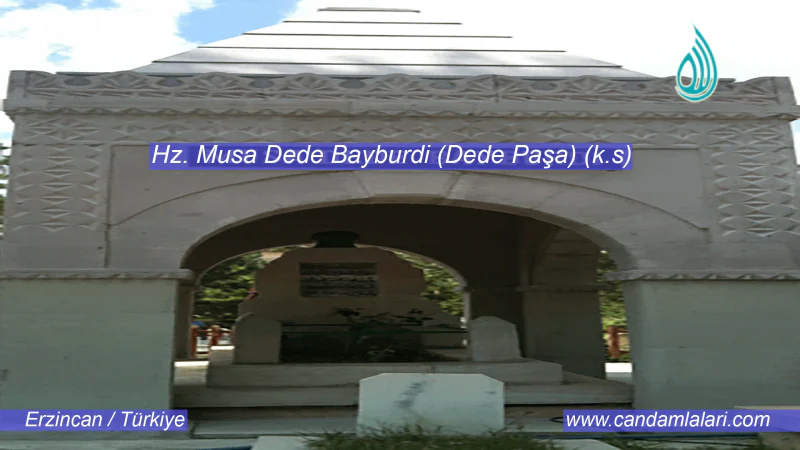
On 4 September 1973 he passed to the abode of eternity and was laid to rest at the entrance of the Terzibaba cemetery in Erzincan, in a grave cloaked in humility, as in his life. The quatrain inscribed on the tombstone is as follows:
Dede Pasha is his pen name
The chosen one of all the saints
He guided many people
He was the Ghawth of the age
"Pray, brother, prayer reaches its destination..."
"Our prayer is his own counsels."
"O Lord, favor us with that which accords with Your divine pleasure."
"O Lord, do not cut our hands from the hem of our sheikh.."
"O Lord, do not separate our minds from Your grace and Your granting of success.."
"O Lord, be generous by letting us digest Your blessing.."
With a judgment versified by Virani, which we always heard repeated, we thus bind a few bouquets of the sparkles reflected from the occasion of our seeing the people of truth and of the arrangement of this book.....
COME, BE A SUPPLICANT AT THE EXALTED DOOR
BE A BELIEVER IN THE HOUSE OF MUSTAFA
The judgments and meanings belong, in their perfection, exactly to their owner.......
If there is any error or fault, it comes from our style.. it is ours... A servant is not without fault; we ask for forgiveness...
We repeat the judgment of the great ones.
Take what you like and do not meddle with what you do not like....
May God of exalted glory, from Adam (peace be upon him) onward, bring his noble forefathers to His forgiveness, and dye his descendants and followers until the Day of Resurrection with the attributes of the Guide and the Beautiful, and bring them to His beauty......
MAY GOD SANCTIFY HIS MIGHTY SECRET.
Category: The Noble Chain