Türkçe
 Español
 Français
 日本語
 हिन्दी
 العربية
 中文
34. Sheikh Abdurrahman Tagi (k.s)
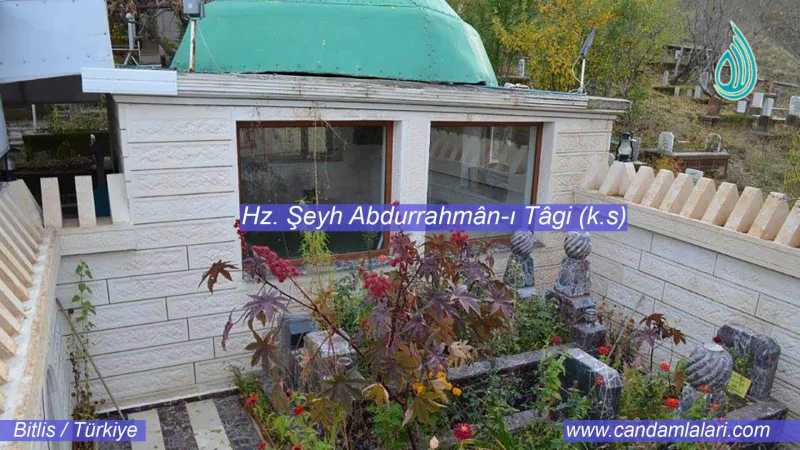
One of the great saints of the nineteenth century. His name was Abdurrahman, and he is known by the nisbas Tagi, Tahi and Nurshini. He became famous by the titles Ustad-i A'zam (the Greatest Master) and Seyda. His father was Molla Mahmud Efendi, and his mother was Meyasin Hanim, daughter of Seyyid Molla Muhammed Efendi. He was born in 1831 (H. 1247) in Shirvan. He died in 1886 (H. 1304) in the district of Güroymak (Nurşîn), in the province of Bitlis. His tomb is in Nurşîn.
The house of Abdurrahman Tagi, who came from a noble and pure family, became known among the people as the Sufi house. For his father Molla Mahmud Efendi was a righteous man, possessed of perfection and maturity, who acted upon his knowledge and was scrupulous in following the exalted Sunna of our Prophet (peace be upon him). At first he had entered the Qadiri path. Later he attached himself to the Naqshbandi path as well. His mother Meyasin Hanim, a sayyida by origin descended from our master Hazrat Husayn, was also a righteous woman. Molla Mahmud Efendi, his father, had no brothers. He had a sister who belonged to the Qadiri path and was famous for her miracles.
Abdurrahman Tagi drew attention at an early age by his manner and conduct, and his mother and father took great care over him, saying of him, "This child that God (Exalted is He) has graced us with is not like other children. We must take care that he is raised more in the spiritual than in the material respect!" His grandfather Molla Muhammed's greatest wish too was that he be raised in knowledge and spirituality. Indeed his grandfather would put his hand on the child's shoulder and say, "The knowledge of our family passes by inheritance from grandfather to son. Yet none of my sons sought the knowledge I have. You are the one who will be the heir, the inheritor, of my knowledge."
Abdurrahman Tagi, who with the encouragement and support of his family began to seek knowledge at a young age, learned to read the noble Quran. Because of his mother's upbringing and the purity of his nature, he stood out among his peers. He did not busy himself with play and idle things, and always spent his time in useful pursuits and in learning. Concerning his childhood, Abdurrahman Tagi used to say:
"Because of my mother's beautiful upbringing, my connection with the world of spirits was never cut. I was never heedless of God (Exalted is He). Among the children I always saw myself as at fault."
When Abdurrahman Tagi turned ten, his mother died. After his mother's death, his father attached importance to his upbringing and schooling. He read, among the Shafi'i books of jurisprudence, Imam Rafi'i's work called Muharrer. He learned the science of Arabic grammar and studied with his father up to the book Hada'iq al-Daqa'iq. Then he went to Molla Abdussamed, one of the famous scholars of his country. When Molla Abdussamed died, he went to the great scholar Molla Ziyaeddin Arvasi and studied under him. He read with him up to Molla Jami. He won Molla Ziyaeddin's affection and never parted from him. Molla Ziyaeddin Arvasi turned to him with love and closeness. Once he said, "There is nothing equal to love," explained the characteristics of love, and described the superiority of love. Meanwhile he studied the religious sciences such as jurisprudence, exegesis and hadith from other scholars of the area. He became a possessor of high knowledge and rank in these sciences. He received authorizations, diplomas, from the teachers he studied with. Then he began to teach and train students in the madrasa in Ispahart that had been endowed to his father. Both in the madrasas where he learned knowledge and in those where he taught it, the people to whom he felt closest were those who had not given their hearts to the world. For this reason he himself was a person who did not incline toward the world and who took attaining the pleasure of God Most High (Exalted is He), as his true aim. While teaching in the madrasa, he would sometimes take his students to the banks of flowing waters, to flowering gardens and to hills with beautiful views, and teach there. During his lessons he would describe the natural phenomena that show the existence and oneness of God Most High (Exalted is He). Sometimes, when he encountered problems in the book he was teaching that were hard to solve, he would close the book, ask his students to recite a qasida about divine love, and then ask God Most High (Exalted is He) to make known to him the answers to these difficulties.
His real aim was to gain the pleasure of the Almighty. He explained this matter to one of those who loved him:
"Although I had no perfect murshid to show me the way, no guiding leader, no tariqa I was attached to, no path, God (Exalted is He) was protecting me from sins. One night I intended to go to a bad place. On the way my foot slipped in a muddy spot and I fell to the ground. I returned home and began to wash my clothes. I could only finish my cleaning by morning."
Abdurrahman Tagi, a man of contentment and a satisfied heart, did not give his heart to worldly goods and ranks. For this reason, although the directorship, the judgeship and the teaching post of the district where he lived were offered to him, he paid them no attention. For he was seeking a spiritual guide who would raise him in Sufism. He applied to Hajji Emin Shirvani, entered the Rifa'i tariqa and became his student. After that he turned to daily dhikr and supererogatory worship. But after a time, when Hajji Emin Shirvani was rejected by Sheikh Abdurrahman Talebani, he went and became a student of Sheikh Hamza Telvi. After a time he became a student of Sheikh Abdulbari Charchahi, a member of the Qadiri tariqa. His sheikh gave him duties such as fasting, eating little, sleeping little and visiting cemeteries frequently. Some nights he stayed an hour or two in the graveyard. Indeed in the cemetery of the village of Tahi there was an open grave. Some nights he would enter this grave and spend the night there until morning. Meanwhile he grew cold toward people and the pleasures of the world and withdrew from them. His teacher ordered him to say "La ilaha illallah" one hundred seventy thousand times in a day and a night, and said, "Consider your heart a stone of fire and the words La ilaha illallah a piece of fiery iron. Strike your heart with this exalted sentence, in love and ecstasy (being seized by the Truth). Thus, as seen in stones beneath the blows of iron, may sparks come out of your heart." Abdurrahman Tagi, following this advice, attained spiritual states.
At that time the great saint Hazrat Seyyid Sıbgatullah Arvasi was living in Külat and working so that people might attain happiness in this world and the hereafter. One of his students, Süleyman Erbusi, went back and forth to the village of Külat from time to time. Once when he had returned from the village of Külat, Abdurrahman Tagi asked mockingly, "What are the Sufis in Külat like? What are they doing?" Süleyman Erbusi answered Abdurrahman Tagi, "If you crossed such-and-such a stream you would not say that." These words of Süleyman Erbusi affected Abdurrahman Tagi greatly. At that time Abdurrahman Tagi, who had been appointed khalifa by his sheikh and had several students, said to one of his students, "By God, the words of so-and-so have affected me greatly. I am going to Külat." All the entreaties of his murids could not turn him from his decision. That whole night he could not sleep for the longing and desire within him. As soon as the dawn hour came, he went to the house of Süleyman Erbusi, the student of Hazrat Seyyid Sıbgatullah Arvasi. Waking him, he said, "Will you come with me to Külat?" When Süleyman Erbusi said, "I will come," the two set out together at dawn. They came to the place Süleyman Erbusi had mentioned with the words "If you crossed such-and-such a stream you would not say that." But as Abdurrahman Tagi crossed that stream he felt a strange state in his heart. At last they reached Külat. He felt himself in one of the gardens of Paradise. Hazrat Seyyid Sıbgatullah Arvasi accepted him as a student, took him under his protection and influence, and raised him within a short time. Abdurrahman Tagi, rising on the path of Sufism, attained states that tongues cannot express and that only those worthy of them understand. Then he understood that the states he had earlier obtained and reached were nothing other than heedlessness and a vain waste of life.
Abdurrahman Tagi, who reached the high degree of sainthood within a short time, went one morning into his teacher's presence and described his state, saying, "My master! I hear the dhikr of the Name of Majesty (the name of God Most High (Exalted is He)) in everything. I even heard that dhikr from the dog walking in front of me." Seeing that his student had reached maturity, Seyyid Sıbgatullah Arvasi ordered him to serve as judge in the district of Ispahart.
At his teacher's command he carried out the duty of judge of Ispahart for two years. During this duty he served people with his good character and tolerance. From time to time he went to his teacher and was honored with his suhba and tried to ease his longing.
After two years he left the judgeship, withdrew entirely from the world, and returned to the service and suhbas of Hazrat Sıbgatullah Arvasi. Many nights he did not sleep, but sat on a stone facing the window of his teacher's room and waited until morning on that stone, summer and winter, snow or rain. After nine years in his sheikh's suhba and service, he reached the most mature and highest degree of sainthood. Hazrat Sıbgatullah Arvasi gave him authorization and charged him with irshad, that is, with explaining the commands and prohibitions of Islam.
Before beginning to train people in Sufism, he sold all his land and spent the proceeds for the pleasure of God Most High (Exalted is He). Of this he said, "While asking people to abandon the world, I wanted to learn the state of my own nafs toward worldly goods. By the spiritual aid of the Ghawth, that is, of Hazrat Sıbgatullah Arvasi, I saw that my trust in God (Exalted is He) was complete."
After being charged with guidance, he visited the tomb of Sheikh Muhammed, grandfather of his student Sheikh Fethullah-i Verkanisi, in the village of Verkanis. During this visit it was indicated to him that he should be called "Seyda." After this he became famous by the name Seyda. Wherever he went he worked so that people might attain happiness in this world and the hereafter, by explaining to them the commands and prohibitions of the religion of Islam.
At one point he went to Mecca the Noble to perform the pilgrimage. After performing this duty he was honored to visit the noble tomb of our beloved Prophet. In Medina the Radiant he met Sheikh Muhammed Mazhar Efendi, one of the grandsons of Hazrat Imam Rabbani, and was in his suhba. On returning from the pilgrimage, at his teacher's command, he settled in the district of Nurşîn, in the province of Bitlis, and continued the duty of guidance.
After his teacher's death he continued to explain to people the commands and prohibitions of the religion of God Most High (Exalted is He). With his heart-winning talks he strove so that people might attain happiness in this world and the hereafter.
In response to a question his students asked about dhikr, he said:
"These great ones of the Khalidi path do not perform dhikr aloud; the student should sit facing the qibla with adab. He should perform dhikr with a present heart. For during dhikr the presence of the heart is absolutely necessary. The aim of dhikr is tawhid, remembering and voicing the oneness of God Most High (Exalted is He). One should not even worry whether one has counted one bead too few or too many. For the aim of reciting the glorifications is the state. What does it matter if there is one more or one less?"
Hazrat Abdurrahman Tagi said in one of his talks open to the public:
"Once, through unveiling, I saw an insect in my hand. I looked and it was a scorpion. I threw it to the ground at once. When I looked after it fell to the ground, an animal resembling a bear was playing with it. I looked carefully again, and that animal was a pig."
One of his students said to him,
"My master, what does this animal point to?" and he answered:
"That pig is a human being who was put into the form of a pig. He is a person who was at first bound to his teacher with sincerity, and later denied his greatness. All the saints have agreed that such people go to the hereafter without faith. I think that in the time of Sıbgatullah-i Arvasi there were some among the deniers, that is, those who denied him, who went without faith. Deniers deny either from ignorance or because of knowledge. Denial from ignorance is less harmful than denial because of knowledge. The most harmful denial is that out of envy of a saintly person."
One of his students asked what that scorpion was.
"It is the same person as the pig. Because he shows his enmity openly, he appeared in that form," he said.
To a question asked about the state of a mature murshid, a guiding leader, he answered thus:
"The perfect murshid treats every kind of illness of his student, except the illnesses caused by lack of sincerity and love and by innovations. For these illnesses change the student's course, his path. The student departs from the Sirat al-mustaqim, that is, the straight path. But their treatment is possible. One who commits adultery knows that adultery is a great sin and then feels remorse. In the case of lack of sincerity and love and committing innovation, they do not know they have sinned and do not feel remorse. So the essence of the cure depends on feeling remorse, seeing the fault of one's nafs, and pleading with and taking refuge in one's teacher. The sign of those who lose human form and enter animal form is that they do not benefit from sermons and counsels and continue the sins they commit. Because this poor one (that is, Abdurrahman Tagi) knows that denying a saint endangers faith, I have not denied anyone who said he was a saint. I take a stand only against those who deny my teacher. I have not been a denier, but I do stand against them.
The student who says "why" and "for what reason" to the teacher who teaches him his religion will not prosper. The gates of grace close upon the student who objects to his teacher. A student cannot inspect his teacher and object to him.
A sincere student receives all the actions of his teacher with surrender. It is related in some books: In the time of Hazrat Abdulkhaliq Ghujdawani there was an abdal, a great saint, who had command over rain-laden clouds. This person prayed to God Most High (Exalted is He), and asked Him to make the clouds rain on the lands that greatly needed it. But it did not rain. The clouds drove the rain to a rugged land and much rain fell there. Upon this event the person who was an abdal spoke in objection: 'O my Lord! Why did You not give rain to the place that needed it, but rained on another?' Thereupon his rank of abdal was taken away by the Almighty. He fell to the ground in the form of a dog and in a swoon. One of the students who noticed this state came to Hazrat Abdulkhaliq Ghujdawani and asked for a prayer. Hazrat Abdulkhaliq Ghujdawani prayed. His prayer was accepted. Then God Most High (Exalted is He), gave this person back his former station and rank."
Hazrat Abdurrahman Tagi, to encourage good deeds, said in one of his talks:
"Perform your obligatory prayers on time and in congregation. Do not abandon the Sunnas. After the evening prayer, bind your heart to your teacher. If you are heedless during this, you cannot establish the bond. In particular, do not abandon your good deeds after the morning prayers.
In this Siddiqiyya, that is, Khalidiyya, path there is no entering into seclusion. In seclusion there is fame. Fame is a calamity. The aim and purpose of this path is to make the student abandon the nafs. In dhikr done in seclusion, the feeling of selfhood can prevail in a person. After the night prayer, put out the lamps and do not speak, or busy yourselves with your devotions. Those on the Siddiqiyya path should behave with dignity toward those who are rich in the world, in order to show that they are not in need of them. On the other hand, toward the needy who are in need of them, they should behave humbly and show themselves lower than them."
Abdurrahman Tagi trained many students. The most famous of his khalifas are these: Fethullah Verkanisi, Abdurrahman Nurshini, Molla Reshid Nurshini, Abdulkahhar, grandson of the great scholar Molla Halil Siirdi, Abdulqadir Hizani, Seyyid Ibrahim Es'irdi, Abdulhakim Fersafi, Ibrahim Ninki, Tahir Abiri, Abdulhadi, Abdullah Hurusi, Ibrahim Chuhrushi (Chukrushi), Halil Chuhrushi, Ahmed Taşkesani, Muhammed Sami Erzincani, Abdullah Subaşı, Khalifa Mustafa Bitlisi, Hajji Süleyman Bitlisi, Hajji Yusuf Bitlisi and Hajji Yusuf Köşki.
The Golden Chain continues with Hazrat Muhammed Sami-il Erzincani.
Of these, Muhammed Ziyaeddin Nurshini, the khalifa of Fethullah Verkanisi, was the son of Abdurrahman Tagi. The words of Abdurrahman Tagi were collected by his khalifa Ibrahim Chukrushi, who named the collection Isharat (Indications). This book is very precious. Abdurrahman Tagi's son Muhammed Ziyaeddin Nurshini was the teacher of Abdulhakim Huseyni Efendi of Adıyaman.
Abdurrahman Tagi, a possessor of lofty states and miracles, said near his death:
"I was shown that I was in Mina in the pilgrimage season. Those who came for the pilgrimage were the spirits of all the saints. These spirits asked God Most High (Exalted is He), for pardon and forgiveness for me. I hope that God Most High (Exalted is He), has forgiven me."
Hazrat Abdurrahman Tagi, one of the great saints raised in Anatolia, one day ordered one of his students to perform a service. But a reluctance toward this task arose in the student. He muttered to himself, "It would be better for him if another Sufi did this service. This work is hard on me." Noticing this, Abdurrahman Tagi said to his student:
"When a human being is in distress, doing a task is harder than not doing it. But proposing to someone else a task that is hard for himself comes easily. Yet a person does not know that the good that comes from that task is for himself, not for another. On the other hand, when a task is pleasant, a person finds doing it easier than not doing it. But this time it comes easy for him to advise his friend, rather than himself, not to do the task. Yet the harm of not doing the task is his own, not his friend's; he does not know this."
Abdurrahman Tagi, who strove for people's progress on the path of Sufism by commanding good and forbidding evil for the sake of God (Exalted is He), did not cease for a moment to call the people of the town of Nurşîn, where he stayed eighteen years and held the duty of guidance. Before he died he was seized by a grave illness. Despite this, he did not neglect even a single Sunna prayer, performing them all standing. He never abandoned his night worship. Yet at this time he could only sit by propping pillows on all four sides, and when he could not sit he leaned his back against the wall. He paid no heed to those who reminded him of this and said, "You are ill, you cannot worship in this way," and did not even want them to speak like that.
During his illness he advised his students who came to visit him to observe the following manners: "Let those who come to visit me enter my presence in full adab and presence of heart. For the spirits of the saints are constantly in my room. Just as an act contrary to adab would harm the one who does it, I fear that I too would be harmed by that act. When you enter my presence, let your hearts be one and your intentions the same. For during my illness I am disturbed by the reflection onto me of your different desires."
Hazrat Abdurrahman Tagi said that at the dawn hour of the last night before he died, our Prophet (peace be upon him) appeared to him openly and ordered him to eat honey and drink sherbet.
After these words, when he was asked, "Is a journey on your mind?", he said, "Yes, it is. If a journey were not on my mind, our Prophet (peace be upon him) would not have appeared to me openly."
Around the time of the afternoon prayer that day, taking hold of the hem of his wife Seyyide Kadriye Hanim, who had come to him, he recited this couplet:
You cannot arrive at the precinct of the sanctuary of the Kaaba
Unless you hold fast to the hem of the children of Ali.
It was clearly understood from the expression on his blessed face that he recited this couplet with the aim of seeking intercession.
During his last illness, despite his grave sickness, Hazrat Abdurrahman Tagi said to his family and relatives:
"Do not neglect loving God Most High (Exalted is He), and His Messenger, holding fast to the commands of Islam, keeping strictly away from its prohibitions, and obeying and following Sheikh Fethullah Verkanisi," and thus announced that he was leaving Sheikh Fethullah Verkanisi as khalifa in his place.
In his last days he treated those around him and his devotees with compassion. He looked at them with the eye of mercy. As for his children, he did not show them much favor. He said to his son Molla Muhammed Ziyaeddin: "My son, Sheikh Fethullah is better for you than I am. For I do not set you apart from others, but he prefers you over the others."
At one point he lost consciousness. After coming to himself he said: "I saw two angels who had come to take my soul. I said to them, 'I am not content with your taking my soul. Because I have served very many scholars, I want the angels who belong to the scholars to take my soul.' After a while I heard God Most High (Exalted is He), say to the angels who had come to take my soul: 'Let the one who takes the souls of my friends take his soul.' When I heard this command, I said, 'Let him come quickly.'"
Then, turning to his student Molla Abdulkahhar, he said, "Recite the noble Quran over me with your beautiful voice." His students did not leave his side and recited the noble Quran.
Toward midnight he called a family member whom he loved dearly. Knowing that our Prophet (peace be upon him), when about to die, showed great closeness to Hazrat Aisha, and indeed died with his head resting between her chest and her chin, he wanted to pass his last moments in the same way. He leaned his body on his family member's arm and placed his hand in his hand. After a while he withdrew his hand and held it so that it came under his right chest. On Thursday, which fell on the twentieth of December 1886 (H. 1304), around nine o'clock, as the forenoon drew on, he died. After the funeral prayer was performed by a large congregation made up of his students and those who loved him, he was buried in Nurşîn. His tomb is in the district of Nurşîn, in the province of Bitlis, and it is visited.