Türkçe
 Español
 Français
 日本語
 हिन्दी
 العربية
 中文
30. Hazrat Mevlana Hâlid-i Bağdâdi (k.s)
One day Mirzâ Abdürrahim, one of the students of Hazrat Abdullah-ı Dehlevi, arrived from India. He conveyed that his teacher had said, "Give Mevlana Hâlid our greetings, and let him come this way!" The two went to India together. In his joy at coming to the city where Hazrat Abdullah-ı Dehlevi was, he distributed all the belongings he had with him to the poor. He came into the presence of Shah Abdullah-ı Dehlevi, the greatest saint of India and a great Islamic scholar.
Abdullah-ı Dehlevi gave him the task of cleaning the dergah for the training of his nafs. Though he was a scholar, he did not object at all. After he had kept to this task for some time, his teacher came upon him and witnessed a magnificent light rising from his shoulders toward the Throne, with the angels gazing at him in admiration. Seeing that he had reached very high degrees in Sufism, his teacher ordered him to remain constantly by his side. He attained all the secrets and spiritual excellences that lay in Abdullah-ı Dehlevi's heart.
Hazrat Abdullah-ı Dehlevi said: "O Hâlid, now go to your homeland and to Baghdad! Bring the people there to God (Exalted is He)." So he went and began his work of spiritual guidance. The governor of Baghdad, Said Pasha, came to visit him. He saw many scholars sitting silently in his presence, heads bowed, with the courtesy of servants. Seeing Mevlana Hâlid's awe-inspiring majesty, the governor fell to his knees and began to tremble. When the state of majesty (jalal) passed, Said Pasha's trembling also passed. Later the governor was accepted as a student.
Among the scholars (ulama) was Sheikh Ali Süveydi, a master of hadith with a firm knowledge of the chains of transmission of the noble hadiths. He came to Hazrat Mevlana Hâlid intending to test him. By way of test, he recited three hadiths from the Six Books (Kutub al-Sitta) with incorrect chains of transmission. When Mevlana Hâlid recited the true chains of these hadiths correctly, Sheikh Ali at once threw himself at his hands, repented of the thought of testing that had entered his heart, and begged forgiveness. Everywhere he went he would say: "Mevlana Hâlid is a boundless sea in the outward and inward sciences, and we are but a drop."
Many miracles of Hazrat Mevlana Hâlid-i Bağdâdi were witnessed.
While in Baghdad he had a student named Hâcı Mahmud Efendi, who had fallen deeply into debt. One day this student said, "My Master, my debts are so great that I can no longer show my face outside." The master replied:
"Be patient for a month." At this he said, "Oh, my Master, I no longer have the strength to wait a month," and repeated it twice. "In that case, lift that mat and take as much as you want," he said. Mahmud Efendi lifted the mat and saw a gold coin under it. He took the coin and saw another, and so in place of every coin he took he found a new one. He went on until his debt was paid off.
Some of the famous scholars of Sulaymaniyah tested Hazrat Mevlana Hâlid-i Bağdâdi with the most difficult and subtle questions of the rational and transmitted sciences. At a loss, they wrote a letter to Sheikh Yahyâ Mazuri İmâdi, the greatest scholar of Iraq in every respect, who was called Hujjat al-Islam: "From the scholars of Sulaymaniyah, respectfully submitted to our master and teacher, Hazrat Yahya Mazuri İmâdi, the great authority (allama) in the religious and worldly sciences and proof of the Muslims: a man named Hâlid has appeared in our city. Having traveled to India and returned, he lays claim to the great sainthood (wilaya-i kubra) and to the guidance of people. After studying the religious sciences, this man abandoned them and strayed into error. We have been unable to defeat him in learning. You are our elder! It is obligatory upon you to come here, repel his error and the harm he does, and defeat him. If you do not come, these ideas will spread to all people and to other cities," they said.
When this letter reached Sheikh Yahya, he set out for Sulaymaniyah with some of his students. As he approached the city, all the scholars came out to receive him, and although each invited him to his own house, he did not accept, and saying, "At this hour I must meet that person," he went to the house of Hazrat Hâlid-i Bağdâdi.
When the Sheikh entered the house, Hazrat Hâlid received him at the door and seated him by his side. Sheikh Yahya had in his heart a number of subtle and difficult questions, which he meant to ask in order to test him. Hazrat Hâlid-i Bağdâdi, addressing the Sheikh, said: "There are very difficult questions in the religious sciences. Here is one, and its answer is this; here is another, its answer is this," and told all the questions in the Sheikh's heart and their answers. Sheikh Yahya understood the matter. He repented and became one of his students.
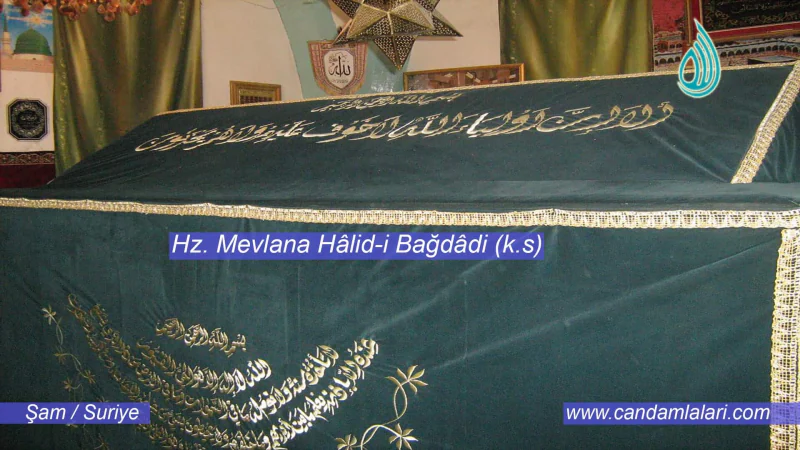
When his student Hazrat Ibn Abidin related his dream, saying, "Last night in my dream I saw that Hazrat Osman had passed away. There was a very great crowd. I led the funeral prayer," Hazrat Mevlana Hâlid said: "I shall pass away soon. And you will lead my funeral prayer with a large congregation, because I am a descendant of Hazrat Osman." Hearing this, Ibn Abidin was deeply grieved. Not long afterward, Mevlana Hâlid passed away. His funeral prayer was led by Hazrat Seyyid Ibn Abidin, the great jurist of the Hanafi school.
He greatly loved Hazrat Seyyid Taha-yı Hakkâri, one of his students and khalifas, and prayed for him often.
The Golden Chain continues with Hazrat Seyyid Taha-yı Hakkâri.
He said:
The sign of being saved from the commanding self (nafs al-ammara) is to regard people's praise and blame as equal. To rejoice at people's favor and to be saddened by their disregard is shallowness and folly.