Türkçe
 Español
 Français
 日本語
 हिन्दी
 العربية
 中文
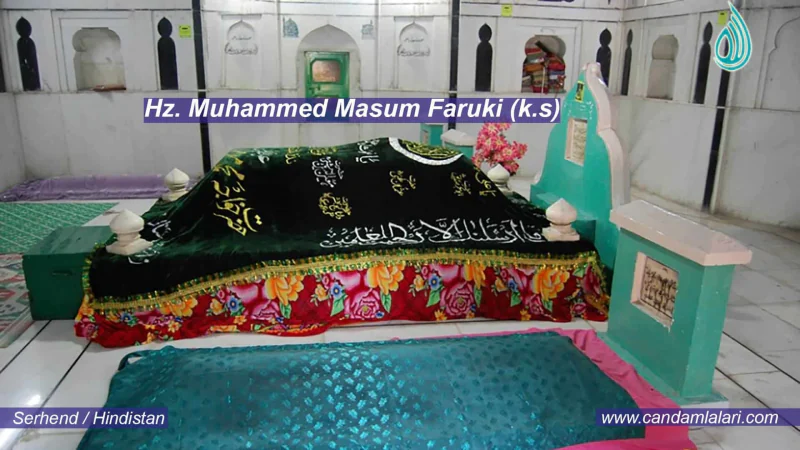
28. Seyyid Şemseddin Mazhar-ı Can-ı Canan (k.s)

Hazrat Mazhar-ı Can-ı Canan was one of the great saints (awliya). He was a Seyyid. His name was Şemseddin Habibullah. His father was Mirza Can, and he was called Can-ı Canan after his father's name. He was born in 1701 and was martyred in 1781. His forefathers were prominent statesmen who stood close to the Timurid sultans. His father, Mirza Can, gave up rank and position and chose poverty and contentment. He distributed his wealth to the poor for the sake of God (Exalted is He). When he heard that a friend of his was in grave distress, he gave him as a gift the whole of the twenty-five thousand rupees in gold that he had set aside for his daughter's wedding. In his homeland, his father was a man known for his compassion, his superior character and the excellence of his human virtues.
Those with penetrating insight, seeing the brilliance of Mazhar-ı Can-ı Canan's intelligence, comprehension and understanding, used to say that he had been given a lofty nature and disposition. His father took great care over his upbringing and education, and over his acquiring knowledge. While still very young he began to acquire knowledge and gnosis (marifa) and various skills. From childhood he made excellent use of his precious life. Besides knowledge and gnosis, he also learned various arts and skills. He himself said: "In my childhood I saw Abraham, peace be upon him, in a dream and received much of his favor and kindness. Also in my childhood, whenever I remembered Hazrat Abu Bakr and called his name to mind, his blessed form would appear before me. I would see his spiritual presence with my own eyes. He showed me great favor."
He also related:
"It was in my childhood. A man was speaking with my father. They mentioned Hazrat Imam Rabbani. At that moment I saw the spiritual presence of Hazrat Imam Rabbani. He signaled to me to get up and leave. When I told my father about this, he said: 'It is clear that you will benefit from their path.' God (Exalted is He) placed in my nature the trait of following and obeying the Sunna of the Prophet."
He described his pursuit of knowledge as follows:
"I learned the Persian language and some other subjects from my father; the Holy Quran, tajwid and the science of recitation from Kari Abdürresul; and the rational and transmitted sciences from the scholars of our time. I learned Quranic exegesis and hadith from Hacı Muhammed Efdal. When I was fifteen, my teacher Hacı Muhammed Efdal, from whom I was studying, gave me a skullcap as a gift. Through its blessing my mind opened wide, and I had no difficulty in reading and learning anything. After completing my studies, I taught students for a while. When I was sixteen, my father passed away. Before dying he left this will: 'Spend all your time on attaining perfections, maturity and lofty ranks. Do not pass your precious life in vain pursuits.'"
"Following my father's will, I continued to learn and to act on what I learned. One night in a dream I saw one of the saints. He rose from his grave, came to me and placed his own conical cap on my head." After this dream, no desire for rank or position remained in my heart. My longing to turn to Sufism grew much stronger. Once, in a dream, a voice from the unseen said: "We have a task for you. Through you people will find guidance, and the path that guides them will spread!" When I had seen this dream too, my resolve to turn to Sufism and to attain the inner connection (nisba) became firm. To reach this goal I went to the presence of Seyyid Nur Muhammed Bedayuni. When I saw his blessed face, I understood that he was a man of gnosis. He was utterly devoted to the Sunna of the Prophet, fully obedient to the commands of the religion and endowed with a lofty character. His company gave purity to the heart and added life to life. It became fully clear that seekers reach their goal in his presence, that a dead heart is revived and finds tranquility there, and that union with the Truth was attained there. When I asked him to accept me as a student, he accepted me at once, although he did not accept students without first seeking divine guidance (istikhara). His outpourings of grace (feyz) were so blessed and effective that, with a single act of spiritual attention (tawajjuh), his student's heart would begin to remember God (dhikr). When I became his student and received his grace, my heart was illumined. I received much of his favor.
In a short time I matured in the company of Hazrat Nur Muhammed Bedayuni. I was immersed in the states of Sufism. From the embrace of divine love and the abundance of ecstasy (jadhba), I had given up sleep, rest, food and drink. I withdrew from people and began to wander alone. From the severity of hunger I ate the leaves of trees. My time passed entirely in a state of self-forgetfulness and contemplation (muraqaba). I waited thus for the attainment of the true goal. At last I reached the state required in the noble hadith: 'Worship as if you see your Lord.' I attained the states of self-effacement, annihilation (fana) and subsistence (baqa). I rose to the goal described by the great ones, to the secret of divine unity (tawhid)."
Nur Muhammed Bedayuni, looking at my states, showed me humility, great love and attention. One day, as we sat facing each other, he said: "Two suns have come face to face; the light of the one hides the other. If you turn to the training of the seekers, the world will be filled with light." Another day he told me: "Your love for God Almighty and His Messenger is at a high degree. Our path will spread through your spiritual attention. You have been given the name Şemseddin Habibullah." And he entrusted to me the training of some of his students.
"I kept the company of my teacher Seyyid Nur Muhammed Bedayuni for four years. Then he gave me the license (ijaza). He charged me to remain firm in the creed of Ahl al-Sunna, to follow the Sunna of the Prophet and to avoid innovations (bid'a)."
After the passing of his teacher Seyyid Nur Muhammed, he began to guide people and to show them the right path. Scholars, officials, saints and ordinary people attended his lessons and talks and drew grace from him. He raised great scholars and saints such as Mir Müsliman, Senaullah Panipüti, Gulam Kaki, Seyyid Âlimullah and Hazrat Seyyid Abdullah Dehlevi.
Hazrat Mazhar-ı Can-ı Canan said:
"God (Exalted is He) granted us the most mature intellect and a sound, penetrating vision. I had learned the best method, suited to the condition of each person, for governing the affairs of a sultanate and ordering a country. For this reason the famous statesmen of the time would ask us what weapons to buy and about other important matters, and would act according to the answer they received from us."
He also said:
"After I had been brought up through the blessed training of my honored father, such a state arose in me that with a single glance I would understand what everyone was and what lay in his heart. By the light of the path I was on, I could read from people's foreheads whether they were among the people of felicity or of wretchedness (Paradise or Hell)."
On a bitterly cold winter day, Nevvab Han Firuzcenk saw Hazrat Mazhar-ı Can-ı Canan in an old garment. Seeing this, he wept. He said to one of the men with him: "What wretched people we are, that one of our great ones accepts no gifts and we are not honored to serve him!" Upon this, Hazrat Mazhar-ı Can-ı Canan said: "We are determined not to accept or take anything from the wealthy. The sun of our life is about to set, our life is nearly over. Until now we have not accepted." Then Nevvab Han Firuzcenk wished to present him with thirty thousand rupees. He did not accept it, and said: "We are not eaters of your wealth; distribute it to the poor."
Again, one of the Afghan commanders had sent three hundred gold coins called ashrafi. He did not accept these either, saying: "Although it is desirable to accept a gift, there is no command that one must accept it in every case. Our own students bring us gifts that they have prepared with sincerity and care, taking heed that nothing unlawful is mixed in, and we do not accept even those. As for the gifts of emirs and the rich, we never accept anything whose complete lawfulness is doubtful. There are people's rights in it. It is hard to render account of it on the Day of Judgment. In the noble hadith that Imam Tirmizi recorded from Ebu Berze, our Prophet (peace be upon him) said: 'On the Day of Judgment no one will escape reckoning until he has answered four questions: how he spent his life; how he acted upon his knowledge; where he earned his wealth and how he spent it; and where he wore out and wearied his body.' Therefore one must be very careful."
Once one of the statesmen sent Mazhar-ı Can-ı Canan a quantity of "anbe" (mango), the famous fruit of India, and begged him earnestly to accept it. He took two mangoes, returned the rest and said: "This poor man's heart does not wish to accept these." A little later a garden owner came into his presence and said: "So-and-so, the emir, took the mangoes he sent you from us by force and presented them to you as a gift." Upon this he ordered that the wronged man's right be returned and that he be protected. Then he said: "Glory be to God, this food he brought has harmed our inner being." After that he never accepted the hospitality of anyone whose wealth was doubtful. Again on this occasion he said: "The most harmful of foods are those offered by the rich whose earnings are doubtful. Even the offerings of the poor are doubtful, because they borrow from rich people of doubtful earnings in order to prepare these meals."
Hazrat Mazhar-ı Can-ı Canan said on this matter: "The morsels one eats should bring a person success and increase the light of obedience and worship. One should prefer poverty to wealth, and choose patience and contentment. One should make submission and consent into one's character. In keeping with the prayer of the Messenger of God, 'O God, make the provision of the family of Muhammad sufficient,' one should ask for what one needs in just measure.
The noble Companions also prayed this way. One should not be so rich as to fall into extravagance, nor so poor as to fall into hardship and debt. One should fulfill one's duty of servanthood, wait ready for death, and not tie one's heart to other desires. Death is a divine gift. It is meeting God Almighty and beholding the blessed face of the Messenger of God."
Hazrat Mazhar-ı Can-ı Canan was bound to his teachers with great love and sincerity. He had a deep love especially for Hazrat Imam Rabbani. "Whatever I have attained, I attained through my love for my teachers. What are a servant's deeds that they should bring him to God's good pleasure! But loving and cherishing those who have attained God's good pleasure and are among His accepted servants is the strongest means of attaining it," he said.
Hazrat Mazhar-ı Can-ı Canan related:
"Once I was honored to see in a dream our Prophet (peace be upon him), the adornment of the world and the master of the universe. We were lying side by side. We were so close that his blessed breath reached my face. In the meantime I became thirsty. The sons of the great one of Sirhind, that is, the children of Hazrat Imam Rabbani, were also there. The Messenger of God commanded one of them to bring water. I, the poor one, said: 'O Messenger of God, they are the children of my master.' He said: 'They obey our word.' One of those noble ones rose and brought water. I drank my fill. Then I said: 'O Messenger of God, what do you say about the Mujaddid of the second millennium?' He said: 'There is none like him in my community.' I said: 'O Messenger of God, has the Maktubat of Hazrat Imam Rabbani passed before your blessed eyes?' He said: 'If you remember any part of it, recite it!' So I recited what Hazrat Imam Rabbani wrote in some of his letters about God (Exalted is He): 'He is beyond the beyond, and again beyond the beyond; that is, God Almighty is beyond all that lies beyond. Whatever the intellect thinks or imagines, He is not that.' The Messenger of God liked this very much, and when he said, 'Recite it again!' I recited it again. He found these expressions very beautiful. This state continued for quite a while.
In this dream, through the blessing of the Messenger of God's blessed breath and company, I found myself wholly in light and peace. Through the blessing of this dream, which was more blessed than anything obtained while awake, I felt neither hunger nor thirst for days."
Hazrat Mazhar-ı Can-ı Canan passed away as a martyr. A few days before his death, he was in a wholly different state of love and ardor, because the time had come to depart this transient world and to meet God Almighty. In those days he increased his worship and devotions still further. Meanwhile his students and those who loved him flocked to his talks. His talks and contemplations passed in a state of great peace. During his talks those gathered in his presence numbered more than a hundred, and they received blessings and grace. In the days when his death drew near, when his student Molla Nesim asked leave to go to his homeland and return, he said to him: "It is no longer certain that we shall meet again." By these words he was hinting at his coming death. Hearing this, his students began to weep and could not hold back their tears. In those same days he wrote in a letter to his student Molla Abdürrezzak: "My age has passed eighty. My appointed time has drawn near. Offer a good prayer for us." In the letters he wrote to other students at this time he hinted at the same thing.
Again in the days when his death was near, he spoke of the blessings he had received and gave thanks, saying: "Whatever passed through my heart and whatever blessing I wished for, God (Exalted is He) granted it to me. He honored me with true Islam and gave me much knowledge. He gave me steadfastness in righteous deeds. He gave me all that the great ones have described on the Sufi path, and bestowed unveiling (kashf), spiritual authority (tasarruf) and miracles (karamat). He kept me far from attachment to the world and from those attached to the world. Only, in drawing near to God Almighty, I have not attained the high rank of martyrdom. Most of my teachers and spiritual guides (murshids) were honored to drink the sherbet of martyrdom. Now I have grown old, my body has weakened. I no longer have the strength to fight in jihad and thus attain martyrdom. One must marvel at those who do not love and do not want death. Death is the means of meeting God Almighty."
Thus Hazrat Mazhar-ı Can-ı Canan expressed how greatly he longed to attain the rank of martyrdom. In the last days of his life, those coming and going in his presence increased greatly. On the night of Wednesday, the seventh of Muharram in the year 1781, a great many people had gathered before his door. Among them three men insisted on coming in. At last they obtained permission and entered. They were Mughals and Zoroastrians. Having come into his presence, they said: "Are you Mazhar-ı Can-ı Canan?" Hazrat Mazhar-ı Can-ı Canan said: "Yes, it is I." In truth, they had come with the intent of killing him. One of them rushed at him and began to strike with a dagger. The dagger blow struck near his heart; he was gravely wounded and fell to the ground.
Nevvab Necef Han, informed of the situation, sent a European physician early in the morning. He told the physician: "Go quickly and treat this blessed man, and when those who wounded him are caught, let retribution be carried out." The European physician went and examined the wound of Hazrat Mazhar-ı Can-ı Canan, then returned and deliberately told Nevvab Necef Han: "He will recover and survive; there is no need to send another physician." Hazrat Mazhar-ı Can-ı Canan lived three more days in this wounded condition. Blood flowed continually from his wounds. The third day was a Friday. At noon he raised his hands and recited the Fatiha. At the afternoon hour he asked: "How many hours remain until the day ends?" They said: "Four hours." That day was both a Friday and the day of Ashura. When evening came, he drew three deep breaths and passed away as a martyr.
Hazrat Mazhar-ı Can-ı Canan rendered most excellent services for the spread of Islam and so that people might attain true happiness. He raised precious men, each a superior jewel, and charged them with guiding people. His students, in the places where they lived, taught people Islam and brought their faith to the level of conscious conviction. Thus each of them, where he lived, brought about adherence to Islam, the spread of good character and good treatment among people. Those who knew and loved them were honored, through them, to live a pure life and to attain happiness.
Hazrat Mazhar-ı Can-ı Canan said:
"Whoever mixes with those attached to the world will not attain the blessings of companionship (suhba) or the lights of Sufism! But if a person mixes with those attached to the world only as much as necessary, and stays among them with sincere intention while preserving his inner connection, there is no harm."
"The world is accursed, and whatever in it is not done for God (Exalted is He) is also accursed. Love of God Almighty and love of the world cannot come together. To attain God Almighty's good pleasure, one must abandon what is other than God (masiwa), that is, everything other than God Almighty and all other aims."
Hazrat Mazhar-ı Can-ı Canan's counsel to his companions and students was as follows:
"The way of piety (taqwa) and scrupulousness (wara), of guarding against the forbidden and the doubtful, is to follow the Messenger of God completely and to accept wholeheartedly what he has conveyed. Compare your own state with what is taught in Ahl al-Sunna. If your state conforms to what Ahl al-Sunna teaches, that is, to the commands of the religion, it is accepted. If it does not conform, it is rejected and will be refused. To attain happiness in this world and the next, one must hold the creed of Ahl al-Sunna wa'l-Jama'a."
The goods of the world are very few. Hazrat Mazhar-ı Can-ı Canan possessed asceticism (zuhd) and trust in God (tawakkul) to a perfect degree. He guarded himself extremely from the world and from those attached to it. He did not accept the gifts that were offered him. It was very rare for him to accept any. The emperor of the time, Muhammed Şah, sent word through his vizier Kameruddin Han to Mirza Can-ı Canan, saying: "God (Exalted is He) has given us such a realm that whatever comes to his mind, we shall send as a gift, if only he asks." To this offer Hazrat Mazhar-ı Can-ı Canan gave this reply: "God (Exalted is He) declares in the Holy Quran, in meaning: اَلَمْ تَرَ اِلَى الَّذ۪ينَ ق۪يلَ لَهُمْ كُفُّٓوا اَيْدِيَكُمْ وَاَق۪يمُوا الصَّلٰوةَ وَاٰتُوا الزَّكٰوةَۚ فَلَمَّا كُتِبَ عَلَيْهِمُ الْقِتَالُ اِذَا فَر۪يقٌ مِنْهُمْ يَخْشَوْنَ النَّاسَ كَخَشْيَةِ اللّٰهِ اَوْ اَشَدَّ خَشْيَةًۚ وَقَالُوا رَبَّنَا لِمَ كَتَبْتَ عَلَيْنَا الْقِتَالَۚ لَوْلَٓا اَخَّرْتَنَٓا اِلٰٓى اَجَلٍ قَر۪يبٍۜ قُلْ مَتَاعُ الدُّنْيَا قَل۪يلٌۚ وَالْاٰخِرَةُ خَيْرٌ لِمَنِ اتَّقٰى وَلَا تُظْلَمُونَ فَت۪يلًاHave you ˹O Prophet˺ not seen those who had been told, “Do not fight! Rather, establish prayer and pay alms-tax.”? Then once the order came to fight, a group of them feared those ˹hostile˺ people as Allah should be feared—or even more. They said, “Our Lord! Why have You ordered us to fight? If only You had delayed ˹the order for˺ us for a little while!” Say, ˹O Prophet,˺ “The enjoyment of this world is so little, whereas the Hereafter is far better for those mindful ˹of Allah˺. And none of you will be wronged ˹even by the width of˺ the thread of a date stone. (An-Nisa 4:77, Diyanet) thereby informing us that the wealth and property of the seven climes of the world is little. India is one of these seven climes, which are little, and it is in your hands. What is its worth? The essence of the aspiration of the great ones is to keep away from it."
Again, one of the statesmen of that region had a lodge (dargah) built for Hazrat Mazhar-ı Can-ı Canan and, announcing that he would meet the needs of all the dervishes, offered it for them to accept. But Hazrat Mazhar-ı Can-ı Canan did not accept it, saying: "For us every place is the same. With God Almighty everyone's provision is decreed. When the time comes, everyone receives his provision. The treasure of dervishes is patience and contentment, and this is enough."
The true remedy: eighty-seven of Hazrat Mazhar-ı Can-ı Canan's letters and recorded sayings are in the book called Kelimat-ı Tayyibat. One of his letters:
"Brother, your letter has come, speaking of the weakness of the students of our time, of their seeking unveiling and miracles from the saints, and of their not keeping the first century in view. Know that there is no need to take as students foolish and senseless people who incline toward other sheikhs. One should accept those among the intelligent and sincere who seek this path. Do not grieve. God Almighty is the true Judge. In the thirty-first verse of Surah Al Imran, قُلْ اِنْ كُنْتُمْ تُحِبُّونَ اللّٰهَ فَاتَّبِعُون۪ي يُحْبِبْكُمُ اللّٰهُ وَيَغْفِرْ لَكُمْ ذُنُوبَكُمْۜ وَاللّٰهُ غَفُورٌ رَح۪يمٌSay, ˹O Prophet,˺ “If you ˹sincerely˺ love Allah, then follow me; Allah will love you and forgive your sins. For Allah is All-Forgiving, Most Merciful.” (Al-i-Imran 3:31, Diyanet) He made the attainment of God Almighty's love and good pleasure, which is the aim of all seekers and students on all paths, dependent on following our Prophet (peace be upon him). That specialist physician has sent the commands and prohibitions, which serve as the medicine and the diet, to save His servants from the diseases of heedlessness and sin. One who applies this prescription, takes the appropriate medicines and keeps the diet finds health and healing. One who shuns it has destroyed and ruined himself.
This prescription has a form and a reality. The common Muslims act on its form. This consists in correcting one's belief and then acting in accordance with the religion and following its commands and prohibitions. Its reward is the blessings of Paradise and deliverance from Hell. Its reality belongs to the elect: the illumination and brightening of hearts and the purification of selves (nafs). This includes the form that has been described, but it also lies in ascetic discipline and striving. What is obtained here is manifestations (tajalli) and unveilings (kashf). The form is called faith and Islam, and the reality is called ihsan. As the noble hadith says: 'Ihsan is to worship your Lord as if you see Him.' Form without reality is like the ointments and medicines put on boils and wounds to cure diseases of the skin. It heals the wound and clears the boil. It is certainly not without benefit. But reality without form has no benefit at all. Rather, that is not reality but divine ruse (makr-i ilahi). We seek refuge in God Almighty from this.
Reality is like cleansing, that is, like expelling the diseased, germ-ridden, corrupt matter. For if it stays in place, it can make one ill again. Complete health and full healing come only when these two treatments are carried out together. From this explanation one can easily understand how our Prophet's treatment worked health and healing in the natures of the noble Companions. Surely that treatment and medicine was nothing other than loving God Almighty greatly, following the Messenger of God with all one's effort, taking delight in obedience and worship, and finding sins ugly and hateful. This produced in them peace of heart and purification of the self. Through the blessed company of the Noble Messenger and the application of the prescription of Islam, they reached these ranks in a very short time, even in an instant. More than the tastes and ecstatic states spoken of in later centuries, they paid the utmost heed and care to form and reality, preserved the form that protects the reality, and did not concern themselves with unveiling and miracles. They did not count these among the requirements and conditions of perfection and maturity.
Therefore a seeker who wishes to attain complete health must regard following the Sunna of the Messenger of God as superior to all ascetic discipline and striving, and the light and blessings that come from it as superior to all outpourings of grace. He must attach no value to any tastes and ecstatic states, compared with inner collectedness and constant presence. He must regard the great one who is the means of attaining these essences and realities as the deputy of the Messenger of God, serve him with heart and soul, and on this path, like children, not be content with walnuts and the like, however sweet they may be.
Teach the knowledge of jurisprudence (fiqh). There is no religion without fiqh. Give great importance to teaching and spreading the creed of Ahl al-Sunna. In everything, strive to follow our Prophet (peace be upon him), the beloved of God Almighty. For God Almighty greatly loves those who follow His beloved." (Letter 21)