Türkçe
 Español
 Français
 日本語
 हिन्दी
 العربية
 中文
Emir Sultan
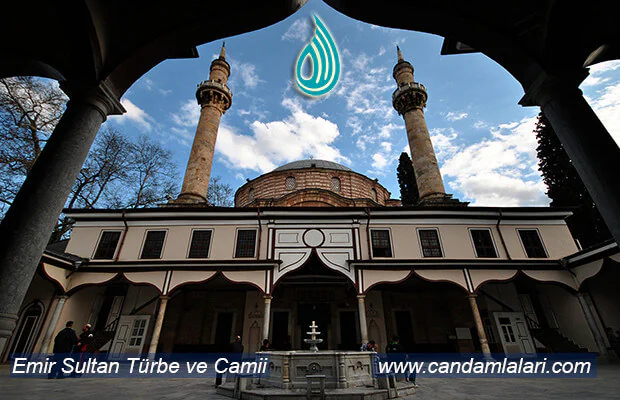
Emir Sultan was a great saint who lived in Bursa during the founding era of the Ottomans. His name was Muhammad, his epithet Shamsuddin. His father's name was Ali. He was born in Bukhara in 1368 (770 AH). His lineage goes back to our Prophet. He was called Muhammad Bukhari because he was born in Bukhara, Emir Bukhari because he was a Seyyid, and Emir Sultan after he became the son-in-law of Yildirim Bayezid Khan.
His father, known as Emir Kulal, was a saint who earned his living by pottery. He was loved in Bukhara and was often approached for his prayers. He belonged to the Nurbakhshiya branch of the Naqshbandi tariqa. Emir Kulal made great efforts to raise his son. Trying to bring him up on a firm foundation of knowledge and character, Emir Kulal also taught his son pottery so that he would have a trade. Emir Sultan lost his mother at a young age and was left an orphan. His father drew close to him to such a degree that he did not let him feel the lack of a mother, and formed a bond of love with him. One of the pieces of advice his father often gave him was this:
“O my son! You must love our Prophet more than your father and your mother. You must not boast of your lineage, and no lie must ever come out of your mouth. You must try to complete every day as if it were the last day of your life. You must never grow lazy or weary in learning knowledge. Even if your beard is white, you must not abandon jihad against the enemy. You must not enter any gathering without giving the greeting of peace. You must not sit with a woman who is not married to you. The noble Quran will be your guide, and the noble hadiths your pointer on the road.
O my son! Life in every aspect is a school for you. Run to good, flee from evil. Your greatest weapon is the prayer you make to God Most High. Never forget this!”
Raised with such advice from his father, Emir Sultan also continued to attend the suhbas of many people of Sufism.
One day he was conversing with his esteemed father in a secluded place, talking about the interpretation of a noble verse. At that moment a man with a sorrowful heart, with many children, in debt and in distress, came and related his wretched state: “I had a garden in Bukhara. Its produce met the sustenance of my wife and children every year and I lived on what was lawful. By divine decree, one day a storm blew. It withered the fresh trees in my garden and most of the newly sprouted vegetables. Since I had no strength to make a living in this situation, I abandoned my wife and children. O descendant of the Messenger of God! Look with the eye of compassion upon me, a weak and helpless servant of God Most High. I fall at your feet, help me.” After telling this, he rubbed his face on the hands of Ali, Emir Sultan's father. Emir Sultan's blessed father consoled him, saying, “God willing, the Lord will bring you to your wish.”
At that moment Emir Sultan Hazrat thought of having mercy on that old man and behaving kindly toward him. That night Emir Sultan secretly went to the garden of this needy old man, pleaded with God Most High from the heart and said: “O my God, who gives blessings and apportions sustenance! Restore the trees and the vegetables and fruits this poor man planted to their former vitality.” and rubbed his blessed hands over his face. Then, by the permission of God Most High, the trees and the planted vegetables in that poor man's garden turned green and revived. When morning came, divine inspiration came to the old man's heart and he went at once to his garden. Entering the garden, he saw that the trees had blossomed, fresh leaves had come out and the vegetables had revived. The old man was astonished at this.
From a corner of the garden he looked at the vegetable patch and said: “O my God, who gives sustenance and creates the creatures! My pleading and supplication are to You. Make this strange secret known to me. Or did Hazrat Khidr come to my vegetable patch and drink the water of life, so that my garden's trees turned green when they were dead?” At that moment Emir Sultan appeared from a corner of the garden. When the old man understood the truth of the matter and wanted to cling to Emir Sultan's hands at once, he vanished from sight. He gave thanks that, by the blessing of Emir Sultan's prayer, the trees and vegetables in the garden had turned green and borne fruit as before. The old man, amazed at the power of God Most High, told the people of Bukhara what had happened to him. When the people came and saw the state of the garden, they were astonished. Seeing this miracle, people asked Emir Sultan Hazrat for prayers.
When Emir Sultan was 17-18 years old, his father died. After his father's death he remained in Bukhara for a while. Then, upon a divine command he received, he went to Mecca. After performing the obligation of the pilgrimage, he moved on to Medina. His intention was to settle near the blessed tomb of his grandfather, the Messenger of God, our Master, and to stay there until the end of his life.
When he came to Medina, he could not find a place to stay. He heard that there was a room set aside for Seyyids and went there. Those who were there said they were Seyyids and that the room was reserved for them, and did not want to take Emir Sultan in with them. Emir Sultan said to them, “I am a Seyyid too.” but they did not listen. They even said, “Who here knows that you are a Seyyid? If you were a Seyyid it would be evident from your state.” Emir Sultan said to them, “I too am a humble servant of God, a stranger here. In our path there is no pride or arrogance. Come, let us go together to the tomb of the Master of the Universe, the Messenger of God, our Master. Let us give the greeting. Whichever of us he answers, let it be known that his lineage is sound.” At this proposal, without even going to the tomb, they turned their faces toward the tomb of the Messenger of God, our Master, and said, “Peace be upon you, O my forefather!” But no answer came to any of them. Emir Sultan said with sincerity and longing, “Peace be upon you, O my forefather!” The Noble Messenger answered with his blessed voice, “And upon you be peace, O my son!” Thereupon those present felt great shame before Emir Sultan, who appeared outwardly poor and lowly, and asked forgiveness.
While Emir Sultan Hazrat intended to settle in illuminated Medina and stay there until the end of his life, he had a dream. In his dream the Prophet, our Master, and Hz. Ali were sitting side by side. He went and knelt respectfully before them and sat. Hz. Ali said to him, “O my son! It has been indicated to you from the Lord that you go to the land of Rum to teach the sunna of your grandfather Muhammad through the way of piety. Three lamps of advancing light will appear before you; where those lamps disappear from your sight, there you will stay. Your grave will be there too.” When Emir Sultan woke from sleep, he set out, saying “So this is the divine decree.” As Hz. Ali had said, three lamps guided him.
As Emir Sultan was coming from Medina toward Bursa, on the way the son of a bey saw Emir Sultan and his heart inclined to become his student. He immediately laid down his weapons and went to Emir Sultan. He begged him to accept him as a student. Emir Sultan accepted him as a student. After a while they reached a crossroads. A man who was a native of that place said that on one of the roads there was a dragon, a huge serpent that gave no passage, and warned them not to go by that road. Because the lamp going ahead of Emir Sultan showed that road, they went forward on that road.
After a while they saw a dragon stretched out by the roadside. The dragon was in a state not of waiting for its prey but of awaiting an honored guest. Except for Emir Sultan, everyone was walking fearfully and anxiously, and the questions “What will the dragon do? Whom of the caravan will it attack?” troubled their minds. When Emir Sultan, who was at the front of the caravan, approached the dragon, the dragon at once prostrated itself at the feet of Emir Sultan's camel and said, “Welcome, my Sheikh! I am at your command!” Those in the caravan watched this in astonishment. But the bey's son who had joined them on the road did not quite believe it. At that moment the dragon at once leapt upon him. The beyzade said, “O my God! O Emir, help me!” and Emir Sultan signaled the dragon to let him go. Thereupon the dragon at once turned back and went away. Thus the doubt in the youth's heart was gone.
Emir Sultan's caravan had camped in a garden on the bank of the Sakarya River. There were all kinds of fruit in the garden. But one of the students craved dates. At that moment a date palm rose before the student. It had ripe fruit on it. But the student could not understand what was happening. The questions “Was it here before? Or had I not seen it?” troubled his mind. Noticing this, Emir Sultan said, “You wanted to eat dates, here are dates, take and eat!” Thereupon the student understood that this was his teacher's miracle.
When Emir Sultan Hazrat came to Bursa, the three lamps of light before him stopped beside an old church set aside for the poor, near the Three Cypresses by the spring. Thus Emir Sultan settled in Bursa.
At this time Yildirim Bayezid Khan was fighting the Hungarians. The enemy forces were inflicting great casualties on the Ottoman army. Meanwhile a youth was bandaging the wounds of the wounded, and at times he would raise his hands and pray. Yildirim Bayezid, wounded in the arm, seeing this young soldier bandaging wounds with effort and skill, felt a closeness in his heart toward that youth. Going up to him he said, “I too have a wound on my arm, bandage my wound!” and Emir Sultan took a handkerchief from his pocket and said, “Here, my Padishah, let me bandage your wound too with this handkerchief.” When morning came, they informed Yildirim Bayezid that all the bandaged wounds were healed and the soldiers had risen to their feet. Yildirim Bayezid, curious, uncovered his own wound and noticed that the handkerchief on his arm was half of the handkerchief that his wife had given him when she was his fiancee. He ordered that the soldier who had bandaged the wounds in the evening be brought to him. But they could not find anyone.
The Ottoman army then moved before the Fortress of Nicopolis. There were days of bloody fighting for the conquest of the Fortress of Nicopolis. The fortress could not be taken. At the most intense moment of the assaults, the youth who had bandaged the soldiers' wounds in the earlier battle opened the fortress gate wide. Yildirim Bayezid and his soldiers entered the fortress. Those in the fortress were forced to surrender at this. After the victory they looked for this youth but could not find him. After the conquest of Rumelia, Yildirim Bayezid Khan did not come to Bursa but stayed at Edirne.
At this time the daughter of Yildirim Bayezid saw our Prophet in a dream. The Noble Messenger said to her:
“Marry my son Muhammad Bukhari; do not refuse me, and heed my word!” Hundi Fatima Sultan, pure of spirit and possessed of manners and modesty, could not tell anyone her dream. The next day she again saw the Noble Messenger in her dream. The Leader of the Universe said to her:
“If you want me to intercede for you in the hereafter, marry Muhammad Bukhari.” Yet it was being said that Hundi Fatima Sultan would marry Suleyman Pasha, the Beylerbeyi of Rumelia. Outwardly, Emir Sultan was a poor and humble stranger. Hundi Sultan, overwhelmed in this helplessness, prayed.
“I wonder if Emir Bukhari knows of this?” she said. She was thinking with whom and how she could send word. Then she told her dream to her maidservant, who had manners and modesty like herself, and told her to inform Emir Sultan of the situation. When the maidservant went and told Emir Sultan of the situation, he said:
“We know it too. Our marriage was performed by God Most High. According to our religion, it must be performed here too. Convey the matter to Hundi Fatima Sultan.” Thereupon Emir Sultan sent matchmakers and asked for the sultan's daughter. But the Valide Sultan did not want to give her daughter, and making matters difficult said to the matchmakers:
“Tell Emir Sultan, if he brings forty camel-loads of gold, I will give my daughter.”
Emir Sultan Hazrat said:
“Let our Valide Sultan send the camels, and we will fulfill her request. Let us send the gold she wants.” and the palace was thrown into a flurry. No one's mind could grasp this matter. They received with astonishment the question of how such a poor dervish would give forty camel-loads of gold. They brought forty camels from the palace to Emir Sultan. Emir Sultan went with the camels to the bank of the Nilufer Stream. To those who had brought the camels he said:
“Fill the saddlebags with this sand, and you too take as much as you wish. What you take will be gold.” Some doubted and took nothing. Others filled saddlebags and purses. When the caravan of forty camels entered the palace,
Emir Sultan said:
“Empty them, what you wanted will be gold.” When the saddlebags were emptied, all of it was gold. Some deeply regretted that they had not taken any for themselves, and others that they had spilled what they had taken along the way.
When it was decided that Emir Sultan and Hundi Fatima Sultan would marry, Fatima Sultan sent shirts and linen embroidered by her own hand to Emir Sultan with the Harem Agha. When the bundle came, Emir Sultan was in a room where he had lit a brazier, holding a suhba with his students. The Harem Agha came in and said:
“From the Valide Sultan.” and gave the bundle to Emir Sultan. Emir Sultan set the bundle aside and prayed for their health and well-being. Then he opened the bundle and took a handkerchief from it. He put a few pieces of ember in the handkerchief and closed it. Smiling, he said to the Harem Agha:
“Give my greetings to the Valide Sultan. The gift of us poor dervishes to sultans can only be such pieces of ember. I humbly ask that she accept it.” The Harem Agha left there amid the astonished looks of everyone. On the way he wondered whether the handkerchief was burning; but not even smoke was coming out of the handkerchief. He barely restrained himself until the palace. He delivered the gift to the Valide Sultan. The handkerchief was opened amid the curiosity of those in the palace. Out of the handkerchief came not grains of fire but dazzling pieces of diamond. It was understood that this was a miracle of Emir Sultan Hazrat.
When news of the marriage reached Edirne, Yildirim Bayezid placed forty soldiers from the Kapikulu troops under Suleyman Pasha's command and sent them to Bursa to bring the heads of Emir Sultan and Hundi Hatun. When Suleyman Pasha came to Bursa, he asked the Valide Sultan for them. When the Valide Sultan did not give them, the forty soldiers attacked the Valide Sultan's palace. The Valide Sultan was frightened by their attack. Seeing her state, Emir Sultan said to her:
“What is this terror and fear of yours? Tell me, for the love of God.” Then he said to the Valide Sultan:
“Take that bow and draw the arrow. Let me watch, you shoot.” The Valide Sultan said:
“I cannot shoot an arrow.” and Emir Sultan said:
“You fit the arrow, it will go by itself.” Thereupon the Valide Sultan set the arrow on the string toward the soldiers from the window and released it. The green arrow went shining and struck all forty. The soldiers fled at once. When the Valide Sultan asked:
“O Emir Sultan! Why did you not shoot the arrow yourself but had us shoot it?” Emir Sultan said:
“If we had shot the arrow, the generations of both those soldiers and of the Ottomans would have perished. Therefore we had you do this.”
Hearing that the Padishah had sent soldiers to Bursa to have Emir Sultan and his daughter Hundi Sultan killed, Molla Fenari wrote the following letter to Yildirim Bayezid:
“I begin my letter in the name of God Most High, who is ever compassionate to His servants. I, the weakest of people, pray to my Lord that the life of my Padishah, the protector of the Turkish and Islamic lands, the pride of the Ottomans, the leader of those who fight for the sake of the Truth, the helper of the religion of Islam and of Muslims, be long, and that his children multiply and live in glory and honor until the Day of Resurrection.
Our Sultan must know this. Before our Prophet Muhammad Mustafa, Jesus (peace be upon him) sent three of his believers to a town to call it to the true religion. But the people of that place called them liars and killed them. After committing this crime, they went home rejoicing. God Most High was not pleased with their behavior and commanded Gabriel (peace be upon him) to cry out over that town with a terrifying, sharp voice that tears hearts apart. When Gabriel (peace be upon him) cried out, all of them died at once. We seek refuge in God Most High from falling into such a great calamity.
Now we too have a request of our Sultan. Emir Sultan, whom you ordered killed yesterday, is a person worthy of respect from the lineage of the Noble Messenger. A person of pure heart like this man, from the Prophet's lineage, has not set foot in Anatolia up to our time. If you had tried to bring a person of pure origin like him from Bukhara to Anatolia by sending envoys with hands full of gifts, it would have been an eternal honor for you. Although you did not do so, if you gain closeness to our Prophet through this man who came to our land upon spiritual will, your happiness in this world and the hereafter will increase.
Let me also state that this son-in-law of yours is among those of whom our Prophet said, “The scholars of my community are like the prophets of the Children of Israel.” No one after Hz. Muhammad has shown the works of grace that we have seen from such Seyyids. If you send soldiers again to have his head cut off, we have no doubt that it would be a calamity for our whole land. The final decree is our Sultan's.”
After days had passed, among those who greeted the Ottoman army and the sultan on their return to Bursa was Emir Sultan. When Yildirim Bayezid exchanged greetings with him, he understood that it was this youth who had bandaged his own wound along with the soldiers on the battlefield. The Sultan asked him in a veiled manner:
“What was that quickness of hand?” Emir Sultan
recited the noble verse whose meaning is: اِنَّ الَّذ۪ينَ يُبَايِعُونَكَ اِنَّمَا يُبَايِعُونَ اللّٰهَۜ يَدُ اللّٰهِ فَوْقَ اَيْد۪يهِمْۚ فَمَنْ نَكَثَ فَاِنَّمَا يَنْكُثُ عَلٰى نَفْسِه۪ۚ وَمَنْ اَوْفٰى بِمَا عَاهَدَ عَلَيْهُ اللّٰهَ فَسَيُؤْت۪يهِ اَجْرًا عَظ۪يمًا۟Surely those who pledge allegiance to you ˹O Prophet˺ are actually pledging allegiance to Allah. Allah’s Hand is over theirs. Whoever breaks their pledge, it will only be to their own loss. And whoever fulfils their pledge to Allah, He will grant them a great reward. (Al-Fath 48:10, Diyanet) (Surat al-Fath: 10)
Yildirim Bayezid asked:
“And what happened to the half of that handkerchief?”
Emir Sultan said:
“Dear father, half of that handkerchief is in my pocket. I am your son-in-law Muhammad Shamseddin.” Yildirim Bayezid Khan dismounted from his horse and embraced him, and unable to hold back their tears, both of them wept.
Sultan Yildirim Bayezid Khan, with the spoils gained after the victory at Nicopolis, wished to have a mosque built in a distinguished place in Bursa for Muslims to worship. He also informed his vizier of this. The site of today's Ulu Cami (Grand Mosque) was found suitable and the owners of the plots were paid the price of their property. Everyone gave up their plots willingly. But at the place where the mosque was to be built there was the house of an old woman. This woman insisted, “I will not sell my house.” She was told, “We absolutely need this house.” but she listened to no one's word. Sultan Yildirim Bayezid Khan himself also went to that woman and explained the situation. But he could not turn the woman from her opinion. Then the Sultan convened the divan and discussed this matter. In the divan it was decided that Emir Sultan Hazrat be informed of the situation and that action be taken accordingly. Sultan Bayezid went into the presence of Emir Sultan, explained the situation and said, “We need your service, otherwise the noble mosque cannot be built.” Emir Sultan consoled and calmed the Sultan, saying, “There is a time in which everything will come to pass.” That night the old woman saw in her dream her state on the Day of Resurrection. Everyone was hoping for the intercession of Muhammad Mustafa and going toward Paradise. The old woman too wanted to go to Paradise like them. But since she had no strength to walk, she was left all alone in the plain of Arasat. Thereupon, when the old woman began to cry out, the guardians of Hell asked her, “Why are you weeping?” The old woman said, “The Muslim community has gone to Paradise. I was left, so I weep.” At that moment a voice from the unseen said: “If you too wish to go to Paradise, sell your house to Yildirim Bayezid Khan, do not be stubborn, otherwise you will be among the stubborn and become one of the people of the Fire, destined for Hell.” The moment it said this, the old woman woke at once. When she woke, she saw that her house was covered with light. “Alhamdulillah, I too have become one of the people of Paradise.” she said, and occupied herself with worship until morning. Then she sold her house willingly and became a means for the mosque to be built.
Despite making great effort, Emir Sultan could not prevent the clash of Timur and Yildirim. Emir Sultan, who did not want two Muslim-Turkish armies to fight each other, knew very well what the outcome would be. When very little time remained before the start of the Battle of Ankara, his wife Hundi Hatun asked:
“Why are you leaving my father alone, O Emir?”
Emir Sultan said:
“Your worry is in vain, O Hundi! This war is against us. I told your magnificent father this earlier.” and his wife said:
“Whatever happens. I want you to be with my father right now.” At his wife's request, by the permission of God Most High, he arrived at the front in an instant. Although he met with Sultan Bayezid Khan there, he could not dissuade the Padishah, who had no intention of turning back from his decision, from the war. As Emir Sultan had warned, the war ended against Yildirim Bayezid.
After the Battle of Ankara, Timur Khan's army came and camped before Bursa. Because the army stayed here for a long time, food ran out in Bursa and the people fell into hardship. Thereupon the people went to Emir Sultan and asked for help. Emir Sultan said to one of them:
“Go to Timur's army; there is a rag-and-bone man there, with a chestnut beard and a red face, who looks at no one's face, one of those who love us from the heart. Give him my greetings and say: “For a month the Muslims have been without food. Will they not move on, I wonder?” he said. The person who received this order found the rag-and-bone man in Timur's army and relayed Emir Sultan's words. The old rag-and-bone man said:
“Yes, it has been quite a while since we came here. Now the time to move on has come.” and placed the needle and thread in his hand into a box. At that moment preparations for assembling began in the army. Shortly afterward Timur's army left the city.
After Yildirim Bayezid's defeat at the Battle of Ankara, Prince Celebi Mehmed, who was at Amasya, one day summoned Molla Ali to his presence and said: “O Molla Ali! Have you taken a lesson from the event that has taken place? Can you think of the causes of the calamities and afflictions that befell my father Yildirim Bayezid? You see that each of us has gone his separate way. My brother Musa Celebi marched against Isa Celebi and took the throne in Bursa. My brother Suleyman Celebi took the throne in Edirne. While the enemy feared us, now we have become a laughingstock to the world. Especially the strife and corruption of my brother Suleyman Celebi, who sits in Edirne, is to be feared. The good intention and zeal I hold toward religion and state have made me even more sensitive in the face of these events. Come, let us abandon the thought of crown and throne and go on pilgrimage!” Celebi Mehmed was both speaking and weeping. In the evening both of them lay down to perform istikhara. Celebi Mehmed saw in his dream his grandfather Murad Hudavendigar. Emir Sultan was beside him. They gave him a sword and a saddled horse and said: “Come, my brave one! Establish the foundations of religion!” Celebi saw that although he did not want to mount the horse, he was forced in helplessness to mount, and that he set off in the direction of Gallipoli. The same night the Molla saw in his dream that he was in Bursa, and saw Celebi Mehmed on top of the throne and Musa Celebi beneath the throne. Thereupon Mehmed Celebi set out for Bursa and ascended the Ottoman throne. As he had seen in the dream, he became master of the Ottoman throne.
One day during a suhba a person asked Emir Sultan whether the Miraj of our Prophet was bodily or spiritual. Emir Sultan Hazrat said:
“My grandfather the Noble Messenger ascended on the Miraj with his body. He saw God Most High without place, without time, without direction, without attribute. Without eyes, without ears, without intermediary, without medium, he spoke with his Lord. Let no one have any doubt or suspicion in this matter. The truth of this has been declared in Surat al-Najm. All the angels and all creatures send blessings upon the Noble Messenger. There is no need for doubt that such an exalted person's Miraj was bodily or spiritual. This body, these eyes and ears can make a Miraj not once a day but four hundred times. One must not doubt this. In a hadith qudsi, God Most High says “O My Beloved, had it not been for you, I would not have created anything.” This hadith qudsi shows that this is true.”
Emir Sultan Hazrat said: “In the heart of one who is on the path of God Most High, there is no desire other than reaching God Most High.”
One of his students relates: One night I saw in my dream: Several people from the distant towns of Bursa:
“There is a saint in Bursa. By the permission of God Most High, he gives whatever need you have.” they said and set out. I was lying in bed. Hearing what they said, I joined them, and together we went to Bursa so that we too might receive his prayer. When I entered the lodge and saw Emir Sultan, I fainted. When I came to my senses, I could not find the strength to rise. I crawled and crawled to the presence of Sultan Hazrat.
“My Sultan, accept me as a student!” I said. “We have accepted!” he said, and stroked my back with his blessed hands. I woke excitedly. I told my dream to my mother and asked her to interpret it. My mother said: “Run at once to that great saint, attain his spiritual aid and receive his prayer.” I set out at once. I saw a group of people walking, as in my dream, saying: “Let us go and visit Emir Sultan. Let us receive his prayer.” Joining them, as in my dream, we entered the lodge one by one and came into his presence. When I attained Emir Sultan's blessed gaze, I lost my senses. I fell and fainted. When I came to my senses, unable to stand, I crawled to the tips of his feet. When I said, “Accept us as students, my Sultan.” he said: “It has been forty years since we accepted you as a student.”
Two men, hearing that Emir Sultan was greatly loved and respected and that his name was on the lips of everyone from seven to seventy, went to visit him. On the way one said: “Let what my heart wishes for be fresh bread and cream.” and the other said: “And mine, a prayer of blessing.” When they arrived at the lodge, Emir Sultan was conversing with his students in the garden. Emir Sultan said: “Give bread and cream to so-and-so among these who have come, and and let us pray for blessings upon the other. May he be far from the whims and desires of his nafs and constant in the fear of God!” The man who had wished in his heart for a prayer of blessing remained in Emir Sultan's service for many years as his student.
Haji Bayram-i Veli went to Bursa with some of his students to converse with Emir Sultan. At that time Emir Sultan's house beside the Bursa citadel had fallen into ruin and was being repaired by craftsmen. Then the carpenters let a large tree fall from their hands. When Emir Sultan's blessed gaze fell on the falling tree, the tree remained hanging in the air. Haji Bayram-i Veli witnessed this event and thought within himself: “Surely Emir Sultan wanted to show me one of his miracles.” Emir Bukhari said to him: “We did not want to show you a miracle with this and prove that we are one of the saints. Children were playing beside the citadel. We did this so that the tree would not fall on their heads and crush them. Our aim was to save the children from a great calamity.” After the children had run from there, the tree fell to the ground.
Hoca Kasim, one of the merchants of Bursa, gave Emir Sultan a turban as a gift. He gave the merchant a sum of money. Hoca Kasim took the money and put it in his purse, and while walking in the bazaar he saw a large diamond being sold for thirty thousand dirhams. He wanted to buy it, but was sad because he knew he did not have that much money in his purse. Then it occurred to him to count the money in his purse. When he counted the money, he saw with amazement that it was more than thirty thousand dirhams. He bought that diamond at once. The same day a Jew who knew diamonds offered a hundred and thirty thousand dirhams for that diamond, and Hoca Kasim sold the diamond to the Jew. Understanding that this was a miracle of Emir Sultan, Hoca Kasim had a lodge built for Emir Sultan.
Sari Yusuf relates: One day in Bursa we were sitting in the presence of Emir Sultan. Emir Sultan was giving a suhba. At that moment something happened to me that had never happened. I suddenly became sleepy. So much so that I could not lift my eyelids. Noticing the situation, Emir Sultan said, “Sleep a little!” and gave me permission. I slept. After a while I woke from a frightening dream. Emir Sultan had a shield in his hand. I fell asleep again. Again I woke from a frightening dream. The same shield was in Emir Sultan's hand. My sleep fled and, curious, I asked Emir Sultan why he was holding the shield. Emir Sultan answered: “There is a person in Crimea who loves us. Just now he had turned to our heart. His feelings were hurt by your sleeping in this gathering. He shot an arrow at you. I blocked it with the shield. He shot again, and again I blocked the arrow. Then, when he understood that you had slept with our permission, he regretted it and gave thanks that the arrow had not hit you.”
One day Emir Sultan went out of his house to perform the noon prayer. His students followed him. One of them, Musa Baba, said: “My Sultan! If only a water would flow here so that Muslims could take ablution for the prayer.” At this moment Emir Sultan was leaning on his staff in contemplation. Reciting the Eûzü Besmele, he moved his staff from its place. A water welled up and surged from there. Thereupon the students offered praise and thanks to God Most High.
One day, while Emir Sultan was taking ablution, a student of his came to him. When he asked the student where he had come from, he said he had come from the city. Emir Sultan said, “What do they say about us?” and he answered, “They say you possess the secret of alchemy.” Thereupon Emir Sultan said, “True alchemy is when flowing water turns into pure gold.” Before he had finished his words, the waters flowing from his arms became gold.
Sheikh Sinan relates: I was still small. With my father we planted melons and watermelons in our garden. However much we strove, the melons and watermelons we planted would not grow as we wanted. One day I was sitting sadly in the field. My father had returned to the village. Then suddenly a person in a green robe appeared on horseback. He asked me for seeds. I gave them. Taking the seeds he scattered them on the field. In an instant the field sprouted and melons and watermelons grew. He asked me for a watermelon. I picked one and gave it. He split the watermelon in two. He took half himself and instructed me to give the other half to my father, and said, “They call me Emir Sultan. Tell your father to bring you to Bursa, to me.” I said, “On my head, I will carry out your command.” The person in the green robe vanished in an instant. After a while my father came. Seeing that the melons and watermelons had grown, he was amazed and said: “O son! Did Khidr come to the field? Or is it a manifestation of a wisdom and secret from the boundless power of God Most High? For it is not yet the season for what has been sown to grow, but by some wisdom, the vegetable patch has grown.” Then he prayed to God Most High. I conveyed to my father Emir Sultan's wishes and instruction. My father said: “On my head and my eyes!” and took me to Bursa into the presence of Emir Sultan Hazrat. When we arrived in his presence, we were very tired and hungry. Emir Sultan told his wife to prepare food. A dish of bulamac (a porridge) came before us. The food was very delicious. I do not remember ever eating such food in my life. I served Emir Sultan for a long time. In the end he appointed me his khalifa, saying: “Reform the people of corruption. Counsel the Muslims with himma (spiritual aid) and grace. So that those who hear your right way based on the noble Quran may also turn from the mistakes they have made.”
One day Emir Sultan Hazrat wanted to send a student named Ali Efendi to Balikesir. That student thought in his heart: “I wonder how I shall pass my time until I reach Balikesir and return?” At once Emir Sultan rose, brought his own prayer beads and put them in his hand and said: “Be occupied with these beads until you go and return.” The student took the beads and set off. He reached Balikesir at the time of the Friday prayer. He arrived in time for the sermon of the hodja whom Emir Sultan had sent him to warn. Then he showed him where his ideas were wrong and what the truth was. But the hodja did not listen to Emir Sultan's student and insisted on his own opinion. As the student was returning, he entered a village in the darkness of evening. As he entered the village, he stepped on a sandy place by the stream and slipped and fell. At that moment the beads vanished from his hand. However much he searched, he could not find them. When the journey was over, he entered Emir Sultan Hazrat's presence weeping. “O my son! How was your journey, how are you?” he said. He said: “My Sultan, I am burning inside. My foot slipped in the dark, I dropped the beads into the water.” Thereupon Emir Sultan said: “O my son! Why do you grieve over that? We did not drop them into the water.” and took the beads out of his pocket and gave them to him.
One day a villager came into Emir Sultan's presence and said: “My Sultan, I have a trouble. I am in distress, write me a prayer and grant me your spiritual aid.” Signaling to his student named Ali Hoca, he said: “We are writing.” He wrote the prayer. Anyone for whom Emir Sultan or the students with him wrote a prayer would find healing, by the permission of God Most High. Indeed it would happen that epileptics would come, find healing and go, and never fall ill again until the end of their lives.
Emir Sultan Hazrat always sat on a mat woven of reeds, and his blessed lips were always moving. He often recited this poem:
If your heart is with me,
Even if you are in Yemen you are beside me.
If your heart is not with me,
Even if you are beside me you are far.
Listen, and see how beautifully God has spoken:
In His Psalms He said to David:
First be an enemy to the affliction of the nafs,
That by following me you may be saved from it.
Come now, you too be an enemy to your nafs,
Deny it whatever it desires,
If you cast off ostentation in this work,
Make the saints your guide.
If you understand, this is for you:
Be freed from the evil of your nafs,
Keep far from the desire of your nafs.
If you fall to Satan, keep far from him.
Emir Sultan Hazrat had a bow and an arrow. They hung ready to be used in battle. When he put an arrow to that bow, forty arrows would come out and strike forty persons. Wherever he wished to shoot, he would give it into a student's hand and order him to shoot in that direction. One day when the Sheikh al-Islam was also present, Emir Sultan asked for his arrow and bow to be brought. He ordered that the arrow and bow that were brought be given to the Sheikh al-Islam. The bow and arrow were given to the Sheikh al-Islam. Emir Sultan said to him: “Shoot the arrow toward the east. Wherever the arrow falls, let that be our grave.” At his command the Sheikh al-Islam shot the arrow. The arrow fell on the place where the present mausoleum stands. That place was then wooded and green. Yet the place from which the arrow was shot and the place where it fell were very far apart. No ordinary shot could have carried it that far. For the distance between where the arrow was shot and where it fell was three arrow-shots. Those present understood that this was a miracle of Emir Sultan.
Emir Sultan died of the plague in Bursa in 1430 (833 AH). When he died he was 63 years old. As he was dying, Emir Sultan left the will that Haji Bayram-i Veli wash him and lead his funeral prayer. On the day he died Haji Bayram-i Veli came to Bursa by a spiritual sign. He performed the washing and shrouding and led the funeral prayer. He was buried on a raised spot in the eastern part of Bursa, where the arrow fell, in the district known today by his name.
emirsultan
When Yavuz Sultan Selim set out on the Egyptian campaign, while he was at Yenisehir he came to Bursa and visited the graves of his ancestors. As he came to the mausoleum of Emir Sultan Hazrat and asked for help from his spirituality, a call was heard from the grave of Emir Sultan Hazrat: “O Selim! Üdhulû Mısra İnşâallahü âminîn! (O Selim! God willing, may you enter Egypt in safety!)” Those who heard said: “Glad tidings, my Padishah! The conquest of Egypt has been announced to you!”
http://www.biriz.biz/evliyalar/ea0652.htm