Türkçe
 Español
 Français
 日本語
 हिन्दी
 العربية
 中文
19. Hazrat Haceki Ubeydullah Ahrar (k.s)
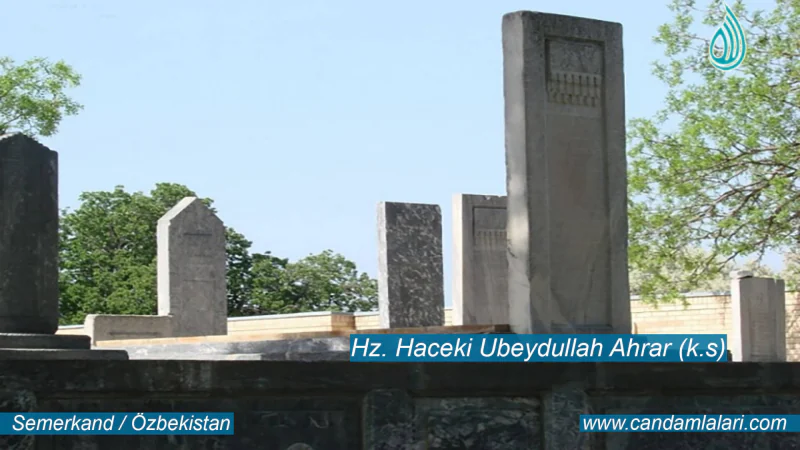
Name: Ubeydullah bin Mahmud b. Şihabuddin.
He was born in 806 AH in the village of Bağistan in Tashkent. He lived 89 years.
As long as his mother was in her postnatal bleeding, he would not take her milk. Only after that period had ended and she had performed the full ablution did he begin to nurse.
He is among the precious descendants of Hace Muhammed Baki Bağdadî. His pure mother is of the descendants of Ömer-i Bağıstanî. The lineage of Sheikh Ömer reaches, in sixteen generations, Abdullah bin Ömer bin Hattab (may God be pleased with him).
His father, Hazrat Hace Mahmud Şaşî, was a great figure who in his time showed the way of the tariqa and the haqiqa.
Even in his earliest years the word God never fell from his tongue, and his thought was always on God Almighty. He himself says:
"I used to go to school and come back. My heart was always with God Almighty. I did not forget Him for a moment, nor was I heedless of Him for a moment. And I supposed everyone to be like myself. One cold winter day, as I was crossing the countryside, my foot sank in the mud. While I was trying to free myself, my hem was caught as well. At that moment a heedlessness came over me. While busy with this, I was seized by the feeling that I had drifted away from remembering God Almighty. Across from me a young villager was plowing. 'Look, this young man is thinking of God in the midst of so much hardship, yet how can you forget Him over so small a task as freeing your foot from the mud?' I said, rebuking myself. And I began to weep bitterly. At that time I supposed everyone to be like myself and thought they were remembering God at every moment. Until I reached the age of maturity I had not understood that there are people heedless of God. I thought that God Almighty had created everyone to think of Him, to remember Him, and not to forget Him. Later I understood that not being heedless of God Almighty is a divine favor reserved for some servants only. It can be attained only through spiritual discipline and struggle against the nafs, and there are some who do not attain it even so."
He himself relates: In my childhood I saw in a dream that I was near the tomb of Sheikh Ebubekir-ı Şaçî. On the threshold of the tomb was Jesus (peace be upon him). I fell at his feet at once. Lifting my head with his hands, he said: "Do not grieve! I will train you!" Those to whom I told the dream interpreted it in terms of the science of medicine. That is, they said I would have a share in the science of medicine. I was not content with this interpretation. My interpretation was this: Jesus (peace be upon him) is a prophet who raises the dead. And the great ones among the saints who are manifestations of the attribute of giving life were called "of the Jesus-like temperament." Since Jesus (peace be upon him) took the training of this poor one upon himself, it means that the attribute of reviving dead hearts would be given to me. Indeed, a short time later God Almighty granted me such a state and power that this meaning came to appear in me in its perfection. Through us many dead hearts came out of the darkness of heedlessness into the light of witnessing (shuhud) and presence.
He himself relates: In the early days of my spiritual state I saw in a dream the Master of the universe. He was gathered with his Companions at the foot of a very high mountain. When he saw me he beckoned with his hands for me to come near and said: "Carry me up to the top of this mountain!" I took him on my shoulders and carried him up to the summit. He said: "I knew that you had such strength. But I had you do this so that others too might see and know."
When Hazrat Hace was 22 years old, his maternal uncle Hace İbrahim sent him from Tashkent to Samarkand to study. Because his inward nature kept him from outward study, he yearned for the suhba of the Khwajagan saints, and for two years went around the assemblies of the great ones of Transoxiana; at the age of 24 he went to Herat. After keeping suhba with the sheikhs of Herat for some five years, at the age of 29 he returned to his original homeland. After that, in order to earn a lawful livelihood, he engaged in agriculture. And he worked in partnership with a man. In a short time God gave his crops such abundance that they had difficulty in managing it and appointed agents in their places. Hazrat Hace had more than one thousand three hundred fields. In just one of his fields, the one bearing the name "Cuyibar," three thousand workers labored. Every year he paid eight hundred thousand batmans of grain as tithe. At that time the ruler was Sultan Ahmed Mirza.
He himself says: "The Exalted Truth has granted my property such abundance that at each threshing a thousand batmans of wheat enter my granary, and when it comes out of the granary it is one thousand four hundred or one thousand five hundred batmans.
He said: "I obtained this path not from the books of Sufism but from serving the people. Each person is led along some road; we were led along the road of service. I serve everyone from whom I hope for good.
Hazrat Hace, in private and in company, observed outward and inward courtesy to the utmost. The author of the Rashahat relates: While this poor one was attending the night and day service of Hazrat Hace, the first time for four months and the second time for eight months, I never once witnessed him yawn. Nor did I see him bring anything out of his mouth through coughing or similar causes. I did not see him blow his nose. In front of people or when alone, I never once saw him sit cross-legged.
Mawlana Ebu Said, who stayed thirty-five years in his service, also says that he never saw Hazrat Hace take out of his mouth the skins of grapes, pears, apples and the like. All those close to him have confirmed that nothing that would give those who saw it a feeling of disgust or aversion was ever seen in him. One of the great ones who were in his presence reports that one night until morning he sat on his two knees and did not move at all. His kindness and attention toward those who served him could not be told; he took the hardship on himself, and preferred the comfort of those near him to his own rest.
Hace Fadlullah, one of the scholars of Samarkand, says: We cannot understand the inward superiorities of Hazrat Hace Ubeydullah (k.s). This much we know, that he studied little of the outward sciences. Even so, he asked us such questions from the Baydawi tafsir that we were unable to answer.
One day a guest comes to him. This person is the scholar Mawlana Ali Tusi, but a scholar of the outward. He says to him: "To speak in your presence would be a fault of courtesy for us; you speak and we shall listen." And Mawlana Ali answers: "In a presence where words come unmediated from the source of spiritual flow, it is we who would be discourteous to speak."
He himself relates: "In my whole life I have not seen a greater person than Hazrat Seyyid Kasım Tebrizi. From each of the sheikhs of the time I went to, a relation (nisbet) would arise in me, but this relation passed quickly. Or I myself would let that relation go. But from Hazrat Seyyid I received such an effect that it is not possible to let it go. Each time I went into his presence I would see that the whole universe was circling around him, as around the center of a circle, and was dissolving into nothingness in him. Hazrat Seyyid had been in the assembly of Hazrat Hace Behaeddin Naqshband and had taken his relations from that path. It is understood that he was on the Khwajagan path.
He had a doorkeeper without whose permission no one could enter his presence. He had instructed his doorkeeper thus: "Whenever a young man from Turkestan comes here, do not stop him! Let him see me whenever he wishes!" With the honor of obtaining this unparalleled favor, I would go every day to the threshold of Hazrat Seyyid. Even so, I would come into his presence only once in a few days. The murids of the Seyyid were astonished at my state and could not understand why, although I had been given permission, I did not come into his presence every day. The assemblies of Hazrat Seyyid were exceedingly delightful. One did not want to leave that assembly. When the time came for the assemblies to disperse, he himself would give a sign and invite his murids to withdraw. He had never made me get up from his presence. At the very beginning he had asked me: "Babu! What is your name?" He used to address those close to him as "Babu!" I had said that my name was "Ubeydullah." He had said: "Realize the meaning of your name!"
He himself relates: One day Hazrat Seyyid said to me: "Babu! Do you know why wisdom and haqiqa appear so little in our age? Because in this age the purification of the inward has remained in very few people. Perfection lies in the purification of the inward, and the purification of the inward is possible by eating lawful food. In this age lawful food is very scarce. A person who has undergone purification of the inward is almost nonexistent. How can you expect divine secrets to be manifested in such people?" Then he said these things about himself: "When my hand was able, I used to sew caps and live by them. After I suffered paralysis and my hand no longer worked, I sold the library left by my father, made it into trading capital and began to live by that."
He said: After the afternoon prayer time there is a time in which one must hold fast to the best of deeds. The best of deeds at that hour is self-examination (muhasaba). Muhasaba is that, during all the hours of night and day, a person reviews what he has done, sorts out his share of worship and sin, gives thanks for his good deeds and asks forgiveness for his evil deeds. And the best of deeds is, growing weary of all other than God, to set out in search of a guide who will bind one to Him. It is to strive to attain the suhba of a great one.
He said: "One must be patient, and even praise God, in the face of the trials of God (Exalted is He). For God (Exalted is He) has trials each more bitter than the other."
All the work of this murshid was dealing with the sultans; that duty had been given to him.
He said thus: "If I had practiced sheikhhood, no sheikh in my age would have found a murid. But since our work is to protect Muslims from the evil of oppressors, contact with the sultans and directing them to the Sharia was given to us as a duty."
He said: "The moment the heart is delivered from being attached to anything other than God (Exalted is He) is the time of union with and vision of the Truth."
He said: "To guard wakefulness, one must proceed thus: one must be aware of the entry and exit of the breath." He said: "If they ask what wretchedness (shaqawat: rebelliousness, sinfulness) is: it is to be attached to one's own existence, to fall behind the Truth.
If they ask what Wasl (arrival) is, say: it is that when the light of the Truth's existence appears, a person forgets himself. If they ask what Fasl (separation) is, say: it is to separate the heart from everything other than God (Exalted is He) (masiwa). If they ask what Sukr (intoxication) is, say: such a state appears in the heart that you lack the power to conceal what, before this state, needed to be kept hidden."
He said: "In reality, muraqaba is waiting (intizar). In the tariqa, the end of the journey (sayr) consists of the attainment of this waiting."
He passed away in Samarkand in 895 AH.
The blessed one was tall and dark-complexioned, with a smiling face and a thick white beard.