Türkçe
 Español
 Français
 日本語
 हिन्दी
 العربية
 中文
The Night of the Hijri New Year
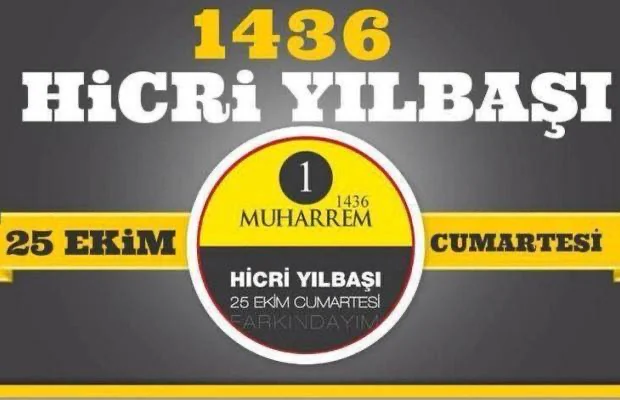
Our Prophet Muhammad (peace be upon him) was born in Mecca on Monday morning, the 12th of Rabi' al-Awwal, which fell on 20 April 571 CE. In 622 he migrated from Mecca to Medina. On Monday, 20 September, he arrived at Quba, a village of Medina. This date became the solar new year of the Muslims. The first day of the month of Muharram of that year became the Hijri [lunar] new year. The first night of the month of Muharram is the new year's night of the Muslims.
This night should be spent in worship and honored. Honoring it is done by not committing sins. Whoever fasts on the last day of the month of Dhu al-Hijjah and the first day of Muharram attains the reward of having fasted the whole of that year. In a noble hadith it was said: (The most virtuous fast after Ramadan is the fast observed in the month of Muharram).
Before Islam, when the Arabs wished to fight in the month of Muharram, they would give the name of Muharram that year to the following month, and attach the name of the following month to Muharram. Thus the sacred month would become the month after Muharram.
The noble verse 37 of Surah at-Tawba, with the meaning اِنَّمَا النَّس۪ٓيءُ زِيَادَةٌ فِي الْكُفْرِ يُضَلُّ بِهِ الَّذ۪ينَ كَفَرُوا يُحِلُّونَهُ عَامًا وَيُحَرِّمُونَهُ عَامًا لِيُوَاطِؤُ۫ا عِدَّةَ مَا حَرَّمَ اللّٰهُ فَيُحِلُّوا مَا حَرَّمَ اللّٰهُۜ زُيِّنَ لَهُمْ سُٓوءُ اَعْمَالِهِمْۜ وَاللّٰهُ لَا يَهْدِي الْقَوْمَ الْكَافِر۪ينَ۟Reallocating the sanctity of ˹these˺ months is an increase in disbelief, by which the disbelievers are led ˹far˺ astray. They adjust the sanctity one year and uphold it in another, only to maintain the number of months sanctified by Allah, violating the very months Allah has made sacred. Their evil deeds have been made appealing to them. And Allah does not guide the disbelieving people. (At-Tawbah 9:37, Diyanet), was revealed and forbade changing the places of the months.
The year of Arabic months that is declared in the Quran and used in religion is ten days shorter than a solar year. The Hijri lunar months come ten days earlier than the Hijri solar and Gregorian months. For this reason, the blessed days or nights of Muslims fall ten days earlier each year relative to solar years, because blessed days are determined not by the solar months but by the lunar months. Our religion commands it so.
In Islam there is no blessed day fixed within the months of the solar year. The Prophet's birthday (Mawlid) and the blessed nights are observed according to the Hijri year. In all acts of worship and religious activities the lunar months are the basis. The days of Hajj, fasting, sacrifice and festivals are determined by the lunar months. To perform the Hajj not in the month of Dhu al-Hijjah as God the Exalted has declared, but in a Gregorian month, for example in January; or to fast not in the month of Ramadan but in February, would be to change the religion. All the blessed nights are likewise determined according to the lunar months.
Because God the Exalted is very compassionate toward His servants, He has given value to these nights and has declared that He will accept the prayers and repentance made on these nights. To move these nights to other days would be to change the religion. God the Exalted has declared that He will accept the prayers and repentance made on these nights.
One of the four months that are held sacred
It is declared that Muharram, together with Dhu al-Qa'dah, Dhu al-Hijjah and Rajab, is one of the four months held sacred in the Quran. (At-Tawba 36) The meanings of a few noble hadiths are as follows:
(The master of the months is Muharram, the master of the days is Friday.) [Daylami]
(The most virtuous fast after Ramadan is the fast observed in the month of Muharram, the month of God the Exalted. The most virtuous prayer after the obligatory ones is the night prayer.) [Muslim]
(If you are going to observe a voluntary fast, observe it in the month of Muharram, for it is the month of God the Exalted. In that month there is a day on which God the Exalted accepted the repentance of one of the earlier peoples. He also forgives the sins of those who repent on that day.) [Tirmidhi]
In order to attain the reward of voluntary acts of worship, it is a condition to hold the creed of Ahl al-Sunnah, to avoid the forbidden and repent of sins, to try to perform the obligations flawlessly, and to intend to do the act as worship.