Türkçe
 Español
 Français
 日本語
 हिन्दी
 العربية
 中文
The People of the Suffa (Ashab al-Suffa)
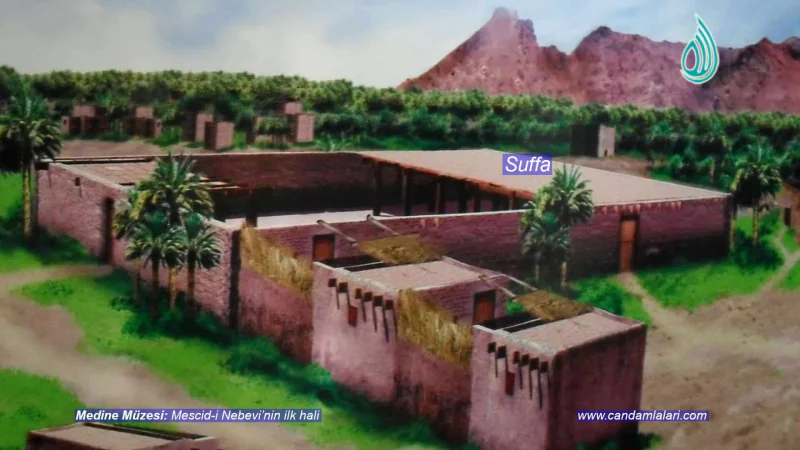
This was before the qibla had yet been turned toward the Kaaba.
On the northern wall of the Prophet's Mosque, a shade and a porch were built with palm branches. This was called the "suffa." The Muslims who stayed there were given the name "Ashab al-Suffa" (the People of the Suffa).
These Companions who stayed in the suffa of the Noble Mosque had in Medina neither dwellings, nor tribe, nor relatives, nor anything at all. Far from family, free of the occupations and worries of the world, they led a life of complete detachment. They studied the knowledge of the Quran and benefited by listening to the sermons and lessons of our Master the Most Noble Messenger. They were mostly fasting.
This blessed company, who spent their time in the presence of the Messenger of Majesty, continually received grace from our Master. They were self-sacrificing students, lovers of knowledge, who had dedicated themselves for God's sake to the madrasa of the Most Noble Messenger. Teachers appointed by our Prophet taught them the Quran. Those among them who became accomplished were sent to tribes that had become Muslim to teach the Quran and to explain the Sunna of the Messenger of God. For this reason they were called "qurra" (the reciters). The suffa, accordingly, came to be called "Dar al-Qurra" (the House of the Reciters).
These choice Companions, numbering some four or five hundred, who lived a humble yet blessed life, were an army of knowledge. While devoting all their effort to learning the Quran and the Sunna of the Messenger of God, they also took part in the military expeditions when necessary.
Those among them who married would leave the suffa. But others would be taken in their place.
These choice Companions were occupied neither with trade nor with any craft. Their livelihood was provided by our Master the Messenger of Majesty and by the wealthy among the Companions. Abu Hurayra, one of the foremost students of the suffa, expressed this very well in his answer to those who found it strange that he narrated so many hadiths: "Let it not seem strange that I narrate many hadiths! For while our brothers the Muhajirun were busy with their trade in the markets and bazaars, and our brothers the Ansar with their farming in the fields and gardens, Abu Hurayra was memorizing the blessed counsels of the Prophet (peace be upon him)."
Our Prophet's Close Concern for the People of the Suffa
Our Master the Messenger of Majesty took close interest in both the instruction and training and the livelihood of the People of the Suffa. He would always sit with them, converse with them and attend to them. From time to time he would say to them, "If you knew what has been prepared for you with God, you would wish your poverty and your need to increase even more!" [2] thereby declaring that their occupation was exceedingly important and blessed.
Our Master the Most Noble Messenger tried, in the first place, to meet the needs of this blessed community. When necessary, he attended to the needs of his own Blessed Household only in the second place!
Once, when Fatima (may God be pleased with her), complaining that she was weary of grinding flour with the hand mill, asked for a servant, our Master gave this beloved daughter the answer, "My daughter, what are you saying? I have not yet settled the livelihood of the People of the Suffa!" [3]
One day he stood over the People of the Suffa and examined their condition. Seeing their poverty and the hardship they were enduring, he gladdened their hearts by saying, "O People of the Suffa! Glad tidings to you: whoever meets me in this state and in this description of yours, content with his condition, is among my companions!" [4]
Whenever anything was brought to our Master the Messenger of Majesty, he would ask, "Is it charity or a gift?"
If those who brought it answered, "It is charity," he would send it to the People of the Suffa without touching it. If they answered, "It is a gift," he would accept it and set aside a share of it for the People of the Suffa as well. For our Prophet did not accept charity, only gifts.
One day a man brought a plate of dates. He asked the man, "Is it charity or a gift?"
When the man answered, "It is charity," our Master sent it straight to the People of the Suffa. At that moment his grandson Hasan was in front of our Prophet. When he took a date from the plate and put it in his mouth, the Messenger of Majesty at once intervened and had him take it out of his mouth. Then he said, "We, Muhammad and his Household [the Ahl al-Bayt], do not eat charity; charity is not lawful for us!" [5]
It is also reported that the blessed verse لِلْفُقَرَٓاءِ الَّذ۪ينَ اُحْصِرُوا ف۪ي سَب۪يلِ اللّٰهِ لَا يَسْتَط۪يعُونَ ضَرْبًا فِي الْاَرْضِۘ يَحْسَبُهُمُ الْجَاهِلُ اَغْنِيَٓاءَ مِنَ التَّعَفُّفِۚ تَعْرِفُهُمْ بِس۪يمٰيهُمْۚ لَا يَسْـَٔلُونَ النَّاسَ اِلْحَافًاۜ وَمَا تُنْفِقُوا مِنْ خَيْرٍ فَاِنَّ اللّٰهَ بِه۪ عَل۪يمٌ۟˹Charity is˺ for the needy who are too engaged in the cause of Allah to move about in the land ˹for work˺. Those unfamiliar with their situation will think they are not in need ˹of charity˺ because they do not beg. You can recognize them by their appearance. They do not beg people persistently. Whatever you give in charity is certainly well known to Allah. (Al-Baqarah 2:273, Diyanet) [6] was revealed concerning the People of the Suffa. [7]
Their Not Missing Our Prophet's Sermons and Addresses
These choice Companions, who had dedicated themselves wholly to the path of God, never missed any counsel or any address of our Master the Messenger of Majesty. They were always present there, memorizing the addresses and exhortations delivered and conveying them to the other Companions. In this respect the People of the Suffa rendered an exceptional service and effort in preserving and transmitting the rulings of Islam! This body of scholars had a great share in the swift spread of the light of the Quran to every part of the world in a short time. In this respect the People of the Suffa occupy an exceptional place in the history of Islam.
Abu Hurayra, a special student of the suffa, an institution of learning, recounts an incident concerning them as follows:
I was lying face down from hunger. Sometimes I would tie a stone to my belly. One day I sat on a road along which people came and went. Just then the Messenger of God passed by. He understood my condition and called, "O Abu Hurayra!" I said, "At your service, O Messenger of God!" He said, "Come!" We went together. He entered the house. I asked permission to enter as well. They allowed me. I entered. He found milk in a bowl. "Where did this milk come from?" he asked. "So-and-so brought it as a gift," they answered. Then he commanded, "O Abu Hurayra! Go to the People of the Suffa and call them to me."
The People of the Suffa were the guests of Islam. They had neither family nor property. Whenever a gift came to the Messenger of God, he would set aside a share for himself and also send them some. As for the charities sent to him to be given to his household, he would send all of them to the People of the Suffa and never set aside any share for himself!
The Messenger of God's inviting the People of the Suffa grieved me! I had hoped, "I will drink the milk in this bowl alone and get by on it for quite some time!" I said to myself, "I am the messenger. When the People of the Suffa come, I will be the one to distribute the milk to them." In that case I knew that nothing of the milk would be left for me. But there was no choice other than carrying out the command of the Messenger of God.
I went and called them. They came, asked permission and sat down.
The Prophet (peace be upon him) said, "Abu Hurayra, take the bowl and offer them milk."
I took the milk bowl and began to distribute it. Each one took the bowl, drank until he was satisfied, then handed it to his companion.
After the last of the People of the Suffa had drunk, I gave the bowl to the Messenger of God. He took it. Only a little milk remained in it. He raised his head, looked at me and smiled, and said, "Abu Hurayra!"
I said, "At your service, O Messenger of God!"
He said, "There remain only the two of us who have not drunk milk!"
I said, "Yes, O Messenger of God!"
He said, "Sit, and drink." I sat and drank.
He said, "Drink some more." I drank. He insisted again that I drink. "More, more!" he kept saying. Finally I said, "By God, who sent you with the true religion, I have no room left to drink!"
He said, "Then give the cup to me." I gave it. He praised and glorified God. Then, pronouncing the "basmala," he drank the rest himself. [8]
[1] Tajrid Translation, vol. 7, p. 47.
[2] M. Hamdi Yazır, Hak Dini Kur'an Dili, vol. 2, p. 941.
[3] Ibn Sa'd, Tabaqat, vol. 8, p. 25.
[4] M. Hamdi Yazır, ibid., vol. 2, p. 941.
[5] Muslim, Sahih, vol. 3, p. 117.
[6] Al-Baqara, 273.
[7] M. Hamdi Yazır, ibid., vol. 2, p. 940.
[8] Bukhari, Sahih, vol. 4, p. 89; Tirmidhi, Sunan, vol. 4, p. 648-649.
Author: Salih Suruç