Türkçe
 Español
 Français
 日本語
 हिन्दी
 العربية
 中文
10. Hazrat Abdülhalik Gücdevani (k.s)
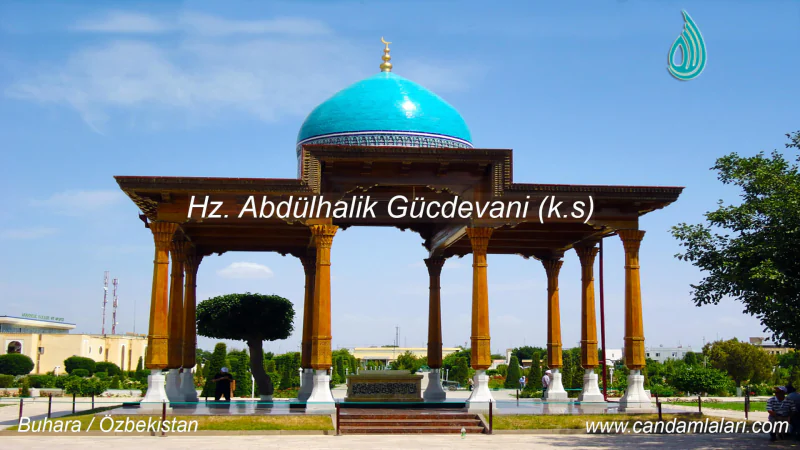
He was tall, with a rather large head, a fair complexion and a handsome face. His eyebrows were thick and his chest and shoulders broad. His teacher was Khidr (peace be upon him). His mother and father had migrated from Malatya to Bukhara. He is among the great ones of the Khwajagan.
His father, Hazrat Abdulcemil, was a righteous gnostic who had formed a brotherhood with Khidr (peace be upon him). Khidr (peace be upon him) said to him:
"God will give you a righteous son. Name him Abdulhalik."
While Abdulhalik was still in his mother's womb, his father Abdulcemil migrated from Malatya in Türkiye, together with his relatives, first to Transoxiana and then to Bukhara, and settled there.
When Abdulhalik was 5 years old, he was learning the Holy Quran from Ustad Sadrettin, one of the great scholars of Bukhara. One day, while he was reciting the verse اُدْعُوا رَبَّكُمْ تَضَرُّعًا وَخُفْيَةًۜ اِنَّهُ لَا يُحِبُّ الْمُعْتَد۪ينَۚCall upon your Lord humbly and secretly. Surely He does not like the transgressors. (Al-Araf 7:55, Diyanet) (Surah al-A'raf 55), Abdulhalik said:
What is the reality of secrecy, and how is silent dhikr (dhikr-i khafi) done? If a person performs dhikr and prayer aloud, there is the fear of ostentation (riya). Once ostentation enters, dhikr and prayer are not performed as they should be. If he performs dhikr and prayer in the heart, that is, secretly, then, as the noble hadith says, since Satan circulates in the blood, he mixes into the dhikr and prayer. His teacher, admiring this question and this understanding, said:
"My son, this is God-given knowledge (ilm-i ladunni). If God Almighty wills, He will bring you to one of the people of God. He will teach you silent and loud dhikr. Thus your problem will be solved."
While this and similar thoughts occupied his young mind, one day Khidr (peace be upon him) appeared before him. He taught him the ways and methods of loud and silent dhikr, gave him ijaza for silent dhikr, and instilled in him the "wuquf-i adadi."
For the Naqshbandi path, the silent dhikr with wuquf-i adadi begins from this instruction. Then Khidr (peace be upon him) accepted Abdulhalik Gucdüvani as an adopted son and taught him to perform dhikr by way of negation and affirmation (nafy and ithbat). This begins by holding the breath and, with the head plunged into a pool, saying from the heart 7 or 21 times La ilaha illallah. This silent dhikr is negation and affirmation. It also brings one to the muraqaba of the Truth. In loud dhikr, grace is received by continually contemplating with the heart the meaning of the dhikr performed sincerely with the tongue.
Because he was a companion of Khidr (peace be upon him), Hazrat Abdulhalik Gucdüvani laid down 11 principles as proof, rule and method in the exalted tariqa. Those who enter sayr wa suluk are obliged to apply them in order to benefit and receive grace along this path.
- Hüş-derdem: to be awake in every breath taken in and given out
- Nazar-berkadem: to walk looking at the tip of one's feet, avoiding idle glances and guarding oneself
- Sefer-der vatan: to journey toward one's origin, the Truth, with every step
- Halvet-der-encümen: to be alone with the Truth among the people
- Yad-kerd: to unite the dhikr of divine unity (tawhid) of the heart and the tongue with the breath, for God's sake alone
- Baz-geşt: to know that the sought and the intended is none other than the good pleasure of God
- Nigah-daşt: to guard the heart from stray thoughts
- Yad-daşt: to be with God in every breath
- Vukuf-i zemani: to know and make good use of the time one is in
- Vukuf-i adedi: to observe the count in dhikr
- Vukuf-i kalbi: for the heart to be occupied with the dhikr, thought and command of God
Hazrat Abdulhalik Gucdüvani was a master of sharia, tariqa, marifa and haqiqa. His words are proof and authority. He trained great figures. He received the trust of the silsila from Hazrat Yusuf Hemedani. He is called "the Mine of Grace (Kan-ı Feyz)."
Category: The Noble Chain